
“Tank Bottom” Date: July 4
 “Tank Bottom” Date: July 4
 The ceasefire in the Persian Gulf is now one month old. And while the guns aren’t firing (for the most part), the noise is nonetheless deafening.
A deal is on, a deal is off. The president posts on social media, the war secretary holds a press conference, the Iranians put out a new Lego video.
Noise, noise, noise.
Once more, here’s what matters most…
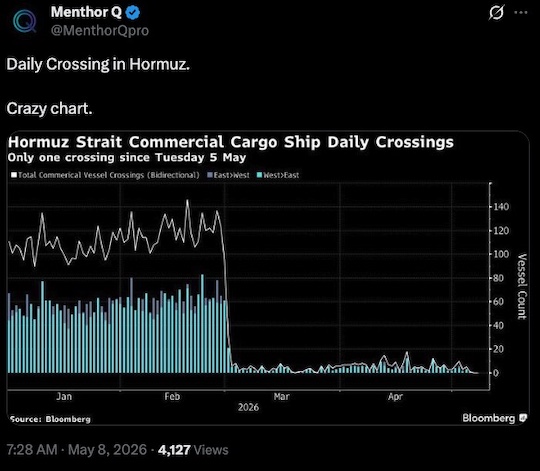
AAA says the national average price for a gallon of regular unleaded gasoline this morning is $4.55 — up from $4.17 a month ago and $3.15 a year ago.
Product is pricey — but it’s still available.
That might not be the case in some spots by the Fourth of July — which, interestingly, is also a critical date for the Iranian side.
“When do storage tanks run empty?” a Bloomberg TV anchor asked Carlyle Group’s Jeff Currie yesterday.
When it comes to commodities, Currie is a vital voice outside of Paradigm that we follow closely.
His answer: “It’s going to be sometime in the month of May that you’re going to end up with Europe hitting tank bottoms.
“And in the U.S. it’s somewhere in that July Fourth time period — if not sooner.
“By the way, the inventories number coming out of the U.S. — the ones we got last night, the ones last week — I’ve never seen anything like that before.”
Overall crude inventories still look robust. But beneath the surface…
- Fully 5% of the U.S. Strategic Petroleum Reserve has been drained since late March (and it was already near historically low levels)
- Gasoline inventories are now 4% below the 5-year average for this time of year
- Distillates inventories (diesel, fuel oil) are 11% below the 5-year average for this time of year.
As we’ve mentioned in recent days, July 4 is also a date that looms large for Iran.
Last week, corporate media outlets reported that the U.S. blockade on Iranian ports is bottling up Iranian oil shipments to such an extent that there’s nowhere to store it and the country’s oil infrastructure will soon be damaged beyond repair.
Bloomberg even put a date on that point of no return — sometime between tomorrow and May 18.
We gave these reports the side-eye from the start. More objective observers examining the evidence and presenting their findings on social media figured Iran had two more months before reaching the bursting point.
Later that week, Ronald Reagan’s budget director David Stockman ran the numbers and came to the same conclusion: Iran can stick it out until nearly the Fourth of July.
Now it seems that America is facing the same drop-dead date — for the opposite reason.
Eight weeks from tomorrow. Stay tuned…
➢ For the record: We have a new estimate of the Iran war’s cost to the U.S. taxpayer: $72 billion for the first 60 days, according to Stephen Semler of the Center for International Policy.
 Insider Trading: Is the Denial a Confession?
About the skeevy-looking insider trading in the oil markets this week…
As we mentioned in real-time on Wednesday, U.S. oil futures plunged when Axios reporter Barak Ravid reported that “the White House believes it's getting close to an agreement with Iran on a one-page memorandum of understanding to end the war.”
About an hour and 10 minutes before Ravid’s report was posted, someone or a group of someones placed a $920 million bet on falling oil prices. It generated $125 million in profits in just 3½ hours.
Later on Wednesday, an X account called “The Hormuz Letter” made a grave accusation…
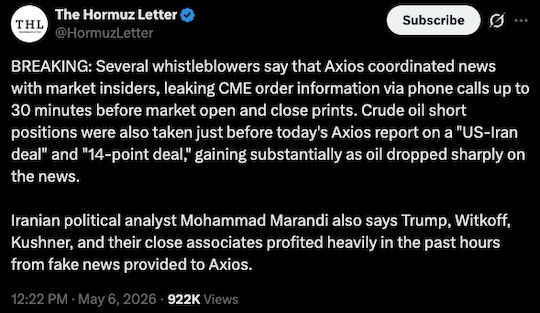
Background: The Hormuz Letter is an account launched last December. It claims to be Iranian although X says it’s based in Europe. It’s acquired nearly 50,000 followers, most of them since the war began.
So… who are these “whistleblowers,” exactly? White House insiders? Financial pros who know the ins and outs of market plumbing?
The Hormuz Letter did not say in any subsequent posts. Nor did it seem to be latching onto the reporting of any Western news outlet — nothing your editor could track down, anyway.
And so I blew the whole thing off as engagement bait on the part of The Hormuz Letter.
Until…

Why on Earth would Barak Ravid deny a thinly sourced claim from an Iranian X account that’s been around for less than six months?
Of course The Hormuz Letter hit back with the obvious rejoinder: “The fact that you’re denying it confirms it’s true.”
This much we know for certain: Barak Ravid is a veteran of Unit 8200, Israel’s version of the National Security Agency. He’s also been a reliable conduit for authorized leaks from the Trump administration for months now — including a handful of market-moving claims that peace is at hand.
“Time after time,” tweets the independent journalist Max Blumenthal, “his ‘reports’ are discredited and/or shot down by Iranian officials.
“And now, everyone who’s paying attention is onto him.”
Moving on…
 All-Time Lows, All-Time Highs
In addition to the war noise, the government’s monthly jobs report figures into the market mix today.
The headline number was robust: The wonks at the Bureau of Labor Statistics say employers added 115,000 jobs in April — nearly double what the typical Wall Street economist was expecting. The official unemployment rate held steady at 4.3%.
The longer-term picture is still… concerning.
As we’ve pointed out now and then in recent months, the fact the U.S. border has been effectively sealed for the last year changes the calculus when it comes to new jobs: In years gone by it took at least 150,000 new jobs a month to keep up with population growth. But without an influx of immigrants, the number could now be as low as 30,000.
Unfortunately, the average over the last 12 months is closer to 21,000. Not dire, but not great.
The report also says average hourly earnings grew 3.6% over the last year — which is more than the official inflation rate of 3.3%.
The numbers notwithstanding, wage earners don’t feel as if they’re keeping pace: The other big economic report today is consumer sentiment from the University of Michigan.
At 48.2 the number is still in the toilet — not quite record lows, but abysmal for a survey that’s been conducted monthly since 1977. Asked what the inflation rate will be over the next 12 months, the average respondent said 4.5%.
Often this survey is little more than a reflection of how the stock market is doing. Not now — not with consumer sentiment near all-time lows and the market near all-time highs.
Speaking of the market near all-time highs… the S&P 500 is on the way to its sixth-straight winning week.
At last check the index is up three-quarters of a percent to nearly 7,400 — more than offsetting yesterday’s modest losses. The Nasdaq is likewise in record territory, comfortably surpassing 26,000. The Dow, as usual, is the laggard — barely in the green and still 350 points away from 50,000.
“The chip stocks are soaring again today, leaving everything else in the dust,” says Greg Guenthner at The Trading Desk. “But this rally is stretched to the max, and it’s starting to concern me. I’d like to see some consolidation before it gets out of control.”
Amid this rally, the Paradigm editors have racked up several wins in the last two days…
- Readers of Enrique Abeyta’s Breaking Profits bagged 227% in 13 months with shares of Quanta Services (PWR). And in Enrique’s premium advisory The Maverick, long-dated call options on PWR generated 468% gains in less than a year
- Meanwhile, Altucher’s True Alpha readers collected 50% gains on the first half of a couple of trades, while letting the other half ride.
The aforementioned noise about the situation in the Persian Gulf has put U.S. oil futures at $94.68 — not much different from yesterday, but well below the $102 we saw at this time last week. (That’s the power of a Barak Ravid article.)
Precious metals are gyrating around their late-April levels — gold over $4,700 and silver comfortably above $80.
Bitcoin is only a few bucks from reclaiming $80,000 while Ethereum rests at $2,281.
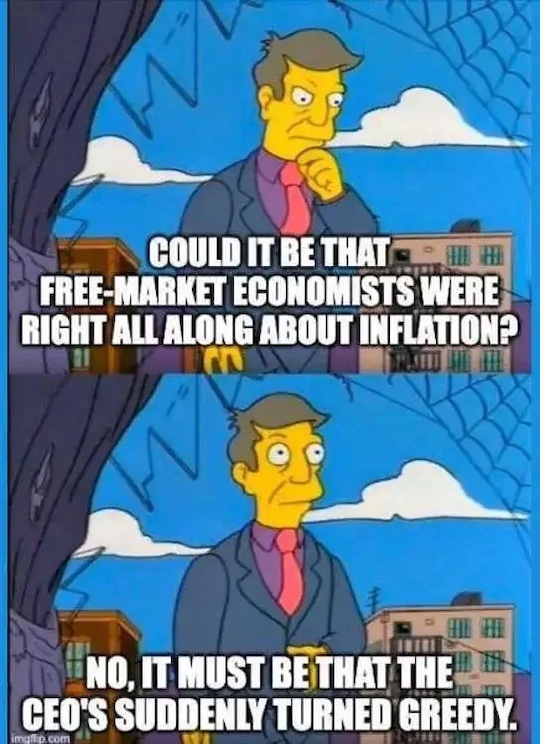
 Comic Relief
This one might have been around a few years ago, but it’s relevant once more…
 Mailbag: YOLO, California Fuel, Liquid Gold
In a reminder that we can’t take certain things for granted here… a reader submits a three-word email after Greg Guenthner’s guest essay yesterday: “What is YOLO?”
YOLO is short for “You only live once.” The term came to the fore after legions of young people entered the markets for the first time during COVID lockdowns in 2020… and really took off amid the frenzy over GameStop and other “meme stocks” in early 2021.
On the subject of the last tanker of Persian Gulf oil arriving in California this week, we heard from someone in an inland county that votes reliably “red”...
“I think this ‘no oil-no gasoline’ crisis will be used by the California greenies to say, You should have bought your electric cars and solar panels, now look who’s laughing.”
Buck Sexton’s reminder in Wednesday’s edition that “when cash is king, gold gets sold” prompted the following reader comment…
“That is a great point — and it jibes with a recent observation by Alasdair Macleod: ‘U.S.-centric pricing is a credible explanation for gold’s performance’ re: why its price seems to be doing the opposite of what it should.
“Lately, gold falls when the risk of war increases or the price of oil goes up, and rises when tensions ease.
“Fun times!”
Dave responds: Really, it’s a point we can’t emphasize often enough. In the short term, events occur that might lead you to believe gold should rise — but it doesn’t. (As I like to say, should is the most dangerous word in all of investing.)
If there’s a scramble for liquidity — margin calls, derivative bets gone bad, whatever — gold is one of the most liquid assets out there. It’s easy to sell, so it gets sold.
The most instructive example is the 2008 financial crisis. Gold surpassed $1,000 an ounce for the first time in March of that year. But when the crisis went critical that autumn, it tumbled to nearly $700.
Then it began to roar higher — reaching a peak of $1,900 less than three years later.
But leave aside the liquidity issues: After the insane ramp gold experienced in January — from roughly $4,300 at the start to $5,600 at the peak, some sort of consolidation period before the next leg higher was inevitable.
And that’s where we are now: Gold at $4,713 might not feel great. But if you’re a long-term holder, take heart — $4,713 was a record high less than four months ago!


