SpaceX Partners With Rival
 SpaceX Partners With Rival
 On the surface, the story is only mildly interesting.
Anthropic, the company behind the Claude AI platform, announced a deal last week with SpaceX.
"We're partnering with SpaceX to use all the capacity of their Colossus One data center," said Anthropic head of product Ami Vora.
That’s the big one located in Memphis — so big that Elon Musk made sure to install its own on-site power plant fed by natural gas, so it would be less of a burden on the local power grid.
The agreement will help Anthropic meet the exploding demand for its services.
But the story gets more interesting when you realize Anthropic and SpaceX are competitors.
Recall that Musk merged his AI venture called xAI into SpaceX earlier this year.
When Colossus One went into service in July 2024, its initial task was to train up xAI’s chatbot Grok. Now Anthropic gets access to all that computing power in Memphis.
So why would they be striking up a partnership like this?
That’s where the story gets most interesting.
Here’s what SpaceX said in its announcement of the partnership: "As part of this agreement, Anthropic also expressed interest in partnering to develop multiple gigawatts of orbital AI compute capacity.”
We first started telling you about data centers in space last November. If people are getting sick and tired of data centers being built in their neighborhoods and driving up electric bills — and they are — what can the AI industry do?
Well, the industry can put data centers in orbit. The advantages are unbeatable — 24/7 solar power that doesn’t compete with homeowners and businesses for scarce electricity back on Earth.
By January, Musk himself was talking up orbiting data centers at the World Economic Forum in Davos, Switzerland: “The lowest-cost place to put AI will be in space. And that will be true within two years, maybe three at the latest.”
If Anthropic’s needs are exploding to the point it needs access to Colossus One… space really is the next logical frontier. Anthropic needs Musk and SpaceX to make it happen — and Musk is happy to play ball.
 AI and Productivity: It’s Happening
It’s not just that demand for “compute” is exploding. “We’re starting to see real evidence that the compute is being used productively,” says Paradigm analyst Zach Scheidt — “rather than just being hoarded for the next training run.”
Zach wears several hats in our firm — including as senior analyst for Altucher’s True Alpha. He perked up last week when he saw the latest numbers on productivity from the U.S. Labor Department.
Bottom line: “Workers are getting more done in fewer hours.”
That means AI is no longer just a story about the prodigious amounts of capital that Microsoft, Meta, Google and Amazon are pouring into data centers.
Result: “We're moving back toward ‘buy ANYTHING AI-related at any price’ territory,” says Zach.
“That's the kind of environment where stocks tend to go higher than anyone expects, faster than anyone expects.”
Yes, Zach is exercising caution. But for now, he says you have to respect the fact that “earnings have been strong, capital spending continues to be robust and the AI cycle is showing no signs of slowing down regardless of what's happening overseas.”
Still, “the rally is narrowing and the rebound is being driven by the smallest number of stocks on record,” says Zach.
Per the Financial Times, over half of the S&P 500’s gains in the past month came from only five names — Google, Broadcom, Amazon, Nvidia and Apple.
Result: SPY, the big S&P 500 ETF, is surging. But RSP — the equal-weighted ETF where every stock makes up 0.2% of the total — is stalling out.
“That tells me there’s weakness under the hood,” Zach says. “Not enough to short the market on. But enough to keep us from getting too aggressive on the long side.”
As a new week begins, the major U.S. indexes are all in the green — though not by much.
At last check the S&P 500 is adding to Friday’s record close — up a quarter percent and over 7,400. The Nasdaq’s gain is more modest, but the index is nonetheless approaching 26,300. Once more, the Dow is the laggard, nearly flat at 49,640.
Congratulations are in order for Microcap Millionaire readers who on Friday bagged 363% gains with a tech industry play. (We’re holding back on the name because the recommendation was to sell only half the position and let the rest ride.)
The big economic number coming this week is the Labor Department’s official reading on inflation, due tomorrow.
 The War and the Virus
U.S. oil futures are up over two bucks to $97.62 now that Donald Trump has labeled Iran’s response to U.S. peace terms as “totally unacceptable.”
[Update: Trump subsequently said the ceasefire is on “massive life support.” Now we’re less than 50 cents away from $100.]
We won’t thrash over the details. You can read them anywhere. Suffice to say the Strait of Hormuz is still all but closed. The impacts today include, but are not limited to…
- The giant fertilizer producer Mosaic slowing production at two of its U.S. plants for lack of sulfur coming from the Gulf region (MOS also yanked its guidance for the rest of the year; shares are down 2.2% as we write)
- South Korea imposing price controls on gasoline (with the predictable result of shortages)
- India’s prime minister asking citizens to resume working from home — as during the COVID era — to conserve fuel.
As long as we brought up COVID, we’d better address hantavirus — just to get it on the record.
You’ve probably heard the headlines: The passengers aboard that cruise ship where three people died have, for the most part, returned to their home countries: The Americans are being evaluated in Nebraska and Georgia.
The official line is that the risk to the public is “very low.” Which sounds reassuring until you remember that Dr. Anthony Fauci described the danger from COVID as “just minuscule” on Feb. 17, 2020. Barely a month later, he was practically ordering state governments to shut down bars, restaurants, gyms, etc.
And then there was this event on the world’s most remote inhabited island…
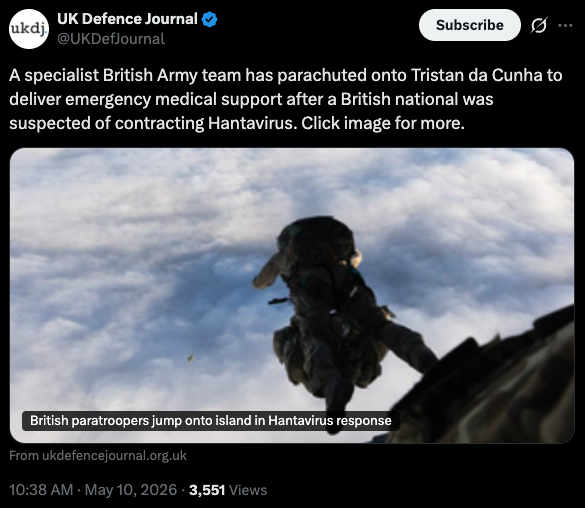
Tristan de Cunha is a British colony in the South Atlantic, home to 250 inhabitants. One of them was on the cruise ship in question, departing during a stop there.
The imagery of the paratroopers was stark and dramatic enough to remind at least one social media observer of the viral videos in early 2020 — people walking down the street and suddenly keeling over.
This is not a forecast that a new round of lockdowns is coming. But it would be foolhardy at this point to dismiss the notion out of hand.
With that, we’ll move on…
 Gold’s Third Phase
Gold sits at $4,723 as a new week begins — the highest in nearly three weeks — but still well below the nosebleed highs in January at $5,600.
Last week we got a gold update from both our macro maven Jim Rickards and Money & Power editor Buck Sexton.
Now we turn to trading pro Enrique Abetya — who says gold’s price action so far this year has developed in three distinct phases…
- Overbought conditions. “The market had reached a point where gold felt invincible… The setup became too consensus-driven, too extended and ultimately unsustainable in the short term. What followed was inevitable. A multimonth correction designed to burn off excess positioning, reset expectations and bring the market back into balance. That process is largely behind us now”
- Selling amid a crisis. Why did gold sell off when war broke out? “Large holders of gold, particularly in regions impacted by the crisis, needed liquidity. With oil revenues disrupted and financial pressures building, they were forced to raise cash. And gold, one of the most liquid assets, became a source of funds… Coming on top of an already overbought unwind, this dynamic accelerated the decline. It extended the correction beyond what most investors expected. But it also created a dislocation. Because once that forces selling subsides, the underlying drivers of gold reassert themselves. This is the phase we are entering now.”
- Repairing the damage. “As the liquidity-driven selling tied to the crisis fades, the natural buyers of gold begin to step back in. At the same time, the broader macro backdrop remains supportive. Inflation pressures are still present. Global debt levels remain elevated. Central banks continue to accumulate gold. Geopolitical uncertainty has not disappeared. If anything, those forces have become more entrenched.”
“That’s why corrections like this tend to be temporary,” Enrique concludes. “They reset positioning, shake out weak hands,and ultimately set the stage for the next leg higher.”
Enrique positioned readers of The Maverick in a gold miner just last week. And readers of his Breaking Profits are up 35% in less than two months on another gold name.
While gold is moving little today, silver is on a tear — up nearly five bucks and pushing $85 an ounce.
➢ Lest we forget, crypto is consolidating near recent highs — Bitcoin at $81,594 and Ethereum at $2,329.
 Comic Relief
OK this is almost certainly photoshopped, but…