
All the Choices Are Bad
 All the Choices Are Bad
 When it comes to the Iran war, “Trump has no good options,” Jim Rickards wrote his Strategic Intelligence subscribers yesterday morning.
Later in the day, as if to reinforce the point, Trump announced he was postponing a “scheduled attack of Iran” that was supposed to start today.
He said he did so in response to a request from the leaders of Saudi Arabia, Qatar and the United Arab Emirates. For whatever it’s worth, The Wall Street Journal says “several Gulf officials from some of the countries Trump mentioned said they were not aware of the imminent plan to attack Iran he described.”
Even before Trump’s announcement, one financial-minded wag on X said there was no way an attack would take place today. Or tomorrow.

“At this point, it’s apparent that Iran has gained the upper hand in its conflict with the U.S. and Israel in the Persian Gulf and the wider Middle East,” Jim Rickards elaborates.
“Trump has no clear plan for victory and no easy way out without risking the appearance of defeat.”
It was Jim who warned us in early March that the U.S. military lacks the defensive and offensive missiles to wage a sustained campaign against Iran; the corporate media caught up with his assessment only a few days ago.
Call him a panican if you insist. But Jim’s pro-Trump credentials are second to none. He still has contacts in the intelligence community from his days working with the CIA to track terrorist financing. If the trajectory of events is going poorly now, he’s not afraid to level with his readers.
“Trump has not achieved regime change,” Jim continues. “He has not secured the removal of Iran’s highly enriched uranium stockpiles. If anything, the conflict has unified the Iranian people rather than divided them.
“Meanwhile, the Strait of Hormuz remains effectively disrupted by the ongoing military standoff involving Iran and U.S. naval forces. Oil flows have been severely affected since late February.
“The impact is not limited to the United States or the Persian Gulf. Japan, South Korea, China and parts of Europe depend heavily on energy shipments moving through the strait…
“The only way to accomplish the goals of seizing uranium, forcing regime change and fully reopening the Strait of Hormuz would be a large-scale invasion backed by overwhelming air power.
“If Trump chooses that route, he risks an escalation path similar to the one the U.S. experienced in Vietnam from 1965–1975.”
And that’s if such an undertaking is even possible. If you mustered every active combat division in the Army and Marine Corps, you’d have about 175,000 troops. That’s roughly the same number deployed at the peak of the Iraq War in 2007 — and Iraq is a quarter the size of Iran.
Meanwhile, why does the economic impact remain relatively muted (apart from, of course, higher fuel prices)?
The most dire forecasts of impacts overseas haven’t come to pass. As Jim Rickards points out, “The lights are still on in South Korea. Manufacturing plants are still humming in Japan. And U.S. stock markets are at or near all-time highs.”
But Jim says rest assured the crisis is coming.
“There are several reasons the crisis has not yet hit the global economy apart from the obvious impact of higher energy prices. First, a large volume of oil and liquid natural gas had already been shipped before the conflict escalated and was already at sea outside the Persian Gulf. Those shipments took four–eight weeks to reach their destinations, creating what amounted to a floating pipeline of energy supplies.
“That cushion is now disappearing. The last vessels from the earlier shipping cycle are reaching ports, and replacement cargoes are limited.
“After that, countries can draw down petroleum and natural gas held in storage, including strategic petroleum reserves. But those reserves are finite and difficult to refill under current conditions.”
Meanwhile, “fertilizer shortages could disrupt the spring planting season in the Northern Hemisphere. Helium shortages may begin constraining semiconductor production. And oil and natural gas shortages could hit Japan, South Korea, New Zealand and China particularly hard in the coming weeks.
“The crisis is not over. In fact, it may barely be beginning.”
In the meantime, however, U.S. oil futures are up nearly two bucks in the last 24 hours — $108.67 as we check our screens, the highest all month.
[Special message from Jim Rickards: “On Thursday, June 4, at 2:00 p.m. ET, my team and I will broadcast a free LIVE summit from Philadelphia — the birthplace of the American experiment.
“We’ll break down what’s really driving markets in 2026, including the Iran war and energy shock, the growing stress in private credit, inflation, the affordability crisis, critical minerals, gold, AI-driven power shortages and the future of the Trump agenda.
“Joining me will be Dan Amoss, Byron King, Zach Scheidt, Matt Badiali, Adam Sharp and other trusted colleagues as we share our latest research, investment ideas and market outlook.
“We’ll also reveal select Strategic Intelligence stock picks LIVE during the broadcast.
“This won’t be a dry economics lecture. Expect fast-moving conversation, lively debate, behind-the-scenes stories and practical insights you can use immediately.
“There’s absolutely no cost to attend and no credit card required.”
More details coming from Jim in the days ahead, but for now save the date: Thursday June 4.]
 SpaceX Needs More Revenue
“Interesting timing here. Just as SpaceX gears up for the largest IPO in history, Starlink is quietly raising prices across several plans,” says colleague Davis Wilson.
As mentioned in yesterday’s 5 Bullets, SpaceX’s IPO date is now set: Friday June 12, launching under the ticker SPCX.
And events are moving fast and furious. Regardless of the data plan, Starlink customers are seeing price increases of $5–10 a month.
“Once a company prepares to go public,” says Davis, “Wall Street starts focusing intensely on revenue and earnings. Starlink is increasingly being positioned as the recurring cash flow engine helping justify SpaceX’s reported $1.75 trillion valuation.”
Maybe the analogy here is Apple. The hardware like the iPhone gets all the headlines — but AAPL is a subscription-revenue machine between the App Store, iCloud and Apple Music. Starlink performs the same function for SpaceX even as Falcon and Starship launches grab all the attention.
Thing is, “competition is coming,” Davis says. “Amazon is rapidly building out Leo, which aims to compete directly with Starlink in satellite internet.
“Right now, Starlink clearly has the lead. But the satellite internet race is just beginning, and pricing power could become much more important once serious competition enters the market.”
As for the bigger picture, Davis cautions that “massive IPOs often stumble out of the gate, even when the underlying company becomes wildly successful.”
No one remembers now… but Facebook took a 40% spill after going public in 2012.
As was the case Friday and yesterday… high oil prices are fueling inflation expectations, which are driving Treasury yields higher.
At last check the 10-year T-note is up to 4.67% — the highest since early 2025. And the 30-year T-bond is up to 5.18% — another level last seen in 2007.
Unlike yesterday, the bond market jitters are spilling into the stock market — the S&P 500 down two-thirds of a percent at 7,355 and the Nasdaq down 1%, breaking decisively below 26,000. The Dow is holding up somewhat better.
Also unlike yesterday, precious metals are selling off again — gold breaking below $4,500 for the first time since late March and silver approaching $74.
Crypto is holding its own compared with 24 hours ago — Bitcoin at $76,570 and Ethereum just over $2,100.
 Data Centers and Electric Costs, Continued
Data centers drove up wholesale power prices 75.5% during the first quarter of this year for the country’s biggest grid operator.
PJM Interconnection serves 67 million customers in 13 states including Virginia, home to “Data Center Alley” in Loudoun County.
The 75.5% figure comes from a report issued by Monitoring Analytics, the independent market monitor for PJM.
“Data center load growth is the primary reason for recent and expected capacity market conditions, including total forecast load growth, the tight supply and demand balance and high prices,” says the report. “But for data center growth, both actual and forecast, the capacity market would not have seen the same tight supply demand conditions.”
Looking ahead, “the price impacts on customers have been very large and are not reversible,” the report goes on. “The price impacts will be even larger in the near term unless the issues associated with data center load are addressed in a timely manner.”
The report says the only practical solution is for data centers to supply their own power, not connected to the grid.
“This broad bring-your-own new generation solution to the issues created by the addition of unprecedented amounts of large data center load does not require a continued massive wealth transfer through ongoing shortage pricing,”
Clearly the issue isn’t going away. Paradigm’s Baltimore-area headquarters is in PJM territory. One of our team members reports seeing a “No to Data Centers” yard sign in the distant suburbs of Harford County — even though data centers aren’t currently allowed under county code.
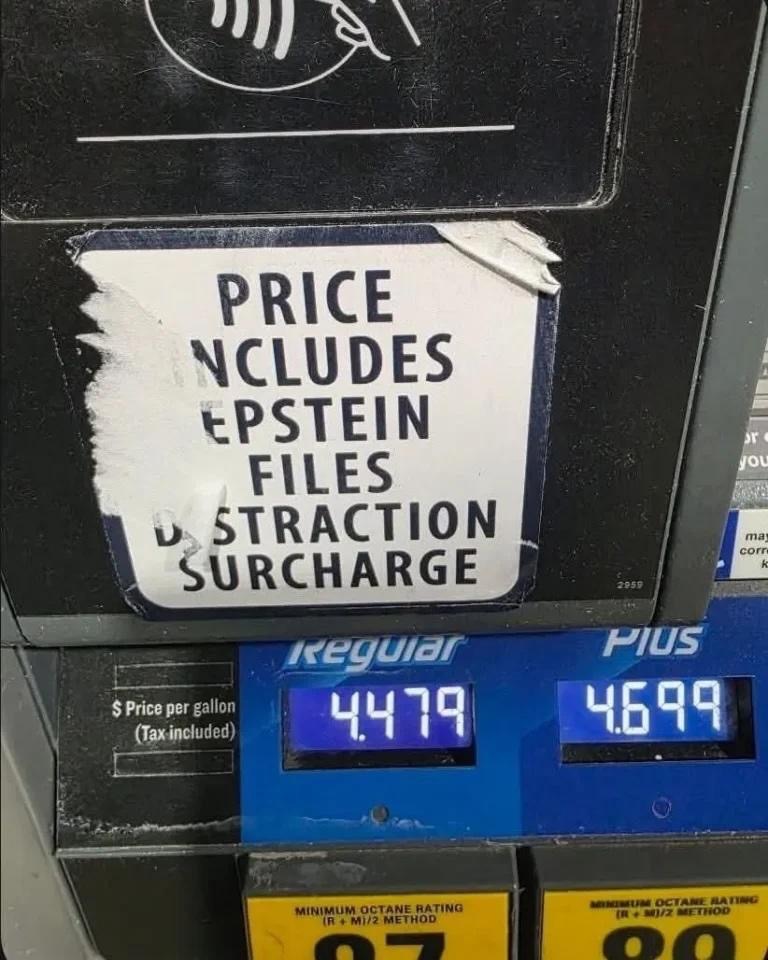
 Comic Relief
Before anyone sees this and gets their boxers in a wad… this is another one of those memes I share both because it’s pithy and because it reflects the vibe in at least some conservative pockets of social media…
 Mailbag: Generational Warfare
Meanwhile, I’m still getting an earful about the last meme that got people’s hackles up — the one shared in last Thursday’s edition.
“I get you’re trying to show the zeitgeist but at the same time you also show no respect to the massive numbers of readers who pay you who are in fact boomers and Gen-Xers.
“Please be more respectful — and besides that, the millennials and Gen-Zers had it so freaking easy in a world that gave them so much protection and new exciting things, all the new tech, never had to worry about nothing to do, they had it all in the palm of their hands, probably the most spoiled generations IMO…”
You get the idea. I won’t share the whole thing. It was very long and it expressed the sort of generational grievances you find everywhere on social media these days. (Although I got a chuckle when he said he was born in 1977; this editor was born, ummm, rather earlier than that.)
This generational-resentment thing is getting out of hand.
You see it when Kevin O’Leary — the boomer who wants to build a massive data center in Utah — hits out at Gen-Zers who he says make $70,000 a year and spend $28 on lunch.
His rant earned an outstanding riposte from Melissa Witte, aka Villgecrazylady, aided by the Grok AI engine…
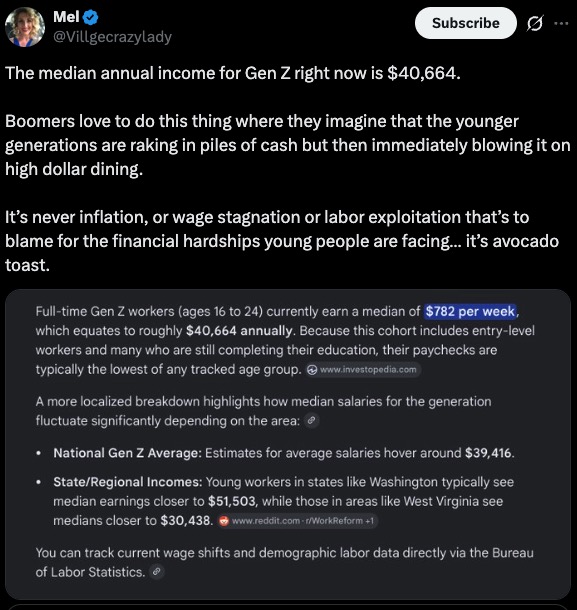
But don’t take it from someone who I’m guessing is an early-wave millennial.
Take it from this early-wave Xer: If you’re a boomer, it’s not about how hard you worked and what you sacrificed. It’s about how you were able to accumulate assets before the power elite hollowed out the middle class in this country and robbed subsequent generations of any hope they could live a better life than you.
(Why do you think they’re not interested in having kids?)
Also, do not lose sight of how this year’s graduating class got profoundly messed up by COVID lockdowns, restrictions and mandates when they were high school sophomores. (Or juniors or seniors if they ended up on the five- or six-year plan because of how universities deliberately stack prerequisites to extract more money from students.)
I’ll leave it there for now. Meanwhile, a boomer reader’s comment last week about the FICA taxes he paid over the years prompted the following reaction…
“I read comments about Social Security with a bit of frustration. Yes, I am collecting from Social Security.
“Politicians that were elected during my working years are largely responsible for destroying the system by giving out benefits that cannot be paid in the long run.
“Those currently paying into the system should also realize that the system was set up assuming people would have children who would contribute in the future. Yes, SS is a Ponzi scheme, but not having children is a bleak future in many ways.
“It would hurt me financially, yet it would truly be fair to cut benefits now to recipients because they did not protest 20–50 years ago.
“There is no doubt in my mind that benefits will be compromised in the future. We will see reductions across the board, means testing, full taxation of benefits or destructive inflation so that the full benefit will be of much less value (and cost to the government).
“Who will tell the uncomfortable truth to the population? Are there enough mature and thinking people in the country to understand the truth?”
Dave responds: Your outlook for Social Security’s fate is spot-on.
A pity, because the system wouldn’t be that hard to fix. As I’ve mentioned now and then since at least 2019, nothing about Social Security is so broken that it can’t be fixed with some combination of higher taxes and higher retirement age.
(Yes, it would still be a Ponzi scheme. That’s a separate question.)
Maybe in time the partisan divide can be overcome as it was in the early 1980s and the system can be put back on a sounder footing.
Medicare, however, is beyond hope.


