
The Day America Shut Down
 May Day 2026
 Are the stores more quiet than usual where you are today? Are high-school and college students skipping class? If you’re still in the workforce, are colleagues calling out?
If so — and that might be a big if — it’s because of this:

It’s International Workers’ Day — otherwise known as May Day.
“This May Day, we’re disengaging from the system that isn’t working for us–a system that’s propping up Trump’s regime,” says a statement from Indivisible — a progressive group organized in 2016 after Donald Trump’s first election victory.
“That’s why we are also calling for May Day to be a day of no work, no school and no shopping.*
Just spitballing here — but despite the president’s abysmally low approval rating, not a lot of people are going along with this.
No protest movement catches on unless it has a coherent set of demands — which are sorely lacking on Indivisible’s May Day page.
But for the sake of argument, let’s assume it does catch on. Then what?
Depending on who you want to believe, today’s event is a trial run leading up to a general strike on May Day 2028 — about six months ahead of that year’s presidential election.
No one has ever successfully organized a nationwide general strike in this country. (Deep in our voluminous archives we find this attempt from 2013, which failed miserably.)
Wikipedia tells us the most dramatic instance of a nationwide general strike is France in May of 1968. Eleven million workers walked out for two weeks — an event that nearly took down the government of President Charles de Gaulle.
No, general strikes in the United States have been strictly local events. The only one to make Wikipedia’s short list of “notable general strikes” worldwide was in Minnesota on Jan. 23 of this year amid the ICE protests.
My wife and I happened to be in Rochester, Minnesota that day. A handful of woke-leaning businesses shut down and about a dozen people gathered on the street corner near our hotel for 20 minutes.
Revolution wasn’t exactly in the air.
It’s true that ICE dialed back its operations a few days later. But it’s safe to say that decision had less to do with a general strike in Minnesota and more to do with normie Americans outside Minnesota appalled by the events they saw streaming on their phone screens.
Yes, the people sitting out school and work and shopping today are expected to turn out and protest.
By one estimate, 3,000 events are registered in all 50 states and Washington, D.C.
Who knows, it might be a different crowd than the exceptionally tame “No Kings” protests of the last year or so — which tend to take place on weekends and seem dominated by a 60-and-older cohort.
An email from the AlertsUSA service tells me that “while coalition messaging stresses nonviolence and de-escalation, historical May Day patterns and recent anti-ICE actions demonstrate that black-bloc and anarchist-affiliated actors frequently embed within larger crowds to engage in property damage, graffiti and confrontations with police.”
We’ll see what happens as the day unfolds. It’s at this moment your editor recalls a startling but credible claim I encountered only recently: At the 1968 Democratic National Convention in Chicago, “an estimated one in six protesters was an undercover agent for the police, the Army or Navy or the FBI.”
If their objective was to thwart the troublemakers and lower the temperature… it didn’t work.
 So You Think You Can Trade?
April is over and the results are in from Paradigm’s first-ever 30 Day Top Trader challenge.
Toward the end of March, we invited readers to identify the one stock or ETF they thought would have the biggest profit potential between April 1–30.
Our team is still tabulating reader submissions — so we won’t announce the winner of our $50,000 grand prize until next week.
But… we can tell you the results from within the Paradigm team; all of our editors and several of our employees made their own picks. (Only readers were eligible for the prize, to be clear.)
Coming out on top is Trading Desk editor Greg Guenthner — bagging a 59.3% gain on LUNL, a leveraged ETF that aims for twice the performance of the aerospace firm Intuitive Machines, Inc. (LUNR).
In second place is our AI and crypto authority James Altucher — racking up 48.2% gains on the chipmaker Micron Technologies (MU) amid a furious April rally in semiconductor stocks.
And in third place is our veteran of the Chicago trading pits Alan Knuckman — up 33.7% on one of those lucrative “critical minerals” producers, United States Antimony Corp. (UAMY).
Again, we’re still sifting through the thousands of reader submissions to determine first, second and third prize. (It’s harder than you might think!)
Updates coming your way next week…
With a new month underway, the stock market is on track for another all-time high.
At last check the S&P 500 is in record territory at 7,252. Ditto for the Nasdaq, over 25,000 for the first time. The Dow is the laggard, still unable to reclaim its over-50,000 levels of February.
Six of the “Magnificent 7” companies have now delivered their quarterly numbers: Apple reported strong iPhone sales and terrific subscription revenue. With that AAPL is up 5.1% on the day.
Treasury yields have pulled back slightly from their danger-zone levels of earlier this week — but the 10-year note is still uncomfortably close to 4.4% and the 30-year bond just under 5%.
Precious metals? Gold is barely in the green at $4,637. Silver’s up two bucks to $75.70. Bitcoin looks as if it wants to make another run toward $80,000 this weekend, but Ethereum is barely over $2,300.
The big economic report of the day is the April ISM Manufacturing Index. The headline number is a healthy 52.7 — anything over 50 suggests a growing factory sector. But under the hood, things are moving in the wrong direction — employment down, prices up.
 Friday Oil Gauge
Another Friday, another day of speculation that U.S.-Israeli attacks on Iran will resume this weekend while the market is closed.
On the one hand, Iranian state media reports that Tehran has sent Washington a fresh proposal for talks via Pakistani mediators.
That’s driven down U.S. oil futures nearly 4.5% as we write, to $100.52.
On the other hand, Iranian President Masoud Pezeshkian is warning that U.S. and Israeli forces have previously attacked Iran while talks were underway — including at the outset of the current war on Feb. 28.
And Israeli media report that Tel Aviv is preparing to return to war on the assumption that talks will collapse as early as next week.
Reminder: Major U.S. military action in this war — and on other occasions during 2024–2025 — tends to come on the weekend when markets are closed, a conscious attempt to tamp down volatility.
[Update: Trump says he’s “not satisfied” with Iran’s proposal. U.S. oil futures are back over $102.]
Meanwhile, the narrative that Iran is rapidly running out of storage capacity for its oil continues to fall apart.
We gave this narrative the side-eye in Tuesday’s edition. Both The Wall Street Journal and Bloomberg tried to make a case that the U.S. blockade on Iranian ports is bottling up Iranian oil shipments to such an extent that the country’s oil infrastructure will soon be damaged beyond repair.
Bloomberg even put a date on when Iran would reach a point of no return — sometime between May 9–18.
On Wednesday, the president himself chimed in: “Something happens where it just explodes,” he told Fox News. “They say they have only three days left before that happens. When it explodes, you can never rebuild it the way it was.”
As it happens, “experts” were telling corporate media as long ago as April 13 that Iran would reach its point of no return “within two weeks.”
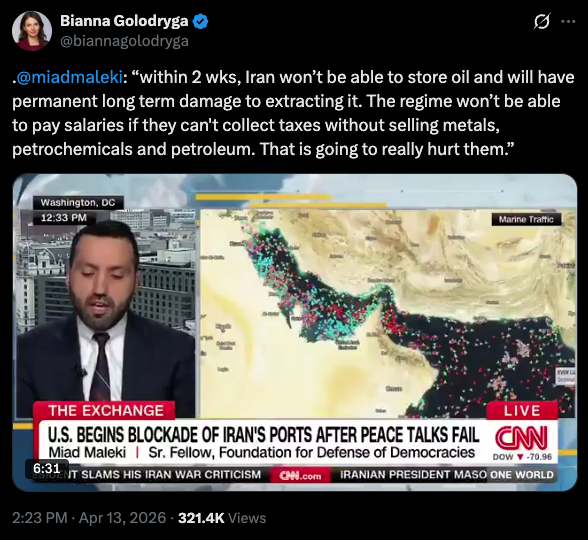
We’ll spare you the trouble of checking a calendar: Those two weeks expired on Monday.
But don’t take it from us. Take it from Bloomberg itself — which published an eye-opening chart this week undercutting its own reporting.
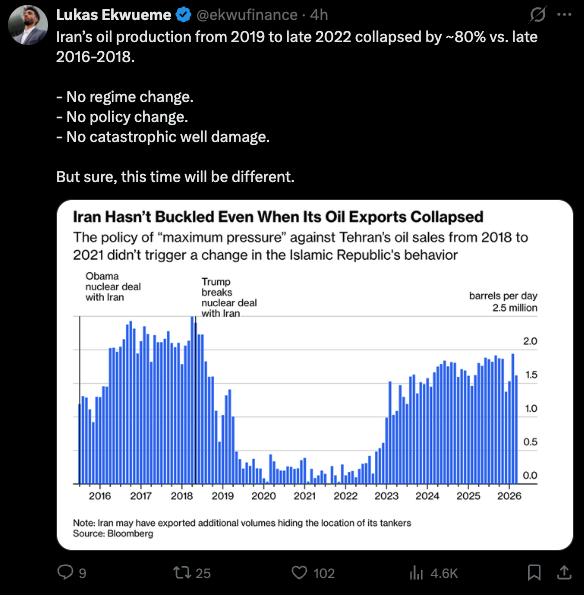
Iranian oil exports tanked from 2019–2022 — first from Trump’s “maximum pressure” sanctions and then from the collapse of oil demand brought on by COVID.
Somehow, the industry did not “explode.”
“Iran is not close to running out of either cash inflows or storage tank capacity,” affirms our former colleague David Stockman.
Mr. Stockman was Ronald Reagan’s boy-wonder budget director back in the day. He’s a numbers guy. With the help of the Grok AI engine, he’s determined that Iran needs to store about 700,000 barrels a day of shut-in production… while it has empty storage to accommodate 41 million barrels.
His conclusion: Iran “may have upward of 59 days of absorption from current domestic production.” (You can see all his math here. As I say, he’s a numbers guy.)
Stockman backs up what we said here Tuesday: Iran can stick it out until nearly the Fourth of July. Can American consumers stick it out that long?
 Ugh — Kimmel Again
Here we go again with the White House and Disney (DIS).
Once more, ABC late-night host Jimmy Kimmel made an unfunny, asinine remark. (We’ll spare you the details. You’re welcome.)
And once more, the president took offense and wants to use the powers of the federal government to punish ABC and its parent firm.
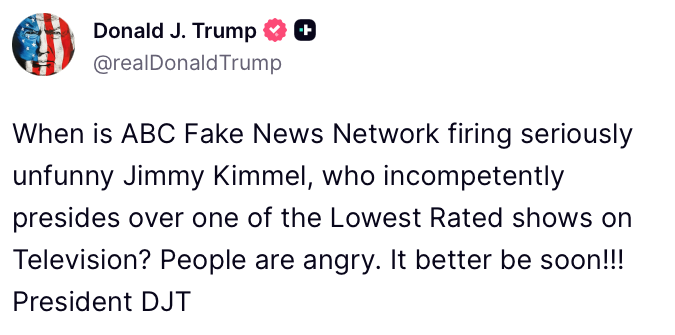
Not sure what the logic is here: If the show is low-rated, presumably the network will cancel it soon, and the president gets what he wants, right? That’s how the free market works.
But the free market isn’t good enough for Trump’s FCC chair Brendan Carr: On Tuesday he launched an early license-renewal proceeding for ABC’s eight owned-and-operated local stations.
“The FCC may claim these actions are based on DEI policies and have nothing to do with Jimmy Kimmel, but its timing makes it clear these justifications are a fig leaf,” says a tweet from the nonpartisan Foundation for Individual Rights and Expression.
“This campaign against a disfavored broadcaster violates the First Amendment, pure and simple.”
This turn of events is “at least as bad as what the Twitter Files showed,” says the civil libertarian Glenn Greenwald — “the Biden administration pressuring and threatening social media platforms to ban dissent.”
Word. I’m not taking partisan shots here. I slammed the Biden regime during our annual censorship issues in 2021, 2022, 2023 and 2024.
And as I mentioned during the previous Kimmel dustup, Ronald Reagan’s FCC chair — the guy who made it possible for Rush Limbaugh to reach a national audience — thinks the FCC’s conduct under the Trump 47 administration is “a disgrace.”
In any event, Disney’s share price is little moved by this week’s events: Whatever losses it experienced Tuesday and Wednesday were reversed yesterday.
 Audiophile Mailbag
For our mailbag section, a merciful distraction as the week winds down: Our mention of rising vinyl record sales during Tuesday’s edition has inspired still more reader feedback about high-end audio gear.
One email observed that “the audiophile community is also ‘K’ shaped.” He sent along several screenshots of insanely expensive equipment, such as…

… which would set you back $550,000.
My own budget-audiophile NAD CD player won praise from a longtimer: “Wow! I’ve owned NAD hi-fi electronics since the ’80s. Great, great bang for your audiophile bucks. (I knew there was a reason why I liked ya. 🙂 )”
Dave responds: Yeah, replacing it would set me back $500. That seems not unreasonable.
For the uninitiated, there’s an iron law of audio equipment: The bigger the step up in price point, the smaller the improvement in performance. A $500 CD player delivers noticeably better performance than a $325 model. But if you spring for a $600 transport and $400 digital-analog converter, that yields only somewhat better results than the $500 all-in-one unit.
And so on, and so on — you can drop $6,500 on a McIntosh transport alone.
“Wednesday’s mailbag mentioned excellent stereo equipment,” adds another reader.
“Let's pile on: Dynaco 70 amp, AR-3 speakers, AR platter, Empire cartridge with Shure stylus. Just listened to Holst’s The Planets on Deutsche Grammophon vinyl from the ’60s. Boston Symphony, William Steinberg. Memories.
“My days of replacing vacuum power and driver tubes are gone. The NAD 3020A does just fine. However, there is a sound difference with vacuum tube systems-cleaner. But at my age, the ears are not as good as they were in my 20s.”
Dave: Oh lord, don’t open the vacuum-tubes-versus-solid-state can of worms. The emails will go on for weeks!
Meanwhile, how’s this for trivia? My junior high school band director was Gustav Holst’s nephew. (And one of my bandmates went on to be an accomplished composer of Hollywood soundtracks.)
“Absolutely loved your audiophile mailbag,” says our final correspondent.
“I too have thousands of records and enjoy every one of them. Thanks for including a piece like that.” And he heartily approves of one of my favorite albums — “Tarkus, yes indeed.”
Tarkus is such a seminal work for me that I sprung for one of those CD remasters issued in the late 1980s by Mobile Fidelity Sound Lab. (When they were still somewhat affordable.)
Anyway, thanks to everyone for the diversion — much needed as another heavy week of fast-and-furious market-moving events winds down.


