
Summer of Shortages
 Summer of Shortages
 The war drums are beating more quietly than they were 24 hours ago.
Forget the competing claims and counterclaims from Washington and Tehran about who shot at whom and when.
What matters for the moment is that as Washington sees it, Tehran has not broken the ceasefire: Everything so far is “below the threshold of restarting major combat operations at this point,” says Gen. Dan Caine, chair of the Joint Chiefs of Staff.
None of which changes the fact that the Strait of Hormuz remains all but closed.
We ran down the numbers two months ago. They’re worth revisiting today. Because it’s not just that a quarter of the world’s crude oil transits the strait during normal times. So does…
- About 15% of the world’s refined diesel and jet fuel (which is why airline stocks are having such a rough time)
- Roughly 20% of the world’s liquefied natural gas (very bad for Europe, whose leaders already swore off Russian gas)
- About 35–40% of fertilizers (Reminder: About 70% of U.S. farmers tell the American Farm Bureau Federation say they can’t afford all the fertilizer they’ll need this year)
- Over 40% of sulfur (used in everything from fertilizers to oil refining to mining to water treatment)
- And 10% or more of aluminum and iron ore.
“There are no easy substitutes for any of these outputs,” says Paradigm’s macroeconomics maven Jim Rickards.
“The U.S. and Russia may increase their oil exports somewhat but LNG, chemicals, fertilizers, aluminum and refined oil products (gasoline, diesel, jet fuel) are not easily replaced if at all.
“Kuwait’s Mina Al-Ahmadi oil refinery, which processes 730,000 barrels of oil per day, has been struck by Iranian missiles extensively. Saudi Arabia’s giant Ras Tanura refinery complex, which handles 550,000 barrels per day, has also come under attack.
“Shortages will soon appear not only in crude oil but also in refined products. Of course, damage to oil production infrastructure elevates the price of LNG alongside the prices of crude oil and refined products.”
Speaking of LNG, “the damage to Qatar’s Ras Laffan LNG export facilities from Iranian missiles and drones is so extensive that 20% of its capacity may be offline for years. Ras Laffan produces 20% of the world’s LNG.”
Who’s feeling the impact most? Jim runs down a list for us…
- In the world’s least-developed countries, Jim says “those most dependent on Persian Gulf nitrate exports and therefore those most likely to suffer from higher prices and supply shortages are Jordan, Pakistan, Sri Lanka, Egypt, Ethiopia and Kenya”
- Among the more prosperous developing countries, “Brazil will be the hardest hit. Brazil relies heavily on imports of nitrogen fertilizer to support its agricultural output including coffee and soybeans”
- In the developed Asian economies, “Japan and South Korea are almost completely dependent on Middle Eastern exports of oil and natural gas. Large sectors of their industrial capacity will begin to shut down within weeks if the energy shortages are not alleviated”
- And in Europe, the impact might be the most severe — given European leaders’ insistence on what Jim calls the “Green New Scam” of solar and wind. “European natural gas reserves were only 46 billion cubic meters (bcm) in early March, down from 60 bcm in 2025 and 77 bcm in 2024. The Telegraph reports that Europe is burning through gas reserves faster than they can be replaced.”
And then there’s California, unique in the United States because of its reliance on oil imports from the Gulf region — the last of which just arrived at the Port of Long Beach after a trip that started before the war on Feb. 24.
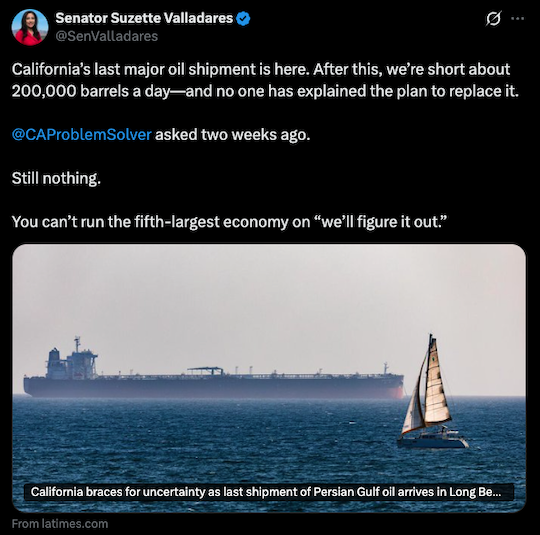
Paradigm’s resident oil field geologist Byron King went in-depth on California’s conundrum in a special guest essay last week — and the arrival of this tanker, called the New Corolla, puts it all into sharp focus.
“After she sails away, California — namely its refiners, and political powers who care about energy & stuff — must figure out how to replace all that imported oil that will no longer be arriving from the Persian Gulf,” says Byron now.
“Alternative sources include Ecuador and Brazil, but that involves outbidding refineries pretty much everywhere else, which are also scrambling for crude oil.
“By the end of May, people in the Golden State will look back with fond nostalgia for the ‘good old days’ of $6 gasoline and $9 diesel. It's going to get bad out there, and effects will ripple across the U.S. economy like a 200-car Union Pacific freight train. Brace for impact.”
 Busting a Buffett Myth
“While value investing is where he started, Warren Buffett is actually the greatest growth investor of all time,” says our senior investment director Enrique Abeyta.
Enrique was in attendance last weekend at Berkshire Hathaway’s annual meeting in Omaha, Nebraska — the first where Buffett was not presiding as CEO and his chosen successor Greg Abel was.
Still, Buffett’s presence was felt everywhere. And many attendees still sing his praises as a value investor. A few were probably lugging around copies of The Intelligent Investor, the legendary book penned by Buffett’s Columbia professor Benjamin Graham.
As a reminder, value investing means buying companies at less than book value — the accounting value of their assets. Alternatively, it means buying a company below the replacement value of its assets, or liquidation value.
Problem is, times have changed. Value investing’s heyday “was before these strategies became well known, the explosion in the asset management business and (most importantly) the internet,” says Enrique.
Besides, value investing isn’t where Buffett made his money. “It was buying large companies that would then go on to grow their earnings tremendously,” Enrique says.
Case in point — the ultimate “Buffett stock,” Coca-Cola. A $1.3 billion investment in 1988 has swelled to $24.5 billion today.
At the time of the purchase, KO sported a price-earnings ratio of 15.8X. Over the following three decades, the median P/E was 27X — up about 70%.
That’s nice. But look at the earnings per share: “It has grown 1,270% from $0.18 per share to almost $2.50 per share in 2023,” Enrique says.
“The valuation of KO stock was not what drove the appreciation in Buffett’s stake… it was the growth in the earnings.”
Oh, and don’t forget the dividends. The dividend grew 2,200% from 8 cents per share to $1.84.
Which gets back to Enrique’s favorite Buffett quote: “It’s far better to buy a wonderful company at a fair price than a fair company at a wonderful price.”
As for the markets today, the major U.S. stock indexes are recovering much of yesterday’s losses.
At last check the S&P 500 is back in record territory at 7,259. Ditto the Nasdaq at 25,310. The Dow is also in the green, but still a long way from reclaiming its 50,000 levels of February.
The attempt in Washington to lower the temperature in the Persian Gulf (see above) has knocked over $4 off of U.S. oil futures — now just over $102 a barrel.
Interesting: The yield on a 10-year Treasury note has been bumping up against the 4.4% level for a few days now. Back in March, every time the 10-year approached 4.4%, Donald Trump made some sort of conciliatory statement or gesture toward Tehran so as to not further spook the bond market. Perhaps that’s what’s going on here as well…
Precious metals are staging a weak rebound, gold at $4,563 and silver at $73.18. Bitcoin has surpassed $81,000 for the first time in over three months and Ethereum is approaching $2,400.
 Trump and AI and Cyberattacks
The Trump administration is rethinking its hands-off approach to AI.
Rewind to the days after Election Day 2024: Silicon Valley venture capitalist Marc Andreessen is interviewed by Joe Rogan. Andreessen tells of a meeting he and his partner Ben Horowitz had earlier that year with Biden administration officials.
“They told us to not even start AI companies because there’s no way they’ll let them succeed,” he said. The aim was to limit AI to “a function of two or three large companies” under tight government control.
Asked by Rogan “What do you do after a meeting like that?” Andreessen replied, “You go endorse Donald Trump.” Which he did.
Last summer, President Trump said of AI, “We’re going to make this industry absolutely the top, because right now it’s a beautiful baby that’s born. We have to grow that baby and let that baby thrive. We can’t stop it. We can’t stop it with politics. We can’t stop it with foolish rules and even stupid rules.”
Evidently that all changed last month when Anthropic took the wraps off its Mythos AI model.
Anthropic claims Mythos is so powerful it unearthed “high-severity vulnerabilities” in “every major operating system and web browser.” Seems the Trump admin is now spooked by the prospect of a major AI-enabled cyberattack.
Thus, The New York Times cites “U.S. officials and people briefed on the deliberations” as saying the administration is “considering the introduction of government oversight over new AI models.
“The administration is discussing an executive order to create an AI working group that would bring together tech executives and government officials to examine potential oversight procedures, according to U.S. officials, who declined to be identified in order to discuss deliberations over sensitive policies. Among the potential plans is a formal government review process for new AI models.”
Anthropic, Google and OpenAI have supposedly been clued into the process.
The Wall Street Journal has confirmed the Times’ account. The Journal previously reported that the White House objects to Anthropic’s plans to release Mythos to another 70 or so companies beyond the 40–50 that got the initial limited release.
Exactly how all of this will shift the investing landscape for AI is way too soon to tell. But it’s not too early to put this on our radar. To be continued…
 Sign of the Times
Presented without comment…

 Mailbag: Lucky Man
“You sure you want to congratulate the winner of your Top Trader challenge with ELP’s ‘Lucky Man’??” a reader writes after yesterday’s edition.
“I mean, the guy dies in the song! Not very lucky.
“Thanks for all your hard and excellent work.”
Dave: Well yeah, he did — but lived a very full life beforehand!
By the way, we finally tracked down and notified the $50,000 winner — a gentleman from Tennessee who was literally too busy working to answer email or pick up the phone. Once he did, he was shocked: “Last I checked the leaderboard I was in 200th place!”
Hey, that’s how it works when you’ve got a hard 30-day window. Again, thanks to everyone who took part. We’re scheming on how to do another event like this even bigger and better.


