
The Truth About Gold “Manipulation”
 The Truth About Gold “Manipulation”
 For most of this century, it existed only in the realm of “conspiracy theory.” Now in 2026 it’s broken into mainstream headlines.
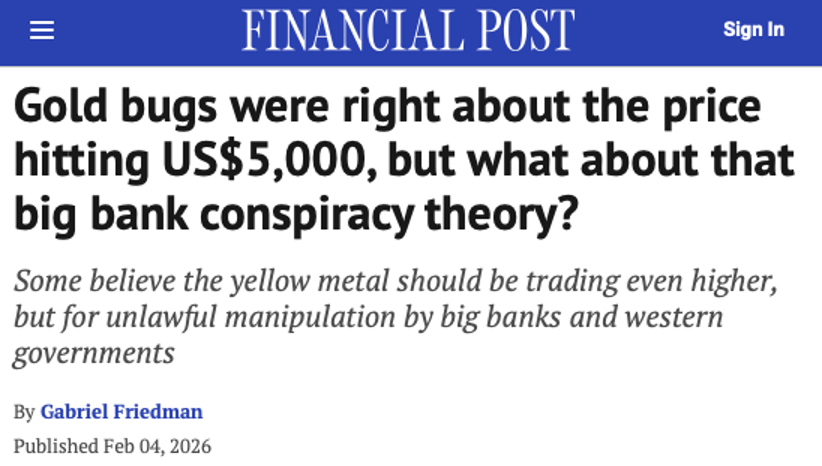
It’s right there in the Financial Post, a venerable Canadian outlet that’s been publishing since 1907.
Gold bugs spent years predicting bullion would hit its present value of around US$5,000 per ounce, but now that their predictions have borne out, some are airing a long-held grievance that it should be trading even higher, but for unlawful manipulation by big banks and Western governments.
Others write this off as a nonsense conspiracy theory. But with gold prices swinging wildly — to their highest-ever price in January of US$5,600 per ounce, only to crash 16% in the waning days of the month and then recover back above US$5,000 on Tuesday — the decades-old debate about what makes the yellow metal rise or fall is rearing its head again.
The article quotes the multibillionaire mining investor Eric Sprott: “I’m going to call them ‘The cartel’ — the major American banks and Canadian ones, too, by the way — thought gold was kind of their whipping boy; that they could sell it and knock it down.”
It’s good to know Mr. Sprott hasn’t changed: Your editor interviewed him in early 2013. In a few words, he described the suppression scheme like this…
“The Western central banks are surreptitiously supplying gold [to the global market] by leasing theirs out.”
There’s a lot packed into those few words. More than many people wish to contemplate. The Financial Post article quotes a fellow who runs a firm that helps precious metals miners fund their operations: He said it’s a “conspiracy theory” — even though he conceded he’d never really looked into the matter. “It’s a rabbit hole.”
Well, yes. But it’s a hole worth jumping down today. Doing so will offer clues about what happens to the dollar price of gold from here. Let’s go…
 Deathbed Confessions
More than a decade ago, Paradigm’s own macro maven Jim Rickards began opening readers’ eyes to how the powers that be manipulated the gold price.
The short version: Central banks leased gold bars to commercial banks… which then proceeded to sell the bars to buyers in Asia. The bars, meanwhile, never left the vault. (Too costly and complicated to transport.)
The slightly longer version: Chinese leaders relentlessly accumulated gold for years, aiming to approach or equal the amount held by the U.S. Treasury and the central banks of Europe.
In doing so, they hoped to be assured a “seat at the table” along with the Americans and Europeans whenever the global monetary system broke down and the powers that be hashed out a new system.
For years, Western movers and shakers went along — enabling China’s accumulation via that leasing scheme. Those Asian buyers included the People’s Bank of China.
“The gold price must be kept low,” Jim wrote in his 2014 book The Death of Money, “until gold holdings are rebalanced among the major economic powers, and the rebalancing must be completed before the collapse of the international monetary system.”
His research and documentation were peerless. “Get the annual report from the Bank for International Settlements,” he told me over dinner one evening. “Read the footnotes. I understand it’s geeky, but it’s there. They actually get audited — unlike the Fed and unlike Fort Knox.”
Of course, this was an era when Western leaders still thought they could keep the Chinese under their thumb. Later on we’ll get into what’s changed…
But first, it’s worth revisiting the deathbed confession of Bart Chilton.
Chilton was appointed to the Commodity Futures Trading Commission by President Bush in 2007 and kept on by President Obama. In 2014, he left government to join the uber-connected global law firm of DLA Piper.
He was colorful and charismatic, with trademark cowboy boots and shoulder-length hair that were out of place in D.C. Fond of the limelight, he joined Russia’s state-run English-language news channel RT in 2018 as host of a daily business news roundup called Boom Bust.
 The telegenic Bart Chilton, in his element
His TV career didn’t last long. He died the following year of pancreatic cancer at age 58.
Perhaps knowing his time was almost up, Chilton granted a candid interview a few weeks before shuffling off this mortal coil.
His questioner was an ex-Wall Streeter named Chris Marcus, who now runs an advisory firm called Arcadia Economics.
In so many words, Chilton confirmed that at one time JPMorgan Chase controlled about 40% of the global silver market. It was after JPM took over the collapsing Bear Stearns in 2008. The two firms’ combined position was way over limits set by the Commodity Futures Trading Commission. The CFTC granted waivers and extensions to JPM, during which time JPM actually acquired more silver.
“They did ultimately get down to the position [limit],” he recalled. “But it was at that time that they were so large, that I made the comment about how large a particular bank was in the market. Which sort of shocked people. And it shocked me, quite frankly, that it was so large.”
Upon further investigation, “we did uncover a lot of evidence that would lead to a manipulation case, or an attempted manipulation case,” Chilton went on.
We’re talking voicemails, text messages and a trail of trades. Chilton and crew recruited a forensic economist to dig deeper. Four years this went on. At Chilton’s behest the CFTC kept it going for a fifth year, commissioning another forensic economist.
In the end, the evidence was compelling, but not enough to nail anyone to the wall.
“We just didn’t have the traders, and we didn’t have the market participants dead to rights. But we had lots of stuff. And we had real stuff that would have played really well in court… But the damning part had to be backed up by other requirements of evidence under the law. And we didn’t get all of that.”
Presumably Chilton was talking about a case big enough to take down the people in JPM’s C-suite — and not the grunt traders periodically prosecuted by the Justice Department for appearances’ sake.
At the time of Chilton’s interview, JPM controlled 45% of all derivatives contracts — futures, options and whatnot — linked to precious metals. And Citi controlled another 30%.
Now? As of Sept. 30, 2025, JPM’s share has shrunk to 27% — with Citi and Goldman Sachs each controlling about 24%. You can decide for yourself whether that constitutes progress.
 Still More Evidence
A luminary in the precious metals space also came around to the manipulation thesis in 2019.
He’s Frank Holmes, longtime manager of the U.S. Global family of mutual funds and ETFs, specializing in precious metals and natural resources.
“Gold price suppression (‘fixing,’ ‘rigging,’ ‘manipulating’ or however else you want to think about it) is not just a conspiracy theory,” Holmes wrote his investors in May 2019. “It’s a well-documented phenomenon, with real actors and real ramifications.
“The best people to speak to about this subject are the folks at the Gold Anti-Trust Action Committee, or GATA.”
For well over a decade, most investment pros dismissed the GATA crowd as cranks of the first order. For Holmes to take their arguments and documentation seriously? That was a sea change.
For evidence of rigging, Holmes directed his clients’ attention to a tumble in the gold price in 2018–19.
Gold rallied from November through February, peaking at $1,343. “Ordinarily,” he wrote, “you could expect inventory in the bullion-backed SPDR Gold Shares ETF (GLD) to continue to climb at least until then. But that’s not at all what happened.
“Three weeks before the price of gold peaked, the holdings in the GLD curiously began to fall, and by March 4, the ETF had lost approximately 57.8 metric tonnes. And because the GLD is the largest gold ETF in the world… such selling will naturally impact the price of gold. Sure enough, the yellow metal soon fell below $1,300. What gives?”
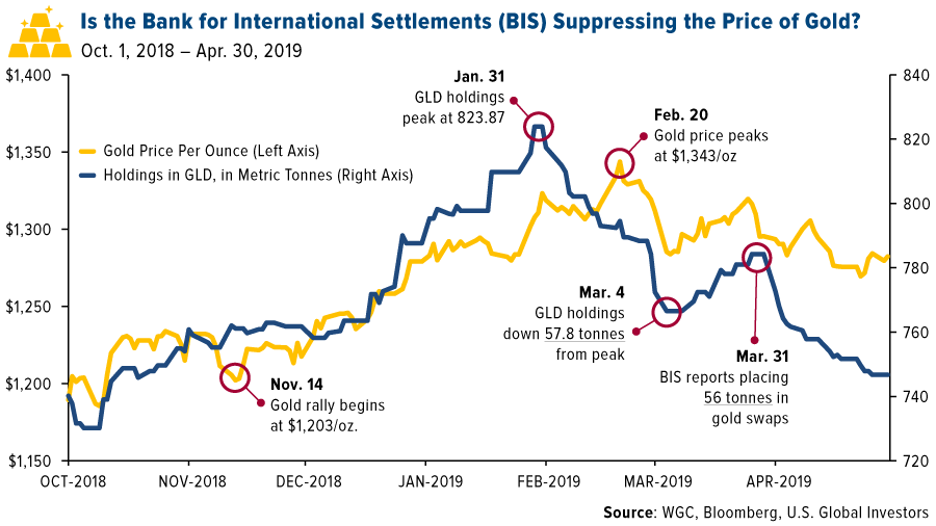
Back to the Bank for International Settlements, mentioned above. In its monthly statement for February 2019, “the BIS was still actively trading gold swaps [contract in which two parties exchange cash flows], which it uses to gain access to the metal held by commercial banks. Specifically, the bank placed as much as 56 metric tonnes of gold swaps into the market in February.
“If you ask me, that amount is remarkably close to the 57.8 tonnes that fled the GLD in the first quarter of this year [2019].”
But enough history. Let’s bring it up to the present…
 The Game Remains the Same
Here in the mid-2020s, the players have changed… but the game remains the same.
Back to the Financial Post piece, and Eric Sprott’s description of how it works…
The banks, he said, manipulated gold futures, which are contracts that allow people to speculate about the gold price at a future date. Such trades can be settled in one of two ways. One is to deliver physical gold on the agreed-upon day; the other is to make a cash payment based on the difference between the contracted price of gold and the spot price on delivery day.
In practice, gold bugs say traders at the big banks figured out a way to game the system. They would short gold or bet on gold futures below the spot price. By executing this strategy at a large scale, they affected market sentiment, and eventually the large number of low-priced gold futures would drag down the spot price of gold.
In that way, the big banks made reams of money and suppressed gold prices in the process.
“It works as long as no one asks for delivery,” Sprott said.
In theory, someone could stand for delivery with the intention of calling BS on the whole scheme.
But as Jim Rickards has reminded us for years, there are powerful disincentives to do so.
“Most major participants in the gold market (banks, dealers and hedge funds) are regulated by one or more of the Federal Reserve, U.S. Treasury, SEC or CFTC,” Jim wrote a decade ago. (And he’s been a lawyer for banks, dealers and hedge funds, so he’d know.)
“Applicable laws contain strict anti-fraud and anti-manipulation rules, including jail time in cases of willful and knowing violations.”
In other words, standing for delivery with the intention of squeezing the shorts could easily open you up to prosecution.
 Target $10K
Gold’s big rally in the mid-2020s — up 150% in two years even after the recent pullback — leads to the obvious question: Have the manipulation schemes broken down?
“That’s where the gold bug’s theory begins to dovetail with a more commonly held view of what drives gold prices,” says the Financial Post piece.
“All the countries used to be united on gold policy,” says Chris Powell of the Gold Anti-Trust Action Committee — recalling the history of the 2010s recounted above. “Gold is the only alternative to the dollar and the central banks are no longer united on letting the U.S. rule the world.”
It comes back to one of those charts we can’t show often enough: Central banks around the world started loading up on bullion in 2022 after Washington responded to the Russian invasion of Ukraine by freezing $300 billion in dollar-denominated assets held by Russia’s central bank.
Leaders of every government on less-than-friendly terms with Washington thought the same thing: If it can happen to the Russians, it can happen to us.
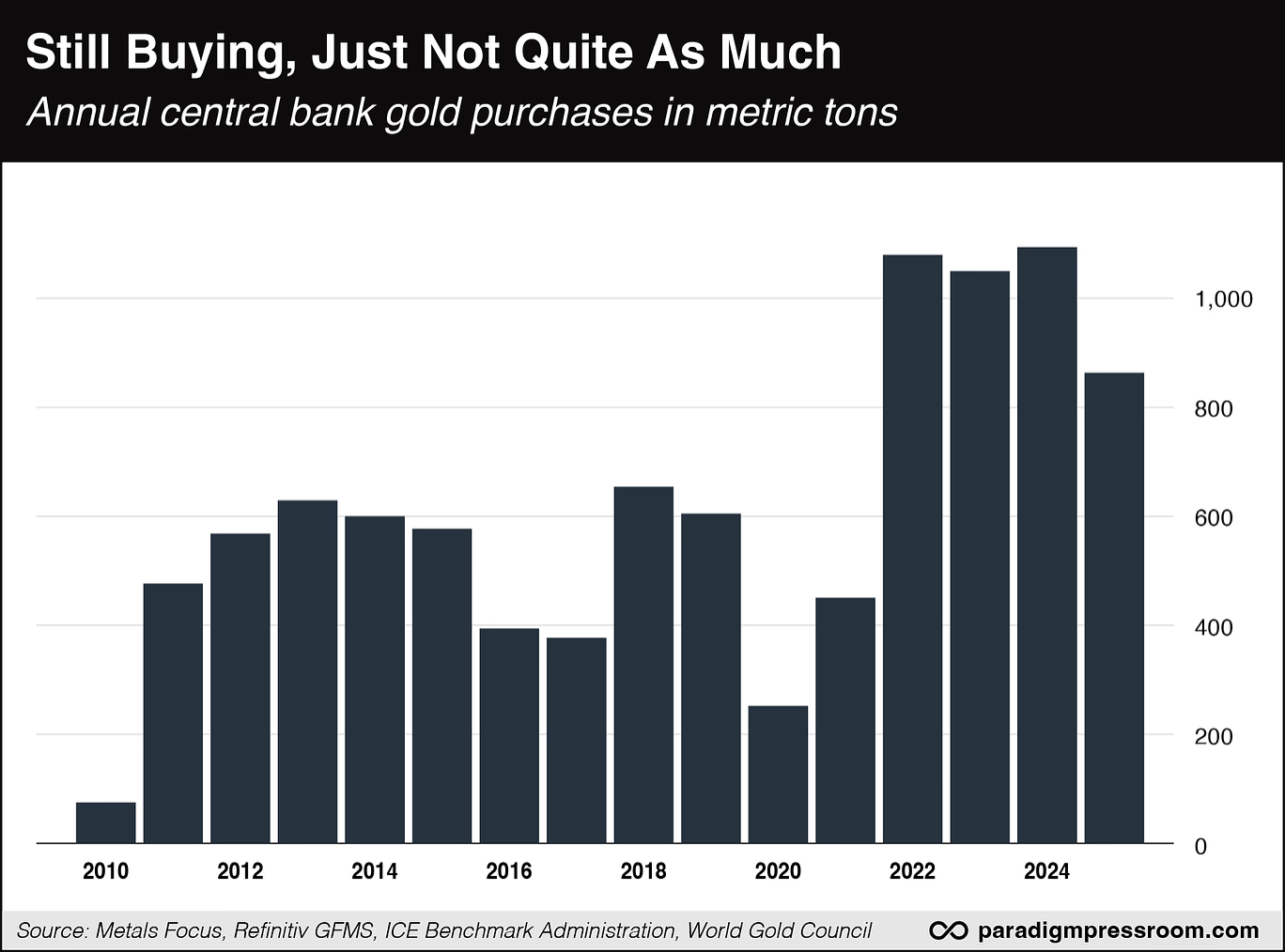
All that central-bank gold buying has an effect of keeping a floor under the gold price.
So where’s the ceiling?
Well, as Jim Rickards pointed out during a 5 Bullets guest essay in December, “Mining output has been flat for the last six years… gold is getting harder to find and more expensive to mine.”
At the same time, “private institutional investors have gold allocations of below 2.0% of total assets. If that expanded to a mere 4.0% allocation, there’s not enough gold in the world at today’s prices to fill those orders.
“That dynamic alone could send gold prices above $10,000 per ounce in the year ahead.”


