
Sorry, You Can’t Have Your Money Now
 Sorry, You Can’t Have Your Money Now
 Hopefully you’ve never had to deal with this and never will, but…
Imagine you have money tied up in an investment and one day the managers of that investment tell you that if you want to pull your money out — say, to cover a child’s college education, or meet a big unexpected medical bill — you’re out of luck.
You’ll get your money back, maybe, on the managers’ schedule.
Keep that in mind as you read the first two paragraphs of this story from the Financial Times…
Private credit group Blue Owl will permanently restrict investors from withdrawing their cash from its inaugural private retail debt fund, backtracking from an earlier plan to reopen to redemptions this quarter.
The New York investment group on Wednesday said investors in Blue Owl Capital Corp II would no longer be able to redeem their investments in quarterly intervals but that the company would instead return investors’ capital in episodic payments as it sells down assets in coming quarters and years.
To be sure, this isn’t the first problem to emerge in the “private credit” market — loans that were once the province of banks but are now dominated by players like Blackstone, Apollo and KKR.
Private credit was how the auto parts maker First Brands financed its operations — until it filed for bankruptcy last fall.
If you’re old enough, you might be asking yourself — Wait, didn’t something like this Blue Owl thing happen with the 2008 financial crisis? Like, really early on?
The answer is yes: More than a year before Lehman Bros. went belly-up in September 2008, cracks in the system emerged in the late summer of 2007.
Bear Stearns liquidated two hedge funds exposed to $20 billion in sketchy “collateralized debt obligations.” The home lender American Home Mortgage filed for bankruptcy. CNBC’s Jim Cramer broke into a crying jag on live television, begging the Federal Reserve to “open the discount window” and cut the interest rate it charged banks for temporary loans.
Good times.
Most important for our purposes today, it was at that time in August 2007 that the giant French bank BNP Paribas froze $2.2 billion in investor assets held within three hedge funds exposed to subprime mortgages.
But don’t take it from us. Take it from Mohamed El-Erian, one of the smartest guys in mainstream finance, formerly CEO of Pimco and formerly president of Queens’ College, Cambridge.
“Is this a ‘canary in the coal mine’ moment, similar to August 2007?” El-Erian tweeted this morning.
“There’s plenty to think about here, starting with the risks of an investing phenomenon in advanced (not developing) markets that has gone too far overall (short answer: yes), to the approaches being taken by specific firms (lots of differences, yet subject to the ‘market for lemons’ risk).“
Don’t get the wrong idea: El-Erian says the risk from private credit isn’t anywhere on the same scale as subprime mortgages in 2007–08. But while the risk is smaller, it is no less real.
Those early subprime tremors in the late summer of 2007 were enough to drag the Dow Industrials down 8.3% in the space of four weeks.
Looking back on those events almost two decades ago… and mulling over the frozen investor funds at Blue Owl now… well, it’s not out of the realm to expect a similar hiccup in the stock market sooner or later, probably sooner.
Which is exactly what Mason Sexton, editor of The Map, warned about on Tuesday in his livestream event titled The Prophecy 2026.
The catalyst could be almost anything. It could be trouble in the private credit markets. Yesterday, we explored the market risk stemming from a U.S. attack on Iran.
It doesn’t really matter: What matters is that as Mason sees it, the potential for big trouble begins tomorrow and continues into the first days of March.
Why is he so certain about the timeline? And what protective measures does he think you should take? Take the time now to watch The Prophecy 2026. By the time we get to the weekend, he says it could be too late.
 Iran and the “TACO Trade”
In the meantime, Iran still looms large over markets — oil trading at its highest in over six months.
A barrel of West Texas Intermediate traded as high as $66.65 this morning amid reports from CNN and the like saying a U.S. attack could be underway by Saturday.
Then Donald Trump said, “Maybe we’re going to make a deal. You’re going to be finding out over the next, probably 10 days.” With that, the price pulled back slightly but is now even higher at $66.78.
So now what? “The TACO trade is real,” says the Armchair Warlord account on X — referring to the expression “Trump always chickens out.”
“Trump talks a big game until the markets start to believe him, whereupon he reliably beats a hasty retreat and pivots to a new distraction from the Epstein files. The moral hazard here is that Trump has done this so many times that by this point global markets don't actually take him seriously and so they're reacting late and weak to what are objectively very concerning developments.”
This much is certain: The administration has still made next to no effort to sell the American people on the necessity of a war that might entail substantial U.S. casualties. They can’t even come up with credible talking points.
Asked yesterday what’s the point of an attack if Trump said Iran’s nuclear program is already “obliterated,” the best that White House Press Secretary Karoline Leavitt could summon was, “Well, there’s many reasons and arguments that one could make for a strike against Iran. The president had a very successful operation as commander-in-chief with Operation Midnight Hammer. As you know, as you just said, totally obliterated Iran’s nuclear facilities.”
Next question: When might the president make the case for war to the American people? Perhaps the State of the Union address to Congress next Tuesday? Leavitt begged off, saying she won’t “engage in a hypothetical.”
Speaking of Congress, Reps. Ro Khanna (D-California) and Thomas Massie (R-Kentucky) are teaming up on a War Powers Resolution aimed at preventing Trump from launching airstrikes without congressional authorization. Khanna says he’ll force a vote next week.
“War with Iran would be catastrophic,” says Khanna. “Iran is a complex society of 90 million people with significant air defenses and military capabilities. We also have 30,000–40,000 US troops in the region who could be at risk of retaliation. Congress must do its job and stop this march to war.”
We’ll give the last word for now to the Armchair Warlord: “As ever, use strict informational hygiene and consider source bias and attempts to box in U.S. decision-making through planted reporting from controlled outlets and journalists.”
Presumably he’s referring to Axios reporter Barak Ravid — whose imminent-war dispatch we mentioned off the top of yesterday’s edition. And it’s why we also mentioned Ravid’s history in Israel’s version of the National Security Agency, known as Unit 8200…
After modest gains yesterday the major U.S. stock indexes are posting even more modest losses today.
As we write they’re all down by less than a quarter percent. The big earnings report comes from Walmart — which reported strong sales growth even as it says consumers are spending cautiously. The news elicited a glass-half-full reaction from traders, sending WMT shares up 1.75%.
The big economic number today is the trade deficit — including full-year 2025 figures. Despite all the tariffs, America’s trade gap registered $901.5 billion last year — down only microscopically from the year before.
Precious metals are looking positively quiescent by recent standards — gold inching its way back above $5,000 and silver up a little over a buck to $78.18. The main cryptos languish where they were 24 hours ago, Bitcoin a little over $66,000 and Ethereum at $1,922.
 NYC’s Big Budget Raid
We’re just putting this on your radar for future reference…
Earlier this week, New York Mayor Zohran Mamdani laid out his plans to close the city’s huge budget gap. What made headlines was the prospect of raising New Yorkers’ already sky-high property taxes.
But there was something else he put on the table that got almost no attention — raiding the fund that’s set aside for the health care of retired city workers.
“We do not want to have to turn to such drastic measures to balance our budget,” he said. “But faced with no other choice, we will be forced to.”
Don’t get the wrong idea: Maybe it’s starting in New York. But it won’t stay in New York.
Way back in 2010, the Pew Center on the States issued an eye-opening report that found state governments had $3.35 trillion in obligations to retirees — pensions, health care and other benefits — but only $2.35 trillion on hand.
A day of reckoning is inevitable — higher taxes, benefit cuts or both — but so far, states and municipalities have managed to put it off.
After tax revenue cratered amid the 2008 financial crisis, states and municipalities shored up their finances with huge federal handouts from the American Recovery and Reinvestment Act of 2009.
Even bigger handouts came in the aftermath of the pandemic via the American Rescue Plan Act of 2021.
But that money’s gone now. I’ve done a cursory search for a more recent version of the Pew report — as well as a similar report issued by scholars at Northwestern University and the University of Rochester — but nothing of consequence turns up.
Still… New York’s budget fix is a reminder that the problem is still out there. We’ll be on the watch for similar troubles elsewhere — just in case they’ll be coming to a town near you.
 Comic Relief
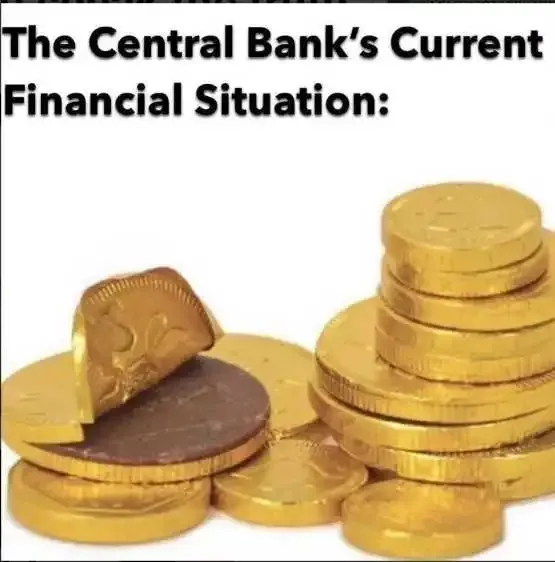
Well, this puts the question of “Is the gold in Fort Knox still there?” in another light…
 Mailbag: “Chicken Little”
“Wow Chicken Little. Alarmist Much? Trump uses Nukes? Seriously??” a reader writes after yesterday’s mailbag.
“Explain to us rubes how Iran could enjoy ‘conventional military success.’ We'd own the skies and sea in 24–48 hours. There won't be a land invasion so how does Iran achieve ‘conventional military success.’
“To be sure… Iran still probably maintains a healthy supply of fixed and mobile launching ballistic missiles. No downplaying that potential threat. They pose a danger to our Middle East bases and our fleet.
“BUT… enough of a threat that Trump would order NUKES?
“Stock market will be fine once the operation is over. Buy gold and silver for the short-term pop both will enjoy. Won't last long. The war or the pop!”
Dave responds: To be clear, I was citing nearly year-old reporting by the independent journalist Ken Klippenstein. His source was “a retired senior military officer who has been briefed on the planning.”
Don’t dismiss his reporting lightly. He’s gotten a number of interesting scoops in the last year. Among them are the “manifesto” of Luigi Mangione, the suspect in the murder of UnitedHealthcare CEO Brian Thompson. More recently he got his hands on a Homeland Security memo warning what could happen if ICE agents confront suspects in vehicles — before the Renee Good shooting in Minneapolis.
Meanwhile, be wary of claims that U.S. victory will be quick and certain.
“Iran will be able to almost immediately detect U.S. aircraft and Tomahawk launches,” tweets the military analyst Will Schryver -- “and, depending on where in Iran is being targeted, from launch to strike will take anywhere from 30 minutes to three-plus hours.”
At the same time, “Iranian [short-range ballistic missiles] can hit US bases in the region within five–seven minutes. Therefore, Iran can very conceivably achieve multiple significant strikes against U.S. targets long before U.S. munitions hit ANY targets in Iran.”
To be sure, “Iran will get hit hard for a week or two,” he acknowledges. “The question is can they be disarmed such that they cannot inflict severe damage against the U.S.?
“The pain threshold for Iran will be MUCH higher than it is for the U.S./Israel. One disabled carrier would be catastrophic.”
In the meantime, reactions continue to pour in to Mason Sexton’s The Prophecy 2026 event.
“Yes, it was controversial!” one reader allows — but he says he kept an open mind about Mr. Sexton’s “research process and result.”
“Great work Mason,” says another reader. “See you've got lots of gray. I'm 84 now and still kicking. Was great to see you’re still highly active. Great report.”
We’re keeping the replay of Mason’s event online for less than 36 more hours. Tomorrow marks the start of the window in which he expects some sort of market dislocation — the kind that people might talk about for years to come. Give it a look right now while there’s still time.


