
First They Came for Small Businesses
 First They Came for Small Businesses…
 It was one of the gravest injustices of the COVID lockdowns six years ago.
Countless small retailers across this country were deemed “non-essential” and ordered to shut their doors.
Meanwhile… big-box giants Walmart, Costco and Target thrived. And of course, Amazon.
From small towns to New York’s Chinatown, many of the small businesses never recovered. Chinatown is uniquely telling. Once the province of small landlords, it fell into the hands of developers.
The result? “Gleaming new storefronts, with $400 jackets and $700 shoes, all curated and lit up like sculptures,” wrote the author and critic Naomi Wolf in 2024. “Little art galleries, selling $12,000–25,000 works of modern art to wealthy, young, hip collectors. Chain bubble tea shops. Chain hotels.”
Something very similar is happening right now — this week — in the realm of AI.
On Monday, the Financial Times reported that “Donald Trump’s administration intends to spare companies including Amazon, Google and Microsoft from forthcoming tariffs on chips as they race to build the data centres powering the AI boom.”
The biggest of the hyperscalers would win this exemption provided they commit to investing in chips made by Taiwan Semiconductor Manufacturing Co.
Which they’d probably do anyway, right?
“The new scheme would allow TSMC to allocate exemptions for its U.S. customers from this next set of tariffs. The carve-outs would be tied to the scale of the Taiwan-based group’s investments in the U.S.”
The details are still fuzzy but this much is clear: Large entrenched companies will get a break on their chip costs. Smaller firms hoping to compete will be cut off at the knees — forced to pay the full load of the tariff.
This morning’s Wall Street Journal brings a similar story: The same three AI giants “are looking to sidestep President Trump’s $100,000 H-1B visa fee, potentially leaving the brunt of the new policy to hit smaller startups.”
As you might know, H-1Bs are the visas set aside for highly-skilled foreign workers. The Trump administration announced the new fee last September to address criticisms that Big Tech was using H-1Bs to fire U.S. citizens and hire cheaper foreign replacements.
The big guys “generally plan to find workers in categories that don’t have to pay the fee, including existing H-1B visa holders, students and people on other types of visas, according to people familiar with the companies’ plans…
“But many smaller companies, including startups in specialized areas such as artificial intelligence and health care, can’t easily navigate the policy changes or invest in alternatives that are cheaper than the $100,000 fee but still more costly than the status quo.”
“It would be prohibitive for us to pay the $100,000 fee,” says Jennifer Ide of the Georgia-based health care startup Rimidi — which has all of 20 employees.
It’s as if her firm, and countless others like hers, has been deemed “non-essential.”
Whatever your opinion of the H-1B visa program, something stinks when the system is designed for the biggest companies to circumvent it while small fry are hung out to dry.
That’s a problem when you consider that world-changing innovations rarely come from big lumbering incumbents in their industry.
They don’t come from the Microsofts, Amazons and Googles of the world.
They come from the scrappy startups, the proverbial kid tinkering in his garage.
They come from a Microsoft releasing MS-DOS for the first personal computer in 1981… from an Amazon disrupting the business of selling books in 1995… from a Google that instantly made people forget about inferior search engines like Lycos and AltaVista in 1998.
So if you care about America keeping its competitive edge in technology… or “winning the AI race with China”... what’s happening this week is cause for concern.
From an investing standpoint, it’s downright discouraging: Among the trio of Microsoft, Amazon and Alphabet-Google — we’ll throw in Meta as well because it’s also pouring gazillions of dollars into data centers — only Alphabet’s share price outperformed the S&P 500 last year.
Developments like these make our jobs harder at Paradigm Press. Ferreting out the small publicly traded companies with potential to change the world becomes harder when the playing field is tilted in favor of giant incumbents.
Of course, we welcome the challenge and will double down our efforts on your behalf.
 About Those Job Numbers…
Mr. Market is of two minds when it comes to the January job numbers.
The numbers came out this morning — five days behind schedule because of the most recent “partial government shutdown.”
The wonks at the Bureau of Labor Statistics conjured 130,000 new jobs for the month — way more than the typical Wall Street economist who was expecting 70,000. The official unemployment rate ticked down to 4.3%.
The initial reaction was positive: “Dow jumps 200 points as strong jobs report eases economy concerns,” said a CNBC alert. “The S&P 500 is set for a record after a much stronger-than-anticipated U.S. jobs report,” was Bloomberg’s take.
Then it dawned on someone: If the job market is holding up OK, that means it’s less likely the Federal Reserve will resume cutting interest rates, right?
At last check, all the major U.S. indexes are in the red: The S&P 500 is down a quarter percent to 6,923. The 7,000 mark will likely have to wait for another day. The Nasdaq and the Dow are both down a little over a half-percent.
But hold on: The January job numbers don’t tell the whole story.
This is the one report each year when the Bureau of Labor Statistics performs revisions to the previous year’s numbers — and the year before that, too.
It turns out that the U.S. economy generated 1.2 million jobs in 2024 — instead of the previously estimated 2 million.
And in 2025, the total was a mere 181,000 — revised down from 584,000.
Now as we’ve pointed out a couple of times in recent months, the fact the U.S. border has been effectively sealed since last spring changes the calculus when it comes to new jobs: In years gone by it took at least 150,000 new jobs a month to keep up with population growth. But without an influx of immigrants, the number could now be as low as 30,000.
But last year’s revised total works out to a tepid 15,083 jobs per month.
So maybe there’s something to this “cooling labor market” chatter after all. We’ll be on the lookout for further signs.
Elsewhere, precious metals are on the rally tracks again today — gold only $10 shy of $5,100 and silver up $3.50 and over $84 for the first time in nearly a week.
No joy in crypto-land, however — Bitcoin a little over $66,000 and Ethereum sinking toward $1,900.
It’s a dangerous juncture here: In my mind, $67K is an extremely important level for Bitcoin,” Greg Guenthner writes his Trading Desk readers. “This marks those prior cycle highs back in late 2021. If it can't hold this level, look out below!”
 Red Lines in the Middle East
Oil is back on the high end of its year-to-date trading range this morning — up $1.73 as we write to $65.69. Some sort of U.S. attack on Iran is looking inevitable now.
Israel’s Prime Minister Benjamin Netanyahu is at the White House today — his seventh visit to the United States since Donald Trump returned to the presidency 13 months ago.
The visit was originally scheduled for one week from today. Last weekend, the Israeli government asked to move it up after widespread media reports that Trump’s enthusiasm for airstrikes is lukewarm: “It’s really the Israelis who want a strike,” a U.S. official told the Axios site. “The president is just not there.”
The revised timing of the visit is resonant with many Iranians: It was on this day in 1979 that the Iranian Revolution toppled the Shah — 26 years after he was installed in an American-engineered coup.
Leave aside for the moment the matter of Iran’s nuclear program. Netanyahu is also demanding that Iran give up its ballistic missiles.

There were conflicting reports yesterday about whether Trump has agreed to go along with Netanyahu and demand the Iranian side surrender its missiles — which pose a potential threat to Israel but not to the United States.
As we’ve mentioned a couple of times in recent days, this demand would be a nonstarter for Tehran.
Really, it would be for any government. In Iran’s case, those missiles serve as a deterrent against an Israeli and/or U.S. attack. If the mullahs agreed to give them up, they’d be overthrown in a heartbeat.
Assuming the mullahs stand their ground… and depending on who you believe… airstrikes could be underway as early as 10:00 p.m. EST tonight.
Or perhaps the president will wait for a three-day weekend while the markets are closed.
In the meantime, there’s been no effort to sell the American people on the urgency of airstrikes — and no discussion of what the objective would be. Full-on regime change? Kill the ayatollah? Bomb the nuclear sites Trump already said were “obliterated”?
Little wonder that on social media, an old tweet of the late Charlie Kirk is making the rounds.
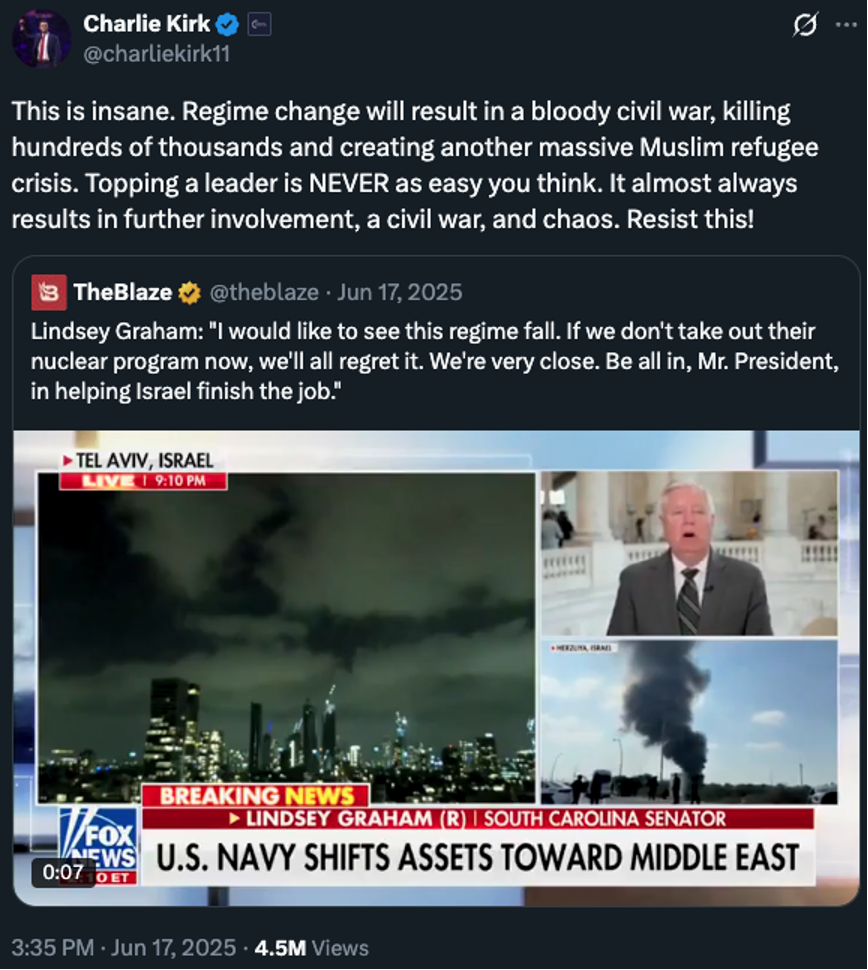
Trump said yesterday he might send a second aircraft carrier to the Middle East — but people who follow these matters closely say it would take six–eight weeks to arrive.
As the Jerusalem Post headline suggests above, Netanyahu would act long before then — forcing Trump’s hand. To be continued…
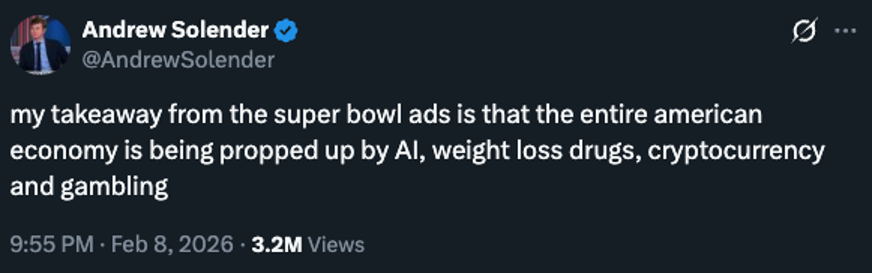
 Comic Relief
He might not be wrong…
 Mailbag: Blackouts… and Nuclear
After yesterday’s warning about the vulnerability of the power grid to blackouts, a reader jotted a one-sentence email…
“Nuclear would eliminate all blackout risk, but the climate people will not give any ground.”
Dave responds: Yes and no. There are definitely some folks in the climate-change crowd who reject nuclear power even though it generates no “greenhouse gases.” It’s as if they watched The China Syndrome as kids and were scarred for life.
But reality has set in for many others. The Silicon Valley giants know that nuclear is the only non-fossil fuel source that can possibly help them achieve their ambitions — hence, for instance, Microsoft’s deal to reopen the non-damaged Three Mile Island reactor that shut down in 2019.
And there’s California Gov. Gavin Newsom’s flip-flop — agreeing to keep the Diablo Canyon plant open beyond its planned 2025 shutdown date — knowing it’s essential to keep the grid up and running.
All that said, it takes time to build new nuclear plants. None in the United States is in the construction stage right now — which means none will likely be completed before large swaths of the country fall into the “high risk” category for blackouts. Consider yourself warned…


