
Jim Rickards: Software-Stock Scare
 Autonomous AI… and Software Stocks
 To hear the mainstream tell it, the stock market fell out of bed yesterday because of a 7,000-word blogpost.
An outfit called Citrini Research issued a report on Substack. It’s written as if it were June 2028 — looking back on the events of the previous couple of years. The firm promoted it on social media like this…
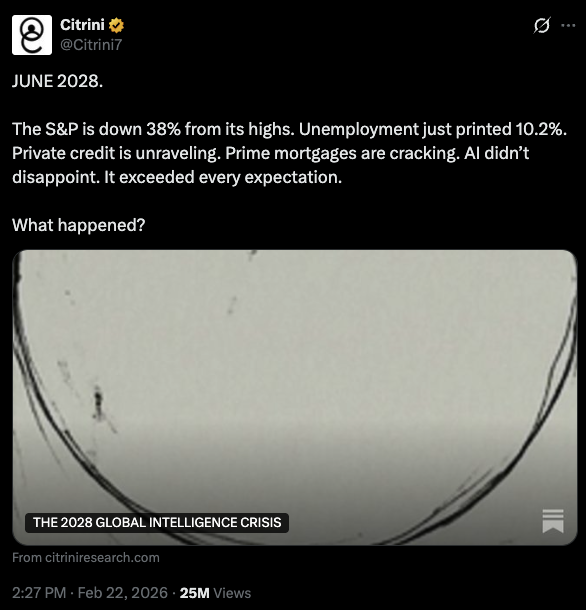
The gist of Citrini’s “retrospective from the future” is that AI has wiped out many high-paying white-collar jobs — cratering consumer spending and thus cratering both the economy and the stock market.
That’s not exactly a novel take on things.
Nearly three years ago, the writer John Michael Greer spun a similarly harrowing scenario: Huge portions of suburbia are hollowed out, Rust Belt style, as AI takes over scads of once-desirable white-collar jobs.
But people weren’t ready to hear Greer’s message about AI back then. People were still oohing and aahing over how you could use ChatGPT to summarize the plot of the latest White Lotus episode in the style of a Shakespearean sonnet.
People are ready to hear Citrini’s message in early 2026 — especially on Wall Street, where narratives have already taken hold that AI is about to wipe out the software business as we’ve known it for decades.
And so the software stocks — already on their heels — took another hit yesterday.
From a peak of $110.08 in mid-December, the iShares Expanded Tech-Software Sector ETF (IGV) slid 26.6% as of last Friday’s close. It slid another 4.75% yesterday to lows last seen in late 2023.
Non-software companies named in Citrini’s scenario also got hit hard: DoorDash fell 6.6%, American Express 7.2% The fallout spread to the rest of the market, the S&P 500 declining 1%.
So how much of this is real and how much is hype?
For perspective we turn today to Jim Rickards. We tout James Altucher as our AI authority at Paradigm — but Jim brings his own perspective to AI, complete with a book published in late 2024 called MoneyGPT: AI and the Threat to the Global Economy.
Yesterday — just as the Citrini report was going viral — Jim wrote to his Strategic Intelligence subscribers about how the worst still isn’t over for the software stocks.
The reason? “AI applications have made a quantum leap in terms of their capabilities.”
No longer do AI bots simply answer questions using their code. “They write their own code,” Jim says.
“And this is not just a case of cut-and-paste code modules plugged into certain routines. That technology has been around for decades. This is a case of writing original code based on minimal prompts from the user.
“Some cases go further. Once the AI-bot is granted access to your computer and to the internet and with a minimal prompt, it will not only write code but apply the code on the internet to perform tasks, order goods and download open-source software without instructions based on inferences about what the user wants.
“We’ve all experienced cases of writing an email or ordering goods only to be bombarded with online advertising about items related to the goods we just purchased. This is a kind of marketing performed by sellers and advertisers using access to our preferences obtained by scanning our output.
“These new AI systems go much further in the sense that they’re not working for the advertisers. They’re working for us — and they’re using their own inferential methods to figure out what we want and how to get it.”
This is the essence of “autonomous AI” or aAI — as Jim demonstrated during the Paradigm All-In Summit earlier this month alongside James Altucher and Enrique Abeyta.
“It’s the cutting edge and it’s coming fast,” Jim says. “But it may be coming too fast for legacy software companies.
“We may not even need coders and off-the-shelf software anymore. Our apps will write their own code. New jobs in the industry won’t be for coders. They’ll be for concierge types who can help customers manage this brave new world of aAI.”
If you have a traders’ mentality, you might consider something like IGV; surely it’s due for an oversold bounce.
But as Jim sees it, that would only be a short-term play. Longer term, he says, “Goodbye to software — and to software company stocks.”
[Editor’s note: Jim has worked with many AI programs from restricted government systems he can’t talk about. But the most reliable system he uses is a financial AI that just detected a huge signal for an important mining stock.
Even better, Jim says this signal is perfectly timed for Donald Trump’s State of the Union speech tonight. “The stars are aligned for a major announcement that could send this stock to the moon,” says Jim — as he shows you when you click here.]
 In Other AI Developments…
The oh-so-ballyhood “Stargate” project is barely out of the starting gate — and hopelessly stalled.
We chronicled the announcement shortly after Donald Trump’s second inauguration — a White House gathering featuring OpenAI’s Sam Altman, Oracle’s Larry Ellison and SoftBank’s Masayoshi Son.
Together, they and the president were touting a four-year $500 billion AI project — sprawling data center construction that would generate 100,000 jobs.
But the details were fuzzy, to say the least — starting with where the funding was supposed to come from. Would any of Stargate ever come to pass?
Your editor likened Trump’s photo op to Bill Clinton taking credit in 1993 for an Israeli-Palestinian peace deal that came to naught.
Fast-forward 13 months: One data center is under construction and no staff have been hired.
That’s according to an extensive report from the tech site The Information — which characterizes Stargate as a “shelved idea.”
It seems the three principals have been squabbling over responsibilities and how the venture should be structured.
OpenAI couldn’t secure the financing to meet its goal of locking down commitments for 10 gigawatts by the end of 2025. As such OpenAI has turned to outsourcing its vast and growing needs for computing power from Amazon Web Services, Google, AMD and the chip startup Cerebras.
The only meaningful sign of accomplishment so far is a groundbreaking last October on a one-gigawatt data center in Central Texas.
If there’s a sudden and unexpected lurch of forward progress in 2026, we’ll let you know…
 Oil… and Sewage
The oil price continues to hover over $66 a barrel as the windup to a U.S. attack on Iran is taking a very odd turn.
The headline news is mostly about the president’s frustration with his generals telling him there’s no quick, “surgical” Venezuela-like action the U.S. military can take with Iran. (For his part, the president denies those reports.)
But the real eyebrow-raiser has to do with the aircraft carrier USS Gerald Ford. The Ford has arrived in the Mediterranean Sea — presumably to function as a one-two punch along with the USS Abraham Lincoln in the Arabian Sea.
The Wall Street Journal reports that morale on the Ford is low. Typical “peacetime” carrier deployments are six months. The Ford is already at eight and on track for 11.
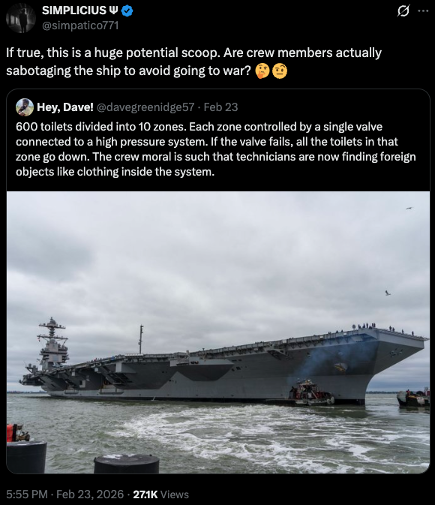
Worse, social media has erupted with reports that the toilets on the Ford are badly backed up — complete with stomach-turning pictures evidently sent by the sailors aboard to family and friends back home.
It’s inspired much online mirth, to be sure…

But the rumors of a stealth mutiny are less funny…
In other peculiar developments, Defense Secretary Pete Hegseth says he might order huge amounts of pizzas for Pentagon staff at random intervals — just to throw off the “Pentagon Pizza Report” account on X that tracks the “popular times” data on Google Maps for pizza joints in the area, presumably as a tip-off to U.S. airstrikes.
In the meantime the major U.S. stock indexes are recovering a fair chunk of yesterday’s losses.
The S&P 500 is up three-quarters of a percent and back within 10 points of 6,900. The index has been range-bound since Thanksgiving — unable to break decisively over 7,000, or even notch a closing high over 7,000.
The tariff news today is that the 10% tariff Donald Trump announced Friday and raised to 15% Saturday has now taken effect and is 10%. FedEx sued the government for a refund plus interest on the tariffs struck down by the Supreme Court Friday. (Expect the case to drag on for years.)
Precious metals sold off hard earlier today, but have since pared those losses. Gold sits at $5,159 and silver at $87.85. Crypto is moribund with Bitcoin a little over $64,000 and Ethereum well under $1,900.
 Comic Relief: But What About the Dow?
Have to say, this is an unusually skilled use of AI-generated imagery…

 Mailbag: Iran, Partisanship
“There is no way Trump or any U.S. president will be the first to use nuclear weapons, particularly against a country that doesn’t currently possess nukes,” writes a longtime reader who’s also a retired Marine colonel. (We’re circling back to a topic that came up last week.)
“The use of nukes would be an easy way to lose the high ground of moral authority. When I was at the U.S. Army War College many years ago, an instructor suggested that the U.S. would not use nukes against North Korea even after they used the weapon first. I was sure we would in retaliation, and I still am.
“His rationale was that we had sufficient conventional means to destroy them without using nukes ourselves. I’m not so sure now, as they have increased their nuclear capabilities significantly since then.
“But Iran doesn’t yet have nuclear weapons, and the whole point is to keep them from getting them, and maybe a little regime change. Overdramatizing a particular outcome and use of fearmongering is a good way to lose your argument.
“Still love the 5!”
Meanwhile another reader strikes back at a contributor to last Thursday’s mailbag…
“To inform the aptly implied ‘rube’ who has obviously never served in the military — Iran could easily ‘conventionally’ defeat the U.S. ‘armada’ and even capture it wholly intact.
“Those forces are on the shoestring end of a very long and complex supply chain that could be easily severed multiple ways. leaving ships without fuel, food and water. This could end with them being captured and towed to port as POWs and war prizes.
“Otherwise, swarm attacks could disable or sink all the vessels exactly as war-gamed many years ago. In case of attack, all U.S./NATO bases up to 2,000 kilometers will be damaged or destroyed (not just functionality but smoking craters). This does not even come close to the asymmetric attacks that could cripple or decimate (90% U.S. casualties) this country.
“Rubes like this are a direct threat to not only you and me but the entire planet by their whole stupidity, ignorance and hubris. Might I suggest he take a combat tour in Ukrainian trenches (plenty of room) before he spews any more stupidity.”
“Dave, where can I find articles you wrote critical of the Biden administration, including the president’s mental competency, border policy and fiscal matters in the archives?
[Evidently the reader took exception to yesterday’s edition?]
“Just trying to get a handle on what emotion you are trying for in your current writings on Trump versus those on Biden.”
Dave responds: You’re wondering whether I was critical of the Biden administration?
Well, let’s see… there were all the annual censorship-and-financial-cancellation issues that I wrote during Biden-time. (Here’s the one from 2024.) And there was the forceful opposition I expressed to Biden’s jab mandates. (Here’s the first of many.)
That should be enough to get you started. If it’s not enough, write back and I’m sure I can direct you to more.
I took a lot of flack during the 2024 campaign cycle from people who thought I was pro-Trump. Now he’s back in power and I’m getting it from the other side.
I mean, it comes with the territory but it does get a little old after a while…


