
SCOTUS v. SOTU
 You Heard It Here First
 We begin the week with a hearty congratulations for every financial pundit who beclowned himself by saying there was no way the Supreme Court would rule on tariffs last Friday.
Such as…
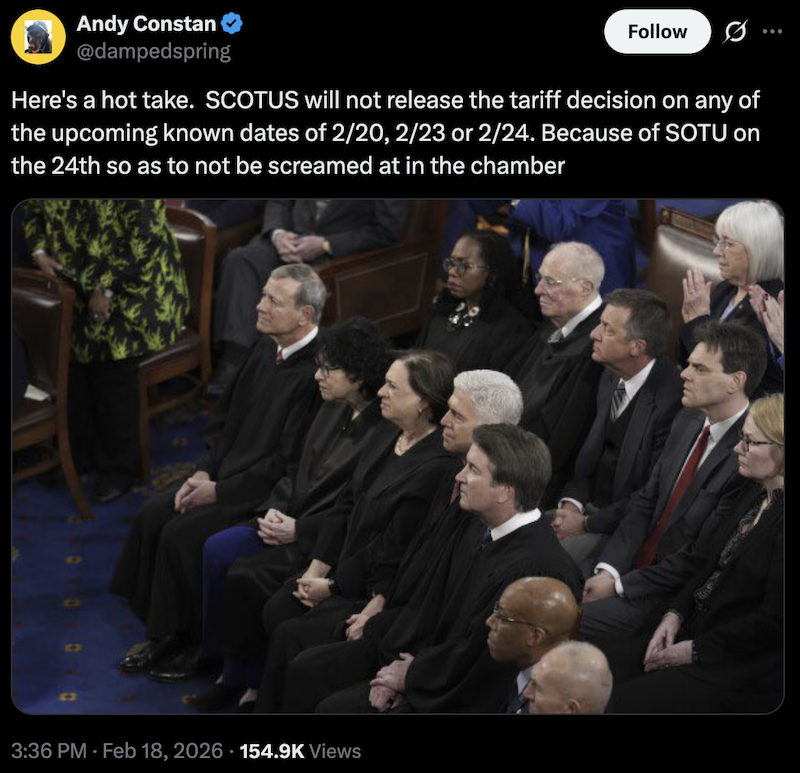
As the thinking went, the nine justices usually sit in the front row for the State of the Union address — which is tomorrow night. Why would they risk the spectacle of the president berating them on live television, especially if the ruling caused market turbulence for which he would blame them?
Well, as you certainly know by now, the justices did rule on Friday — striking down much of the Trump tariff regime by a 6-3 margin. And there was no market turbulence to speak of.
At least the fellow who blew that forecast fessed up — and to his credit didn’t delete the old tweet.
It’s fair to say readers of this e-letter saw what was coming months before the corporate media caught on.
Way back on May 9, 2025 we alerted you to the flurry of lawsuits by small-business owners challenging the tariffs. We profiled a couple of those owners, including Emily Ley. Her Florida-based firm called Simplified relies on imported materials from China not available domestically. She’s written tariff checks to Uncle Sam totaling $1.17 million between 2017–2025.
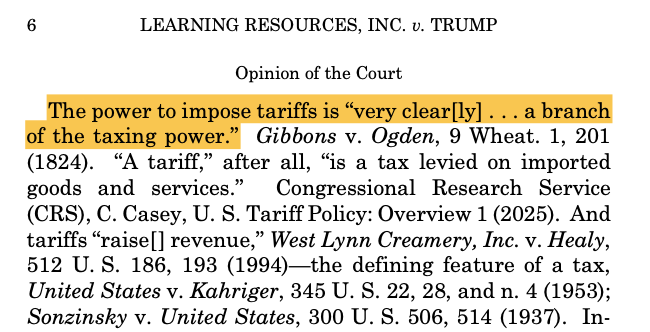
We also alerted you to the likelihood the Supreme Court would (1) take up the matter and (2) strike down many of the 2025 Trump tariffs on constitutional grounds: Tariffs are taxes and taxes must originate in the House of Representatives.
Sure enough, that’s what the majority opinion says…
Emily Ley’s specific case did not make it to the high court. But she’s elated nonetheless.
“When the Supreme Court ruling came down,” she writes on her Substack page, “I felt something unexpected — relief, and deep gratitude. We made it. It required serious financial maneuvering and tightening things up at Simplified in ways I didn’t anticipate, but we got through it. Now we wait for our case in the Court of International Trade — this ruling will guide the outcome of ours — and we celebrate.”
But maybe not for long. Now comes the fallout…
 Tariff Ruling: The Fallout
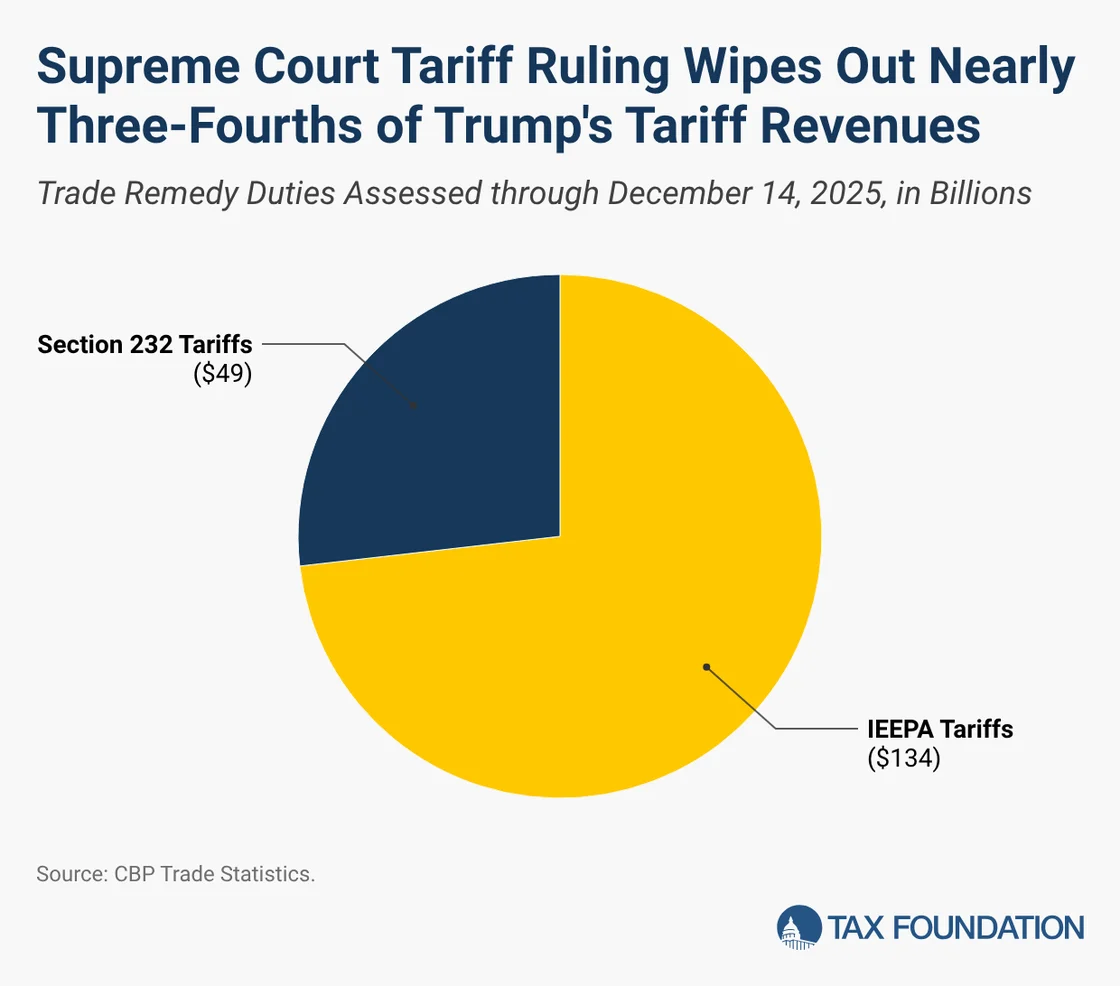
“The decision erases nearly three-fourths of the new tax revenue the Trump administration hoped to raise from tariffs,” says a dispatch from the Tax Foundation.
Specifically, we’re talking about the tariffs the Trump administration levied citing the International Emergency Economic Powers Act of 1977 — which garnered $134 billion in revenue for the government last year. That includes the “Liberation Day” tariffs and the fentanyl tariffs targeting China, Canada and Mexico.
The ruling did not address the tariffs levied under Section 232 of the Trade Expansion Act of 1962 — which affect industries like steel, aluminum, autos and heavy trucks. Those will remain in place.
“In the near term, uncertainty remains as the president could pursue other discretionary trade powers to impose tariffs,” adds the Tax Foundation.
Paradigm macroeconomics maven Jim Rickards has said as much for months: “Trump has many other statutes that he can use to support the same tariffs,” he said in his 2026 outlook we issued at year-end 2025.
Trump did exactly that after the ruling on Friday — instantly reinstating the across-the-board 10% tariff he imposed last spring. Instead of relying on the 1977 law the Supreme Court said was off-limits, he resorted to a different 1974 law.
(On Saturday he upped the tariff to 15%, without saying why.)
Rick Woldenberg — CEO of the company that was the lead plaintiff in the case decided by the Supreme Court on Friday — seems resigned to that prospect.
"If the government is bound and determined to try to harm us through excessive taxes,” he tells the BBC, “I'm sure they'll find a way.”.
Perhaps anticipating that’s what Trump would do, the Supreme Court punted on the question of whether Uncle Sam has to issue refunds to companies that paid the tariffs.
In the final analysis, “the Treasury will not pay refunds,” Jim Rickards told his Strategic Intelligence readers after the ruling Friday. “It will argue that the court’s interpretation cannot be applied retroactively.”
As Jim sees it the ruling “will not have any material impact on the Treasury, the deficit or our trading partners... Economic life will go on much as before.”
Still, there’s that near-term uncertainty businesses must wrestle with.
Case in point: SGAmmo, an Oklahoma-based online retailer of ammunition. In an email to customers Friday afternoon, owner Sam Gabbert talked about what the ruling means for them.
He took pains to say his email “is not meant to be political, partisan or in any way support or oppose U.S. government tariff policy. That said, tariffs are relevant to the ammunition industry in terms of cost and product availability, as many raw materials used to manufacture ammunition in the United States — as well as a significant portion of finished ammunition products — are imported.”
Thus, he said the Section 232 tariffs on copper are unaffected by the ruling. “Those tariffs have contributed to increased input costs for domestic manufacturers, due to the 50% tariff on copper-portions raw materials used to make brass cases and bullet jackets.
“Depending on how trade policy evolves in the coming months, certain imported finished ammunition products could potentially see short-term cost shifts relative to domestically produced products, though the degree of any impact will depend on numerous variables. At this stage, it is too early to determine with certainty how today’s ruling will affect ammunition prices or availability… It may take three–six months before the net effects become clear, and unexpected developments are certainly possible along the way.”
In the meantime, there’s more to be said about those refunds. Read on…
 Bad Look
Then there’s the whole matter of how the family of a senior Trump official potentially stood to profit off the Supreme Court ruling.
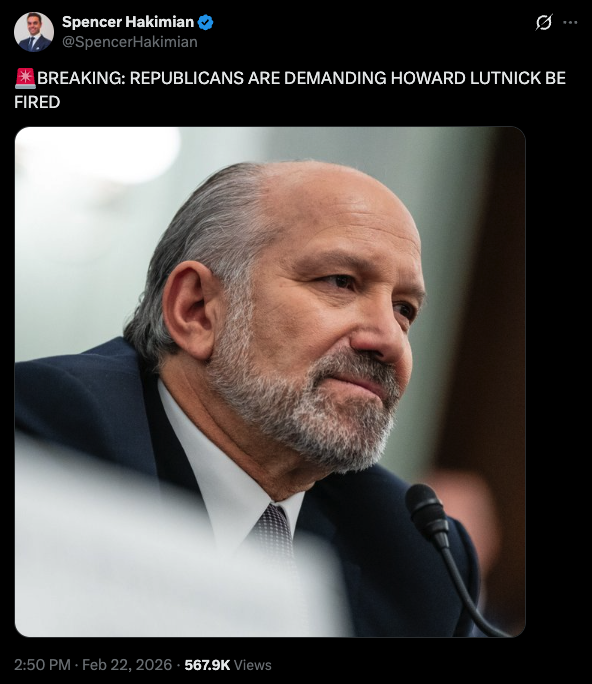
After the ruling on Friday, social media blew up with links to an article published by Wired last summer.
The background: Trump’s Commerce Secretary Howard Lutnick used to run the Wall Street firm Cantor Fitzgerald. After joining the White House last year, he handed control of Cantor to his sons.
Over the last year, Lutnick has been the architect of the Trump tariff regime. Meanwhile, Cantor was positioning its clients for the likelihood the tariffs would be struck down in court.
From the Wired piece…
In a letter seen by Wired, a representative from Cantor said the firm was willing to trade tariff refund rights for 20–30% of what companies have paid in duties. “So for a company that paid $10 million, they could expect to receive $2–3 million in a trade,” the representative wrote. “We have the capacity to trade up to several hundred million of these presently and can likely upsize that in the future to meet potential demand…”
Basically, Cantor would lend companies 20–30 cents for every dollar they’re owed in refunds. The companies would grab the quick cash and wait for the legal process to play out. That could take years — but Cantor’s patience would pay off because at the end of the process it would collect 100 cents on the dollar.
Nice work if you can get it.
For its part, Cantor is now throwing its salesman under the bus — saying he “erroneously” believed the firm would pursue such a scheme.
“Cantor Fitzgerald has never executed any transactions or taken risk on the legality of tariffs,” a spokesman tells the Semafor site. “Any report suggesting otherwise is completely false.”
Even if that’s true, the optics are awful.
As Semafor writer Liz Hoffman points out, “Cantor has clearly benefitted from its ties to Lutnick, becoming a big underwriter of deals aligned with the administration’s crypto, AI, energy and national security agenda.”
And that’s on top of Lutnick’s proven lies about his relationship with the late financier and sexual predator Jeffrey Epstein. The newest Epstein files show he visited with Epstein long after Lutnick said he’d cut ties.
Needless to say, Lutnick remains on the job this morning…
 “If History Is Any Guide…”
Before we move on to the markets today, we give the final word to Supreme Court Justice Neil Gorsuch.
Gorsuch was Trump’s first appointee to the court. He’s often considered part of the court’s most conservative wing, along with Samuel Alito and Clarence Thomas.
For those who think it important for the Nation to impose more tariffs, I understand that today’s decision will be disappointing. All I can offer them is that most major decisions affecting the rights and responsibilities of the American people (including the duty to pay taxes and tariffs) are funneled through the legislative process for a reason.
Yes, legislating can be hard and take time. And, yes, it can be tempting to bypass Congress when some pressing problem arises. But the deliberative nature of the legislative process was the whole point of its design.
Through that process, the Nation can tap the combined wisdom of the people’s elected representatives, not just that of one faction or man. There, deliberation tempers impulse, and compromise hammers disagreements into workable solutions. And because laws must earn such broad support to survive the legislative process, they tend to endure, allowing ordinary people to plan their lives in ways they cannot when the rules shift from day to day.
In all, the legislative process helps ensure each of us has a stake in the laws that govern us and in the Nation’s future. For some today, the weight of those virtues is apparent. For others, it may not seem so obvious. But if history is any guide, the tables will turn and the day will come when those disappointed by today’s result will appreciate the legislative process for the bulwark of liberty it is.
 Markets Today: Is It Really About Tariffs?
The financial media are flailing about — trying to tie the tariffs to both a rally on Friday and a sell-off today.
The narrative on Friday was that the market was “relieved” by the Supreme Court ruling - sending the S&P 500 up 48 points to close at 6,909.
The narrative today is that Trump’s Saturday announcement of a 15% tariff has touched off “confusion” that somehow didn’t exist on Friday — sending the S&P 500 down 66 points as we write to 6,843.
What if — just hang with us here — what if the action Friday and today had little or nothing to do with tariffs and is just a continuation of the choppy action we’ve seen going back to the start of the year?
It’s a safe bet that Nvidia’s earnings — which the company will report after the closing bell on Wednesday — will do much more to set the direction of the major indexes in the coming weeks than tariffs.
In any event, stocks’ losses today are precious metals’ gains: Gold is up over $100 at last check to $5,213 and silver is up $2.74 to $87.26.
Bitcoin is losing its grip on the $67,000 level that’s held most of this month — now $65,552. Ethereum has sunk below $1,900.
Crude is inching past $67 for the first time since last summer despite word that U.S.-Iran negotiations will resume on Thursday.
No major economic numbers are due this week: It’s all about the State of the Union and Nvidia earnings.
We have a full mailbag, but in light of the tariff news it will have to wait until tomorrow. Catch you then!


