
What if Iran Wins?
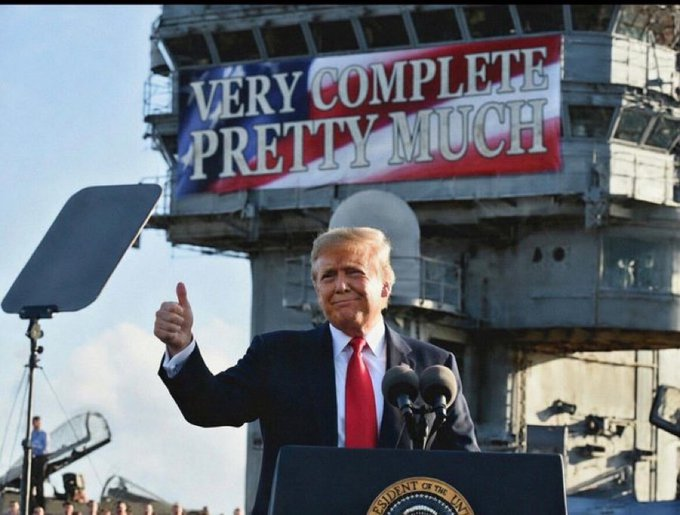
 Very Complete, Pretty Much
 Rarely have four words moved markets like this.
About 40 minutes before the stock market closed yesterday, Donald Trump told CBS News: “I think the war is very complete, pretty much.
"[Iran has] no navy, no communications, they've got no air force,” he added. “If you look, they have nothing left. There’s nothing left in a military sense.”
The market reaction was instantaneous and extreme: The oil price collapsed from over $100 to below $85. The stock market, struggling for traction all day, ended the session with the S&P 500 up more than three-quarters of a percent.
The social media reaction invoked George W. Bush’s “Mission Accomplished” moment from 2003.
But then, later in the evening…
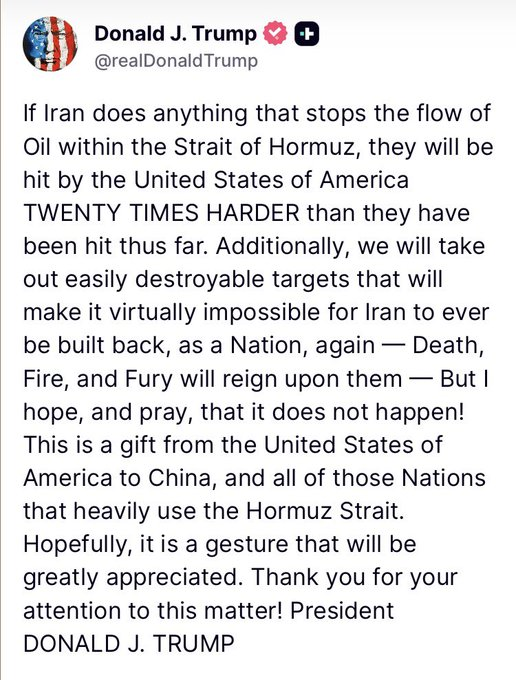
In after-hours electronic trading the oil price leaped 10% in the space of two hours.
So it appears “very complete, pretty much” was not a statement about the progress of the war — but a cynical ruse to talk stocks up and oil down, at least for a while.
In that sense, “Mission accomplished.”
Before we move on, a follow-up about the Strait of Hormuz…
It’s a head-scratcher, the start of the president’s statement about “if” Tehran halts oil flow through the Strait of Hormuz.
As chronicled in yesterday’s edition, the strait has been effectively blockaded for days — except for whoever the Iranian military wants to let through. Chinese oil tankers are getting through in exchange for the Chinese government providing financial help, spare parts and missile components.
Now, according to Iranian state media, the Iranian Revolutionary Guard Corps is extending an offer of passage to vessels from other countries…

So far, no takers — not that we know of, anyway.
In any event, the war continues. And so we’re compelled to return to a question we explored on Friday, this time with the help of our own Jim Rickards…
 What if Iran Wins?
“The Scenario Washington Won’t Discuss — Iran Winning” was the title of a report Jim Rickards issued to his Situation Report readers last week.
We won’t touch on all of the points he ran down to make the case that the Iranian regime is more resilient than conventional wisdom has it. But two are worth highlighting…
Westerners “have little idea just how big Iran is,” says Jim.
“It’s the 17th-largest country in the world by area out of 195 countries. It also has the 17th-largest population in the world with 86 million people.
“Iran is not a giant like India or Brazil, but it is far larger than Americans realize. The terrain is challenging with large mountain ranges and deserts. This is not a country ripe for a land invasion like Iraq or Syria.”
We’ll supplement Jim’s observations with this map, courtesy of the Diligent News site…

“Iran is far larger than Ukraine,” Jim continues, “which is still holding out against Russia after four years of war. Iran has what military strategists call strategic depth, which offers the ability to retreat without surrender. Iran isn’t going anywhere and it will not easily be subdued.”
“The U.S. and Israel are running low on offensive and defensive bombs and missiles,” says Jim.
“This is the result of the massive bombing attacks on Iran, the need to fire thousands of anti-missiles to shoot down thousands of incoming drones and missiles, the fact that the U.S. has allowed its military industrial capacity to atrophy and the large number of weapons wasted in Ukraine.
“U.S. industrial output of 800 cruise missiles per year cannot keep up with Israel and the U.S. launching 100 per week. Ships need to reprovision. Repairs cannot be neglected. Diego Garcia is days away from the battlespace. The U.S. will be badly stretched.”
➢ Update: As anticipated in this space on Friday, the Pentagon is moving parts of a Terminal High Altitude Area Defense system — THAAD — from South Korea to the Middle East.
Here’s some startling missile math Jim shared yesterday with Strategic Intelligence readers: “Iran may have 10,000 drones that cost about $20,000 each. The U.S. is using missiles that cost $4 million each and has a limited supply of them. The U.S. can produce about 1,000 cruise missiles per year but is using more than 100 per week.”
Bottom line: “In a war of attrition, really a war for survival, victory goes to the last man standing. That may be Iran.”
 Oil and Stocks: It’s Not the ’70s Anymore
Even at “only” $83.19 this morning, oil is as costly now as it was last summer. But is a spike in oil prices bad for the stock market?
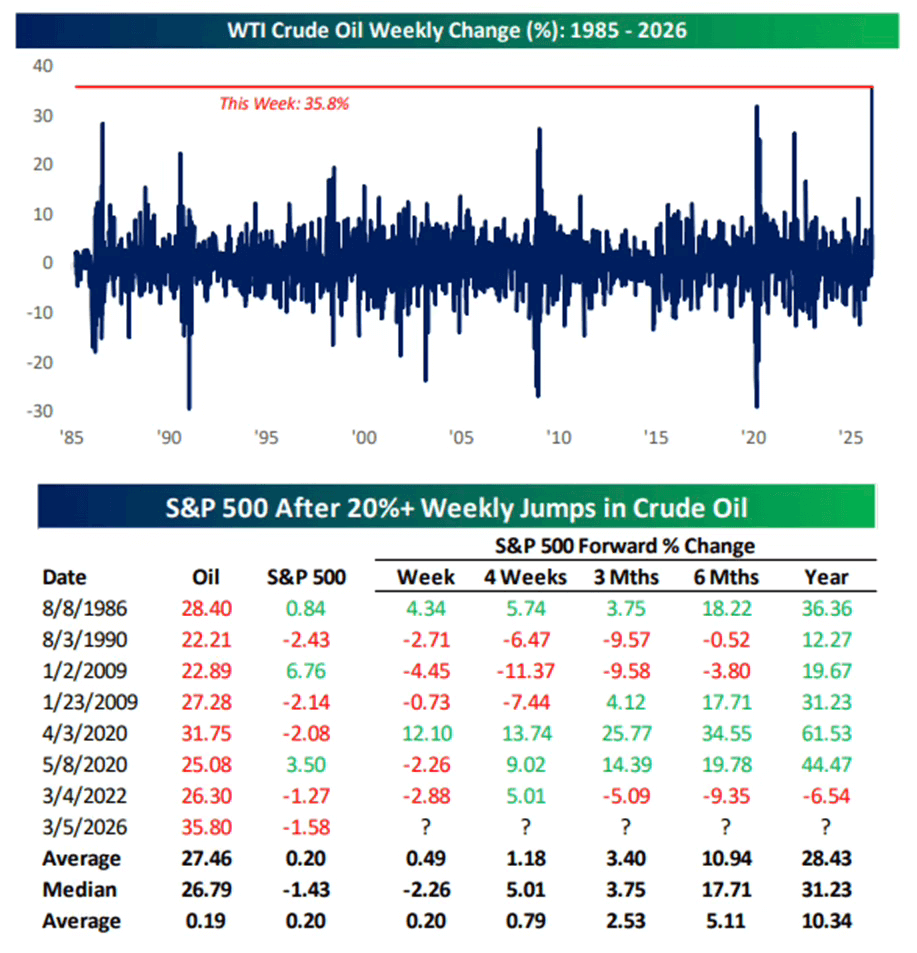
Not really, says Paradigm trading pro Enrique Abeyta. “Here’s a table from Bespoke Investment Group showing every time that oil prices have gone up at least 20% in one week since 1985.
“It also shows how the S&P 500 performed after each one of these price spikes.”
We can hear the objection already: But what about the 1970s?
For one thing, modern-day oil futures didn’t begin trading until 1983. For another thing, the Persian Gulf region accounts for far less of the world’s oil supply now than it did at the time of the 1970s oil shock. (That’s the made-in-America fracking revolution of the 2010s at work.)
Back to the table: “You can see the performance of the S&P 500 weeks, months and one year after these price spikes,” says Enrique.
“The first takeaway is that in the following few weeks and months, the performance of the stock market was choppy. One week later, it was down two-thirds of the time. Three months later, it was down 60% of the time.
“The downward moves may not be big, but the market clearly struggles to digest oil spikes at first.
“Looking out one year, however, the stock market was higher 86% of the time with an almost 30% return — more than double the stock market’s average.”
The lone exception — 2022, which registered a modest 6.5% drop.
Enrique’s conclusion: “This relationship is clear from the overall data: Higher oil prices correlate with higher stock prices over time.”
Meanwhile, the major U.S. indexes are adding to yesterday’s late-session gains.
The S&P 500 is up a third of a percent, back above 6,800. The index has been range-bound between 6,721–6,978 for nearly three months.
Both the Dow and the Nasdaq are registering stronger gains — about a half percent on the day.
Gold has reclaimed the $5,200 level for the first time in a week. Silver is back within a buck of $90.
Crypto is once again trying to break through its recent ceiling — Bitcoin now over $71,000 and Ethereum at $2,073.
 Economy Miscellany
If the aim of the Trump tariff regime is to throttle China’s export machine, it’s not working.
The Beijing government reports that Chinese exports totaled $657 billion in the first two months of 2026 — a 21.8% leap over the same period last year. That’s nearly three times the growth expected by Wall Street economists.
Yes, Chinese exports to the United States fell more than 10%. But exports to Europe grew 27.8% and exports to countries belonging to the ASEAN consortium in Asia grew 29.4%.
The numbers put China on pace to exceed its record 2025 exports by year-end 2026.
Reminder: Donald Trump is still scheduled to meet in Beijing with Chinese president Xi Jinping at the end of this month.
Going by a measure that government statisticians can’t fiddle with, the U.S. employment picture is the weakest in nearly 70 years.
Last Friday, we mentioned the punk February job numbers — with caveats. For one thing, ever since the pandemic, fewer business owners and individuals are responding to Labor Department surveys. Further, the stats have been rigged for decades to make the job picture look better than it really is.
But there’s one number the statisticians can’t game — the labor force participation rate. This is the percentage of the civilian population over age 16 that’s either working or looking for work.
Here’s a very long-term chart of the participation rate — going back nearly 80 years, a period encompassing 12 recessions. The February 2026 number is 62.0%.
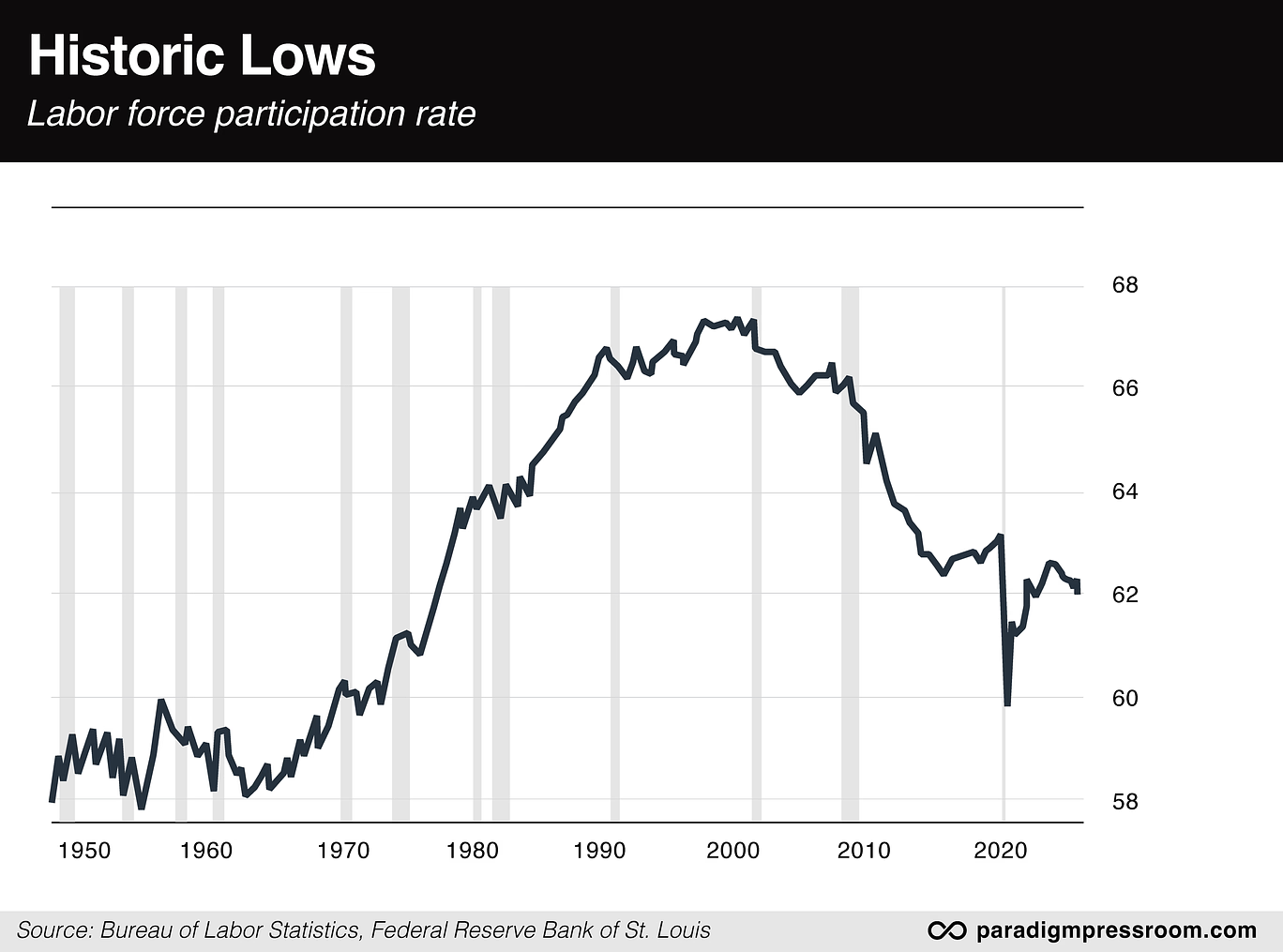
Leaving aside the pandemic plunge and recovery, the last time the number was this low was March 1977 — when women were still entering the workforce en masse, the first Rocky film was the big box-office draw and Barbra Streisand topped the charts with the love theme from A Star Is Born.
Mainstream explanations are wanting: Yes, growing numbers of boomers are aging out of the workforce. The crackdown on immigration might be a factor. Gig-economy workers might not be showing up in the figures.
But is that all? Seems like something else is going on, even if we can’t put a finger on it right now.
We’re going to keep a closer eye on this number in the monthly jobs report throughout 2026…
 Mailbag: Surrealism, Track Records, War Powers
“Surrealistic!” a reader says in response to the start of yesterday’s edition.
“Country Joe was, probably, either dead or dying as President Trump was at Dover, solemnly, receiving the remains of those valiant Americans.”
“I am not an active trader, thus only subscribe to Mason Sexton's trade recommendations for context,” a reader writes after Mason’s accurate call about the stock market’s recent wobble.
“I agree his approach is unique, but you should publish his results. I will bet he has one of the best records out there and he documents it very specifically including stops, timing, etc. This is a forever letter for me; I hope he stays healthy!”
Dave responds: He’s not going anywhere. Meanwhile, we’re working on ways to publicize portfolio performance without giving away valuable information that we want to limit to paying subscribers. Stay tuned…
“I've been reading your 5 Bullets about the so-called war,” says our final correspondent.
“When will Congress actually try to stop Trump or declare a real war? I would like to have those bridges, highways and other infrastructure upgraded.”
Dave: As mentioned on Friday, war powers resolutions failed narrowly in both the House and Senate last week. For all intents and purposes, Congress gave the White House a blank check.
When it comes to matters of war and peace, Congress is becoming as useless as the Roman Senate during the transition from republic to empire. And so it goes…


