
Iran: “Unthinkable Scenario”
 “Unthinkable Scenario”
 Did anyone else notice the strange and sad synchronicity to the weekend news flow?
Country Joe McDonald — who wrote the ’60s antiwar anthem “I-Feel-Like-I’m-Fixin’-to-Die Rag” — dies at the same time White House Press Secretary Karoline Leavitt refuses to rule out a return to the draft.
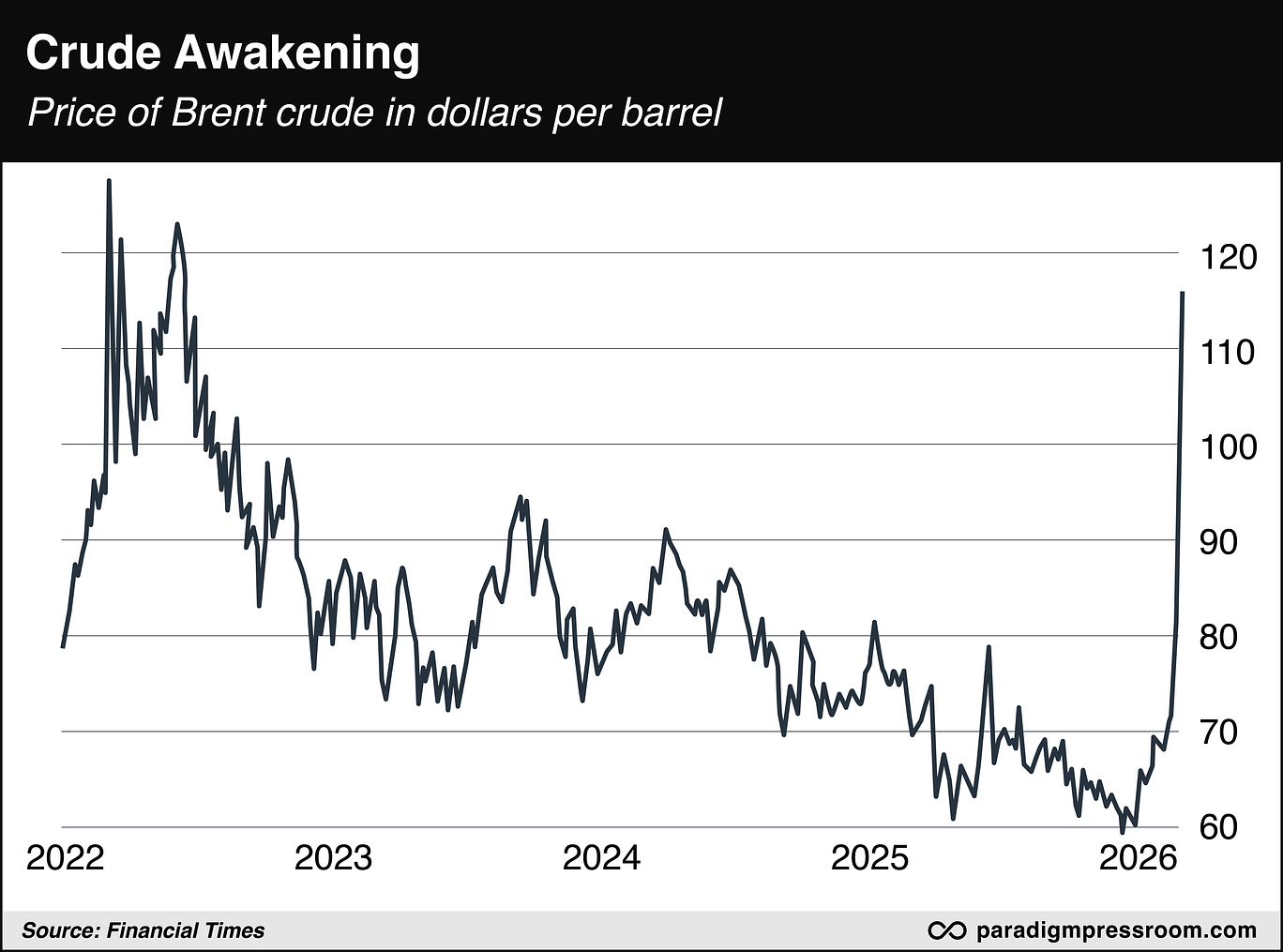
After the oil price zoomed from under $80 to over $90 on Friday… it zoomed further to nearly $120 when trading opened last night for a new week.
As we write, a barrel of West Texas Intermediate has pulled back to just under $100 — but that’s still the highest since 2022. Brent crude, the international benchmark, trades even higher.
The war entered a new phase over the weekend when Israel launched airstrikes targeting Iran’s oil industry…
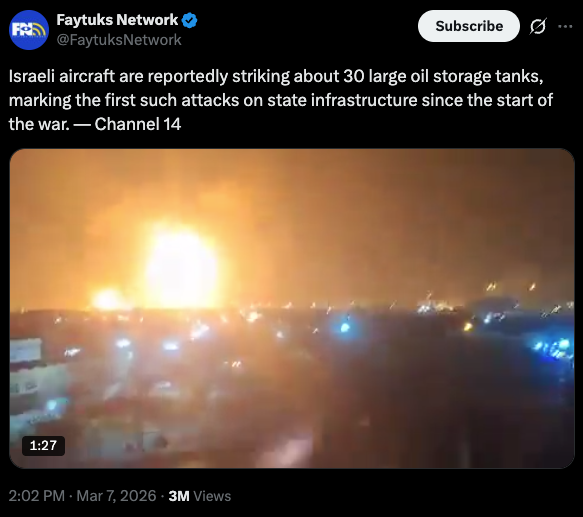
… raising the distinct possibility that Iran might respond in kind and target the oil industry of the U.S.-allied Gulf sheikdoms.
Meanwhile, Wall Street’s allegedly best and brightest continue to beclown themselves as they did last week.
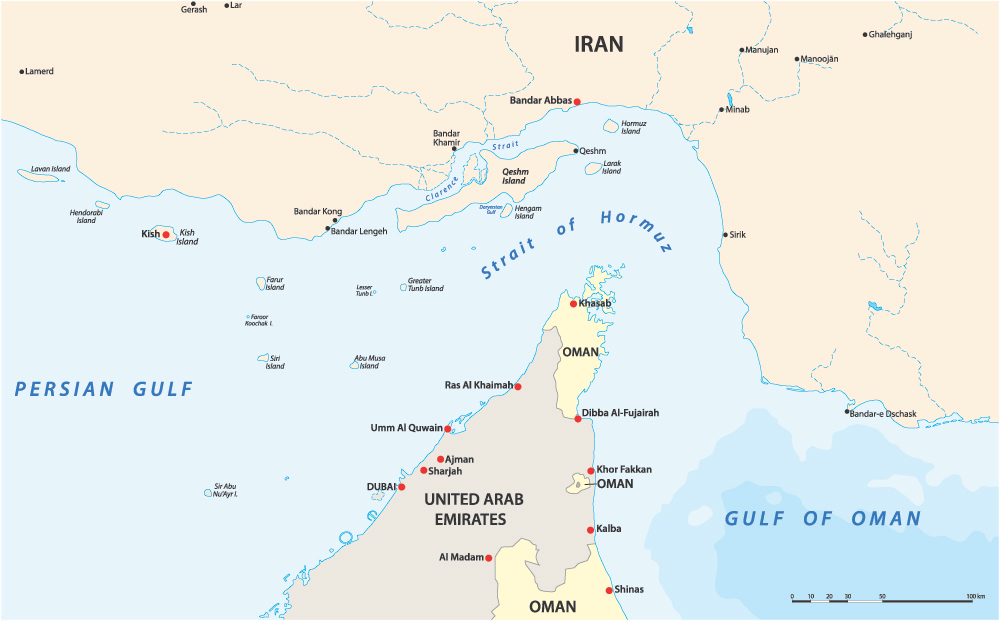
On a typical day, a quarter of the world’s oil trade transits a slender waterway off Iran called the Strait of Hormuz. These are not typical days: Tehran has effectively shut down the strait.
JPMorgan Chase analyst Natasha Kaneva on the front page of today’s Wall Street Journal: “To me, it was not just the worst-case scenario. It was an unthinkable scenario.”
Unthinkable? Jeez, talk about normalcy bias.
Hell, we were entertaining the probability in the autumn of 2023 — when rumors were rampant that the Biden administration would take a whack at Tehran.
And it’s not just a quarter of the world’s oil that transits the strait. So does…
- About 15% of the world’s refined diesel and jet fuel (which is why airline stocks are crashing)
- Roughly 20% of the world’s liquefied natural gas (which is why Europeans are so scared right now after their leaders already swore off Russian gas)
- About 35–40% of fertilizers (Gee, that won’t be a problem during planting season in the Northern Hemisphere, will it?)
- Over 40% of sulfur (used in everything from fertilizers to oil refining to mining to water treatment)
- And 10% or more of aluminum and iron ore.
But even among people for whom a closure of the strait was thinkable, there’s a lot of misunderstanding.
It’s not as if the Iranian military has to mine the Strait to make it impassible. It just has to position artillery on its side of the strait — enough to make shipping insurers blanch at issuing coverage to vessels hoping to steam through.
Which is exactly what’s happened in the last week. Lloyd’s of London — the go-to insurer — threw up its hands.
“Although insurance carriers offer ‘war risk’ coverage,” says Paradigm energy authority Byron King, “most of the world’s insurers all but stopped covering vessels. As in, policies are cancelled.
“So what do shipowners do? They radio the captains and tell them to anchor out and don’t transit Hormuz until the dust settles.
“Global oil markets took the news like a punch in the jaw from Mike Tyson. Buyers rushed in. Prices jumped. Tankers already carrying crude outside the Persian Gulf suddenly held much more valuable cargo. Traders scrambled, sending messages to redirect ships from one port to another.”
Supposedly the Trump administration is hatching a $20 billion scheme in which you, dear taxpayer, will provide the insurance. So far the details are hazy — including the criteria a vessel has to meet to be eligible for coverage.
“I've watched five attempts to modernize Lloyd’s of London since the 1990s get mired in resistance and inept implementation,” tweets veteran finance pro Kathleen Tyson. “Maritime insurance is a very complex, niche, specialist market…
“Lloyd’s of London is still preeminent because it's not an easy risk assessment and management business to model. The idea that Trump and his administration of Fox talking heads can replicate the Lloyd’s of London maritime insurance market to avoid an oil crisis is ridiculous.”
But won’t China suffer — because 45% of its oil imports pass through the strait? Not so fast...
“China is doing something nobody has done in the modern era. It is negotiating a bilateral safe passage arrangement for Chinese-owned vessels through a multilaterally closed waterway,” tweets analyst and author Shanaka Anslem Perera.
“AIS tracking data already shows at least one bulk carrier altering its destination signal to display CHINA OWNER’ while transiting the Omani coastal margin. Reuters confirmed back channel negotiations between Beijing and Tehran on March 5. Bloomberg reported the arrangement taking operational form by March 6.”
In exchange for safe passage, CNN reports that China is furnishing financial help, spare parts and missile components.
Who needs insurance with that kind of an arrangement?
“Iran is not ‘closing’ Hormuz. They are ‘gating’ it. Passage by express permission only,” tweets the military analyst Will Schryver.
“Raise your hand if you believe the U.S. will attempt to interdict oil shipments to China.”
 Software Rebound
What started as another rotten day for the U.S. stock market is now looking rather ordinary.
On top of Friday’s drubbing, the S&P 500 opened the day down nearly 1.4%... but at last check it’s recovered nearly all those losses: It’s just barely in the red at 6,731. The Nasdaq is up a quarter percent. The Dow is still struggling, though — down nearly two-thirds of a percent.
➢ Credit where it’s due: Mason Sexton, editor of The Map, warned that the market was in for a rough patch during a window from Feb. 20-March 7. Sure enough, the S&P 500 fell nearly 2.5% during that time to year-to-date lows. He told his readers to take profits this morning after shorting SPY, the S&P 500 ETF. Several 5 Bullets readers wrote in last month to take issue with the esoteric methods by which Mr. Sexton issued his forecast... but the results are the results.
Beneath the turbulent surface of the stock market’s waters in recent days… the beaten-up software stocks have staged a remarkable recovery.
The trouble began last month when a narrative took hold in the markets that AI was going to render obsolete the business models of software firms like Salesforce, ServiceNow and Intuit.
“Feels like a lifetime ago, but very quietly the software sector has posted a historic comeback,” Paradigm trading pro Enrique Abeyta says on the Paradigm mobile app.
Indeed, the iShares Expanded Tech-Software Sector ETF (IGV) defied the broad market’s volatility last week — jumping nearly 8%. Enrique said in this space on Feb. 4 that the sector was so bloodied that it looked like a screaming buy. [Readers of The Maverick profited big-time as a result — collecting 136% gains last week with call options on CrowdStrike Holdings.]
Enrique still sees upside in the software space: IGV is still slightly below its 50-day moving average. “We are STILL buyers,” he says this morning.
[Reminder: You can find dozens of insights like these throughout the trading week only on the Paradigm Press mobile app. If you haven’t downloaded it yet, you can do so right here.]
 Oil Miscellany
Before trading opened for a new week last night, the outfit that oversees futures trading took steps aimed at calming the markets.
CME Group raised the margin requirements on oil and oil products: Traders have to put up more cash to cover their leveraged positions.
At the same time, CME lowered the margin requirements on precious metals: Traders using leverage have to put up less cash than they did before.
“This looks like they are trying to let gold be a release valve of the coming oil inflation,” tweets the independent newsletter operator Luke Gromen.
“If so, this would be smart IMO, because if gold goes to $7,000, nothing happens… but if oil goes to $130, all hell breaks loose globally.”
As the day wears on, oil has sunk below $97 — still up 6.5% from Friday’s close. Gold is down $67 and barely holding onto the $5,100 level. Silver is slightly in the green at $84.50.
Then there’s the matter of whether the U.S. government is keeping its thumb on the scale of oil prices.
On Thursday, the Reuters newswire reported that the Treasury would attempt to intervene in the market for oil futures. Apparently that was a trial balloon floated by the Trump administration — which the administration then shot down on Friday via a Bloomberg article.
Both outlets portrayed such an intervention as novel. In reality, the U.S. government has been monkeying around in the oil markets ever since modern-day oil futures began trading in 1983. For all we know, interventions are underway regardless of what the corporate media report.
Thing is, most of the previous interventions came at a time oil flowed freely around the world — unlike now. As one market veteran put it on X, “There is no paper solution for a physical problem.”
 The Costs of War (Updated)
It seems the Iran War Cost Tracker — mentioned here last week — is lowballing its numbers.
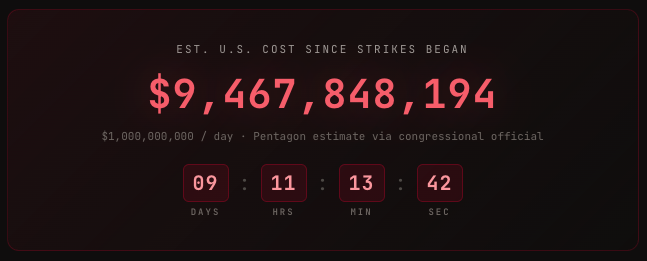
The current $9.5 billion cost to U.S. taxpayers is based on a Pentagon estimate of $1 billion a day, per journalist Nancy Youssef of The Atlantic.
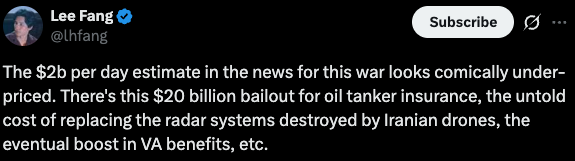
But no sooner did we publish that estimate on Friday than GOP lawmakers told Politico they were hearing figures from the Pentagon that were double — $2 billion a day.
And as independent journalist Lee Fang points out, that’s just the Pentagon’s operating costs
Not coincidentally, we’ve seen an old Donald Trump social media post from 2020 resurfacing in recent days: “We’ve spent $8 trillion in the Middle East and we’re not fixing our roads in this country? How stupid. How stupid is it? And we’re not fixing our highways, our tunnels, our bridges, our hospitals even, our schools even? It’s crazy.”
That $8 trillion figure, by the way, is dead-on balls accurate.
 Civil War (Continued)
On the subject of a prospective new American civil war, broached in last Thursday’s edition…
“Red versus blue: What never seems to get mentioned is most of the food is grown in the red counties. Most truck drivers are conservative libertarian leaning.
“The blue cities are going to run out of food in a few days. Complete civil unrest will begin almost immediately. Hard to fight when you are starving.
“This is not 1861. Are the blue counties dumb enough to start that fight? I doubt it. “
Along the same lines, a reader writes from north of the border…
“Great article. It really made me think. Readers also made good points. I hope it never comes to that.
“If, God forbid, it does, I could see it spreading to Canada, which would also have a rural/urban divide. In Canada the rural people would also be a well-armed militia. The urban left, not so much.
“I write to share an observation from the Commonwealth of Virginia,” says another correspondent.
“Our legislative bodies are currently in Richmond busy creating a new set of laws to add to the existing sets of laws for the clearly lawless public (why else would we need so many new laws each year?)
“This year brings a new set of lawmakers and a fresh — actually not, just regurgitated — set of firearms laws. If one looks closely at the sponsors of said ridiculousness, they are authored/sponsored by folks from the northern part of the state and not getting much support from the southern/western part of the state. This is not particularly new, just very apparent and concerning given the overall tenor.
“Just an observation.
“Keep up the good work and God bless! Thank you for writing on such a swath of things we should consider (though they may scare the hell out of us).”
Dave responds: I remember the last time (scroll down a bit) there was a legislative showdown over gun rights in Richmond. Mercifully, the provocateurs didn’t show up.
Yes, Northern Virginia versus the rest of the state is another intrastate conflict along with Chicago versus Downstate Illinois, Seattle/Portland versus the eastern portions of Washington/Oregon, etc. All worth watching…
Then again, maybe the conflict won’t neatly fit the red-blue divide as we presently know it.
There was an interesting reply to the tweet with which we kicked off today’s edition.
“Will ‘Make Draft Riots Great Again’ fit on a hat?”
For as long as I’ve been writing about a new American civil war — nearly a decade now — I’ve been stuck on the question of what would be the defining issue of such a conflict.
What would be the issue tantamount to the abolition of chattel slavery or independence from Great Britain? (The historian Michael Vlahos reminds us the American Revolution was very much a civil war.)
For all the trouble in Minnesota during January, it doesn’t seem as if the conduct of ICE agents will rise to that level.
But resistance to a draft for a profoundly unpopular war? Maybe…
Back in 2019 I spun a vivid scenario in which resistance to American interventions overseas resulted in armed confrontation on the home front — and that was without a draft. It’s worth a revisit if you’ve got the time: Obviously the picture I painted for the year 2023 did not come about, but It wasn’t a prediction as much as a thought experiment.
Already in the present moment we’re seeing anecdotes on social media about National Guardsmen who would ordinarily have zero interest in smoking cannabis… who nonetheless are partaking of the herb just to get kicked out.
And with something like this going around in the conservative pockets of the meme-o-sphere?

Interesting times these are…


