
Rush for the Exits
 Rush For the Exits
 “There’s a massive financial crisis heading our way, and it has nothing to do with Iran,” says Paradigm’s macroeconomics maven Jim Rickards.
We first alerted you to this looming crisis six months ago – when the auto parts maker First Brands Group filed for bankruptcy.
First Brands financed its operations through the “private credit” market — loans that were once the province of banks but are now dominated by players like Blackstone, Apollo and KKR.
“Private credit funds are a $2.5–$4 trillion market in loans to companies that offer financing for software start-ups, subprime auto loans, tech equipment and more,” Jim explained this week to Strategic Intelligence readers.
“Even a 20% loss rate, which some analysts project, could translate to almost $1 trillion in losses.
“The subprime mortgage meltdown in 2008, if you recall, involved about $1 trillion in subprime loans. The S&L crisis of the 1980s involved about $800 billion of bad commercial real estate loans. Today’s private credit crisis could be even worse and it’s just getting started.”
Yesterday, Blue Owl Capital – which is quickly becoming the poster child for this phenomenon – disclosed that its investors asked to pull $5.4 billion from a pair of Blue Owl funds during the first quarter. “The redemption requests amounted to 22% of its $36 billion private-credit fund and 41% of a technology-focused fund,” says The Wall Street Journal.
A few weeks ago, Blue Owl told some of its investors they would not be allowed to withdraw their money on demand. They’d get their money back on Blue Owl’s schedule, once Blue Owl sold off assets to raise cash.
This week also brought less dire but still concerning disclosures from Apollo, Blackstone, BlackRock and Cliffwater.
So… once the losses materialize, who will eat them?
The losses “begin with fund investors,” Jim continues. “Then they move to managers, whose fees shrink as net asset values fall. But they do not stop there.
“These vehicles often rely on leverage — secured loans, warehouse lines and other funding facilities provided by banks. When collateral values weaken and borrowers cannot refinance, losses move from the funds to the lenders.
“Moody’s now estimates bank exposure to private credit may be $300 billion in direct lending to providers, $285 billion in lending to funds plus $340 billion in unutilized bank lending commitments. That’s a total of $925 billion in direct credit exposure to the private credit sector.”
And while the big banks no longer do much lending to private business, they do lend to the private credit lenders. Wells Fargo has by far the most exposure ($60 billion) with Bank of America in second place ($33 billion) and the other major players not far behind.
“In my experience, financial crises are rarely the product of one shock alone,” says Jim.
“They come when several stresses that seem separate suddenly converge. Those events may not be correlated when the economy is steady, but they become correlated in a crisis. This is known as conditional correlation.
“It’s what happened when the Russian credit failure landed in the lap of Long-Term Capital Management in 1998. And it’s happening again as the software-stock implosion, Iran war and the prime-credit meltdown start to feed off each other.
“For reference, if one compares this to the global financial crisis (2007–2009), we’re closer to the Bear Stearns credit-fund stage (July 2007).”
In other words, the “Lehman moment” (September 2008) might still be more than a year away.
Consider yourself on notice. And of course, we’ll stay on top of the situation, seeking profit opportunities along the way. (Some of our readers bagged 462% gains with Lehman put options in the summer of 2008).
We’ve been a good three months ahead of the mainstream on the private credit car wreck – and we aim to keep that leg up.
 While the Markets are Closed…
With the markets closed for Good Friday, there’s a lot going on that markets can’t react to…
For one thing, an American F-15E has been shot down near the Iran-Iraq border – no word yet on the fate of the crew at last check. Going into the three-day weekend, oil closed last night over $112 – the highest close since 2022.
For another thing, after the market closed yesterday the Trump administration announced a wicked-complicated new tariff scheme for pharmaceuticals. The tariff rate could be as high as 100%, but there’s a host of carve-outs.
For a third thing, the wonks at the Bureau of Labor Statistics delivered the March jobs report this morning.
They conjured 178,000 new jobs for the month – way more than Wall Street economists were expecting, and more than enough to offset February’s losses. The official unemployment rate ticked down to 4.3%.
Whatever. These numbers are so manipulated and noisy that we try to find a lodestar in figures that the statisticians can’t game.
With that in mind, the labor force participation rate – the percentage of the over-16 population that’s either working or looking for work – was 61.9% last month. That’s down from 62.5% a year earlier. Aside from the pandemic plunge and recovery, the last time the number was this low was early 1977 – when women were still entering the workforce en masse.
And there was this tidbit from the jobs report…
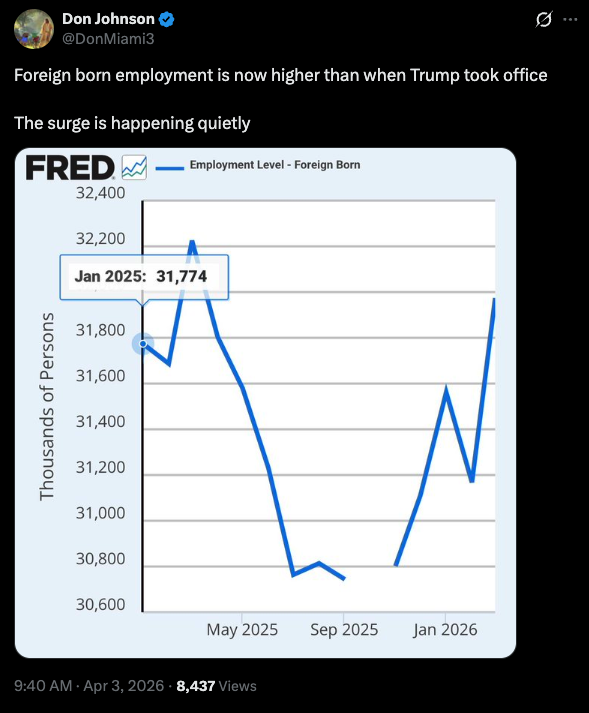
The report also shows that federal government employment is now down 11.8% from its peak in October 2024.
If only declining federal payrolls translated to lower federal spending and a less intrusive federal government…
 Iran’s New Tollbooth
The Strait of Hormuz is slowly reopening “under new management.”
Just in from Bloomberg this morning: “A container ship signaling French ownership has exited the Strait of Hormuz, in what appears to be the first known transit by a vessel linked to Western Europe since the Iran war all but shuttered the vital waterway.”
No comment from the French government, or from the ship’s owner CMA CGM – the world’s third-biggest container line.
As we try to mention every time the subject comes up, Iran hasn’t closed the Strait of Hormuz. Instead, it’s enforcing a selective blockade whereas before the war ships could transit freely.
Tehran has more or less set up a tollbooth.
“Iran's Islamic Revolutionary Guard Corps is exerting control over shipping through the Strait of Hormuz, extracting tolls from vessels passing through and giving preferential treatment to ships from countries it deems friendly,” said an earlier Bloomberg dispatch this week.
“Ship operators have to contact an intermediary company linked to the IRGC and provide information about their vessel to negotiate a toll, which typically starts at around $1 per barrel of oil, and receive a permit code and route instructions to safely pass through the strait.”
With oil trading well north of $100 a barrel, a $1-per-barrel fee seems modest.
To be sure, traffic through the strait is still a trickle relative to what it was pre-war. But as we prepare to hit “send” on this edition, a Japanese vessel has transited the strait along with the French one mentioned a moment ago.
What fee are they paying? And in what currency?
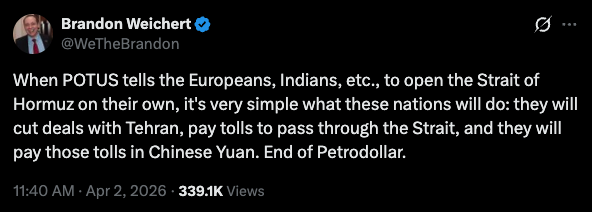
But that’s a story for another day…
 Comic Relief
Note well: The following was posted nearly a month ago and became newly relevant yesterday.
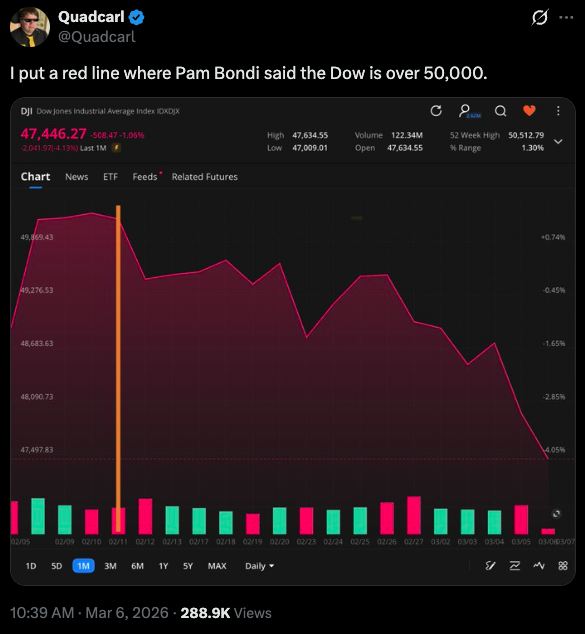
And the Dow has shed another 1,000 points since…
 Mailbag: Alex Jones?!
Yesterday’s edition prompted the following reader feedback…
“I realize that you have a point of view about the war. I respectfully disagree with it. But citing Alex Jones as an example of a pundit souring on the President is laughable.
“What’s next – observing that Trump has lost the Nick Fuentes wing of the MAGA movement, all three dozen of them?”
Dave responds: On the contrary, Jones has immense value as a weathervane.
I’ve never followed him very closely, but he’s been on my radar for a long time. I can remember when it was easier to hear him on a shortwave radio than on a laggy dial-up internet connection.
Key point: He’s never really had a fixed set of beliefs. In his earlier years, for example, he aligned with the “Cop Block” movement, frequently denouncing the excesses of militarized law enforcement. Then he flip-flopped in 2014 during the riots in Ferguson, Missouri – when he figured he could get more clicks and engagement by saying that policing has never been more dangerous, yada yada.
So for him to be turning on Trump now? Yeah, it’s an interesting signpost.
But never mind a crank like Jones or a white nationalist like Fuentes. Pretty much the entire universe of “podcast bros” who put Trump over the top with younger male voters in 2024 has turned on him…
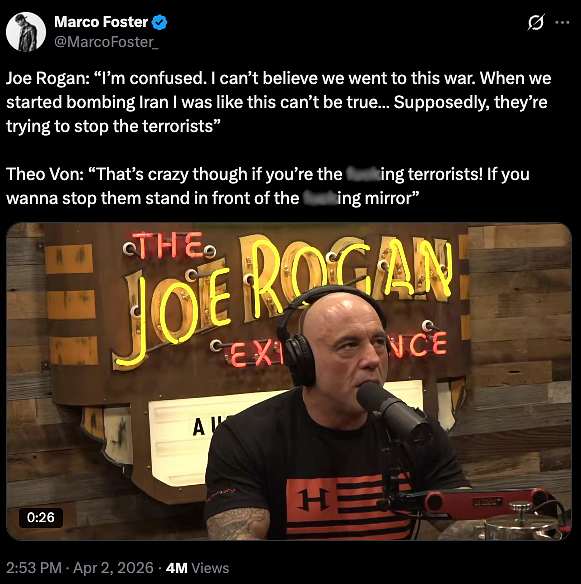
…excepting, of course, the execrable Dan Bongino.
The financial newsletter business has always been about tackling ideas that challenge conventional wisdom – even if, now and then, it means taking readers out of their own comfort zone.
If in the present moment that means piercing the boomercons’ Hannitized echo chamber… so be it.
Better that you learn about this now than wonder next November why throngs of under-50s who voted for Trump in 2024 sat on their hands in the ‘26 midterms.


