PLTR Wants Your Son
 PLTR Wants Your Son
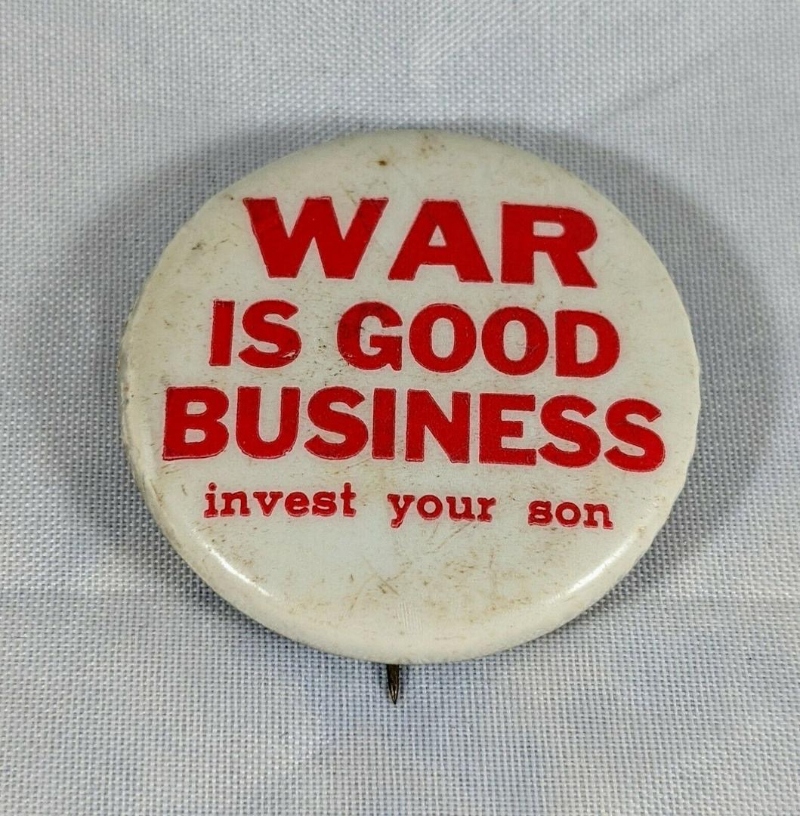
 “War is good business — invest your son.”
It was an anti-war expression. It gained currency in the 1960s as growing numbers of young American men were drafted for service in Vietnam.
 |
 |
The writer and activist Allen Ginsberg drew on it for a collection of poetry published in 1972. The following year, as U.S. intervention in Vietnam was winding down, President Richard Nixon did away with the draft.
Ginsberg was a figure of the left. But a few years later, Ronald Reagan approached the question from the right side of the spectrum — and ended up in more or less the same place.
The draft “rests on the assumption that your kids belong to the state,” Reagan wrote in a 1979 newspaper column.
“If we buy that assumption, then it is for the state — not for parents, the community, the religious institutions or teachers — to decide who shall have what values and who shall do what work, when, where and how in our society.
“That assumption isn’t a new one. The Nazis thought it was a great idea.”
The following year, after the Soviets invaded Afghanistan, President Jimmy Carter reinstated draft registration.
Alas, once Reagan became president he caved to the deep state — and “selective service” registration has been the law of the land ever since.
War is very good business for Palantir Technologies (PLTR) — and it wants more. Including, it seems, your son.
“Palantir, a company that has feasted off of wars in the Middle East, supplying AI-powered kill-chain data to Israel in Gaza, the U.S./Israel in Iran and the Ukrainian armed forces against Russia, is in this business for the long run and it’s in this company’s interests to have more wars involving its main clients,” says a Substack post this week by the author Leo Hohmann.
Last weekend, Palantir’s X account posted a sweeping 22-point plan for how the company wishes to reorder society. It’s adapted from a book published last year by Palantir’s co-founder and CEO, the billionaire Alex Karp.
The post went viral. Point No. 6 got the most attention: “National service should be a universal duty. We should, as a society, seriously consider moving away from an all-volunteer force and only fight the next war if everyone shares in the risk and the cost.”
(We’ll spare you the suspense. Karp himself has never served.)
Point No. 6 dovetails with Point No. 1 — which says Big Tech should also be conscripted to serve the interests of the state: “Silicon Valley owes a moral debt to the country that made its rise possible. The engineering elite of Silicon Valley has an affirmative obligation to participate in the defense of the nation.”
Huh? What?! Palantir owes its entire existence to a hand-in-glove relationship with the national security state.
Palantir’s founders — including Karp and Peter Thiel — launched the firm in 2003, knowing that a post-9/11 U.S. government was obsessed with surveillance.
They took seed money from In-Q-Tel, the CIA’s venture capital arm. For the first several years of the company’s existence, the CIA was Palantir’s only client. The online muckraker Whitney Webb makes a convincing case that Palantir’s sole reason for being was to give the feds cover to do things that the Constitution forbids the feds to do themselves.
Remember the creepy “Total Information Awareness” surveillance program launched about 18 months after the 9/11 attacks? Civil liberties activists objected loudly enough that the feds shut it down — only to put many of its operations under PLTR’s auspices.
Fast-forward a generation — and Palantir’s powerful surveillance tools might be the key to implementing a return to the draft after 53 years.
On the basis of an executive order signed by Donald Trump in March 2025, the administration is increasingly turning to Palantir to make it easier for federal agencies to share data with each other. The New York Times speculated whether Trump “might compile a master list of personal information on Americans that could give him untold surveillance power.”
Americans across the political spectrum were waking up to the power Palantir seems to wield no matter who occupies the Oval Office. (Karp himself is a longtime Democratic donor who did a heel turn early last year.)
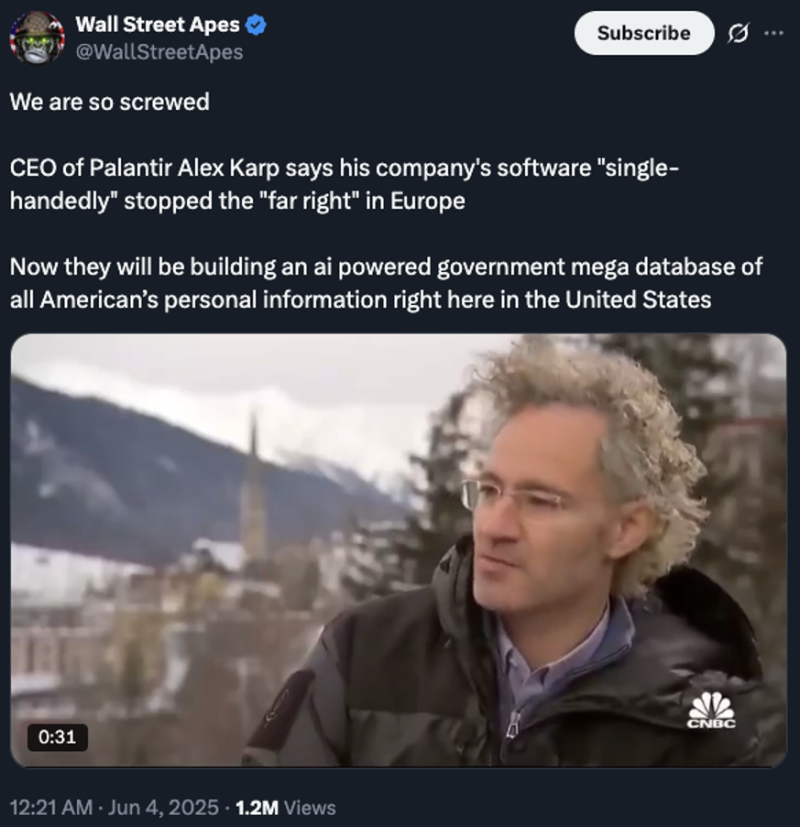
By June, Karp felt compelled to go on CNBC to declare his company is “not surveilling Americans” at all. PLTR shares tanked 7.8% that day.
Then in December, Congress tacked on a new provision to its big annual military-spending bill — aimed at boosting compliance with the selective-service registration requirements imposed by Jimmy Carter in 1980.
Young men ages 18–26 are supposed to not only register — but also notify the Selective Service System every time they change address. Compliance rates under the system have been notoriously poor. In 2019 the former SSS director told Congress the database was so incomplete and inaccurate that it would be “less than useless” should a draft be implemented.
To address these issues, the revamped law authorizes SSS to cross-reference with the databases of the IRS, Social Security and other federal agencies — registering young men automatically.
A few years ago, this might have been no big deal: Federal databases are notoriously inefficient, error-prone and incapable of communicating with each other.
But if anyone has the tools to address those issues… it’s Palantir.
Under the new law, automatic draft registration comes into effect next December. It’s not a stretch to think Palantir is building out the systems now.
Draft opponents are mobilizing — a coalition of 40 groups ranging from Code Pink to the Ron Paul Institute, according to a recent New York Post article.
But they have an uphill climb — especially when White House press secretary Karoline Leavitt, asked at the outset of the Iran war about a revival of the draft, refused to rule it out.
Stay tuned…
 Markets Today: Oil, Tesla, Weed
In the absence of major developments in the Iran war’s new and indefinite low-grade phase, the paper price of oil is creeping still higher.
At last check a barrel of West Texas Intermediate is up nearly 1.5% to $94.32, the highest in a week.
The most significant and least-publicized development of the last 24 hours is this: Indonesia’s finance minister floated the idea of charging tolls for passage through the Strait of Malacca — another major “chokepoint” for global shipping like the Strait of Hormuz.
He walked back the remark later, but no matter: Iran could be setting a precedent for how goods move around the world on the water.
Yes, the Strait of Hormuz is still closed — or to be precise, subject to a selective blockade by Tehran. “We're close to shutting down the global industrial economy,” warns our macro maven Jim Rickards.
But first come the price increases: “They’re about to kick us into something that makes the Biden-era inflation look tame if this lasts another two–three weeks,” tweets Don Johnson, chief economist at the MacroEdge research firm.
“People need to stop approaching the current environment with 'we're in a stable price environment' — we're shifting toward a third-world-style market where markets crashing up aren't necessarily a positive thing.”
Speaking of markets crashing up: At 7,133 the S&P 500 is down microscopically from yesterday’s record close. The Dow is down about a quarter percent, the Nasdaq about a third of a percent.
Big movers include Tesla, down nearly 3% despite reporting year-over-year improvements on both revenue and earnings.
Cannabis stocks are pulling back after a big ramp-up yesterday: The Justice Department is reclassifying marijuana from “Schedule I” — on par with LSD and heroin — to “Schedule III,” comparable to Tylenol with codeine.
Near as we can tell, the move still won’t give the industry access to the banking system. For the foreseeable future, weed remains a cash-only business.
Gold is still trying to get its bearings after Tuesday’s beatdown, the bid now $4,734. Silver’s getting whacked again, down $1.27 to $76.30. Crypto is pulling back — Bitcoin at $73,364 and Ethereum at $2,331.
 The Business of AI Just Changed Dramatically
Here’s the story about the new “killer AI” put out by Anthropic that you haven’t heard about.
As you might be aware, Anthropic — the company behind the Claude AI engine — recently announced a new model called Mythos. According to the company, Mythos is so powerful that it unearthed “high-severity vulnerabilities” in “every major operating system and web browser.”
For that reason, Anthropic is not releasing Mythos to the public — only to about 40 big companies like Apple, Amazon and JPMorgan Chase. They’re getting early access to find security holes in their systems — and presumably patch them faster than hackers can exploit them.
At least that’s the official explanation — and for all we know, it’s true.
“But there's another reason nobody at Anthropic is saying out loud,” according to Paradigm AI authority James Altucher.
OK, let’s backtrack a bit. Remember early last year, when the Chinese AI model DeepSeek scared the bejeezus out of the U.S. tech industry? It was touted as more capable than ChatGPT, and achieved at a fraction of the costs shelled out by the likes of OpenAI and Google.
OpenAI accused DeepSeek of “distilling” OpenAI’s own work. Distillation is a process described last year by White House AI czar David Sacks like this — “one model learns from another model [and] kind of sucks the knowledge out of the parent model.”
So here’s the thing about Mythos’ limited release: “You can't distill a model you can't access in the first place,” says James Altucher.
Mythos might be the first limited release of its kind, but James says it won’t be the last.
“I keep thinking about where this goes from here, because it's not going to get looser. It's going to get tighter.
“Enterprise customers first, then verified users in developed countries, then a much harder question about what happens everywhere else. Identity verification is hardest in places where institutions are weakest.
“Researchers and developers in parts of South America, Africa and Asia are eventually going to find themselves locked out of tools they've been building on for years — not because anyone targeted them specifically, but because the wall went up and they happened to be on the wrong side of it.”
The more that Anthropic and OpenAI and Google go down this road, the more it opens the door to decentralized AI networks — the kind where James says “anyone can access its models without an enterprise contract, a government ID or an identity check of any kind.
“For years, that openness was a nice feature nobody urgently needed — because the best models were available to almost anyone who wanted them.”
Soon the need will become urgent. “Think about the researcher in Brazil who built her entire workflow around Claude's most capable models and loses access because Anthropic can't verify her identity through local institutions.
“Or the developer in Nigeria who has been using the OpenAI API for two years and suddenly can't clear the new requirements.”
Decentralized AI models aren’t some pie-in-the-sky future thing. James has already clued in members of Altucher’s Investment Network to a model they can invest in via the crypto market.Not a member yet? Altucher’s Investment Network is the best $50 you can spend for an introduction to the world of AI and crypto and all things tech. Access here.
 Compliance With the Law Is Not Enough
The IRS just won a big court battle — and for American business, compliance with tax law may never be the same.
The story goes back to the Trump tax cuts of 2017 — and a change to the way foreign earnings are taxed. As The Wall Street Journal explains it, “The law left a gap where companies could claim a new deduction for certain foreign profits without paying other taxes that were supposed to apply.”
The telecom firm Liberty Global (LBTYA) — its controlling shareholder is the media mogul John Malone — seized on this change. It executed a complex series of transactions it called “Project Soy” — at the end of which it sued the IRS for a $110 million refund.
The IRS balked, citing something called “economic substance” doctrine. Under this concept, businesses can’t resort to tax-reducing steps unless they have a “substantial business purpose.” The IRS has been aggressively applying this doctrine during audits for over 15 years.
On Tuesday, in a 2-1 decision, a federal appeals panel in Denver upheld a lower-court ruling that sided with the IRS and against Liberty Global.
In an opinion written by Judge Michael Murphy, a Clinton appointee, the majority ruled that economic substance doctrine “is relevant to attempts by taxpayers to mechanically utilize the provisions of the Tax Code to obtain a benefit not intended by Congress,” wrote Judge Michael Murphy, a Clinton appointee. “That is exactly what [Liberty Global] did with Project Soy.”
Let’s put that in plain English: You can comply with the letter of the law — but if the IRS decides that your compliance is intended to reduce your tax liability, you’re still hosed.
Two relevant quotes from the Journal piece: “This case is about whether compliance with the literal words of the tax law is sufficient to uphold artificial transactions that have no purpose other than tax minimization,” says University of Michigan law professor Reuven Avi-Yonah. “The court answered with a resounding no, dealing a blow to renewed efforts by large corporate taxpayers to use artificial tax maneuvers to shelter their profits.”
And this: “It’s going to be hard for taxpayers going forward to know what the rules are beforehand,” says Tyler Martinez of the National Taxpayers Union Foundation. “‘I know it when I see it’ isn’t viable in tax law.”
A Liberty Global spokeswoman says the firm is “evaluating options for next steps.” If it doesn’t fold, the most likely next step is to ask for a review by the full federal appeals court in Denver.
 Comic Relief
Yeah, YouTube probably wants this one back…