
Is AI Suddenly Doomed?
 Is AI Suddenly Doomed?
 Suddenly, AI stocks are falling out of bed.
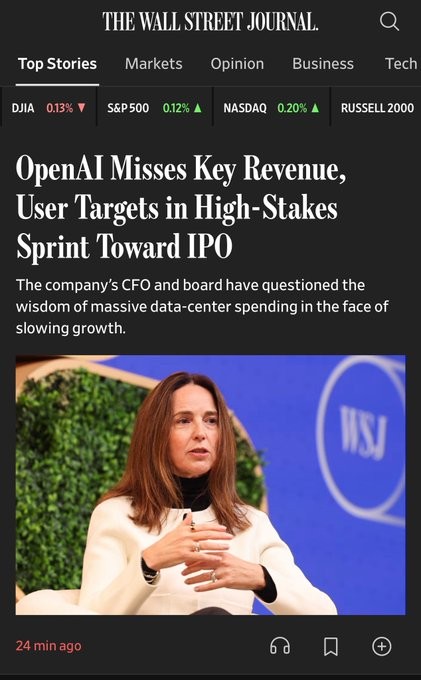
Early this morning, The Wall Street Journal posted a story that begins thus: “OpenAI recently missed its own targets for new users and revenue, stumbles that have raised concern among some company leaders about whether it will be able to support its massive spending on data centers.”
The story cites the usual “people familiar with the matter” as saying OpenAI’s board is questioning CEO Sam Altman’s efforts “to secure even more computing power despite the business slowdown.” In addition, CFO Sarah Friar is supposedly worried “the company might not be able to pay for future computing contracts if revenue doesn’t grow fast enough.”
Because OpenAI is not (yet) a public company, there aren’t any numbers to go on. We’re taking everyone at their word here — the Journal, the Journal’s sources and OpenAI’s C-suite.
To its credit the Journal put a denial by Altman and Friar in the fifth paragraph. “We are totally aligned on buying as much compute as we can and working hard on it together every day,” says a joint statement that calls the article’s premise “ridiculous.”
For the moment, the market attributes more credibility to the Journal’s sources than to Altman and Friar.
Publicly traded companies adjacent to OpenAI are getting smoked today — Oracle down 4.3% as we write, CoreWeave down 5.7%, Nvidia down 3.5% after touching an all-time high yesterday.
That’s dragging down the Nasdaq as a whole. At 24,552 the index is down 1.3% from yesterday’s record high. Ditto the S&P 500, down nearly three quarters of a percent from yesterday’s all-time high, 7,123 at last check.
The price action is giving Paradigm’s AI authority James Altucher a sense of deja vu.
He recalls only last month when Google announced it had developed software to make memory more efficient. The memory stocks like Micron (MU) and Astera (ALAB) took a 20–30% hit.
“I recommended MU and ALAB then,” says James — “and they are both up significantly since then (MU from about 300 to over 500, for instance).
“Similarly, I'd scoop up your favorite AI stocks at bargain prices that are being created today.”
There’s an undeniable tailwind, he says: About 86% of organizations plan to grow their AI budgets this year — and 40% expect growth of 10% or more.
Don’t shed a tear for OpenAI, says James: He points out Google’s Gemini AI platform has doubled its number of users in a little over a year — from 400 million to over 800 million now.
“Even if OpenAI ‘missed’ (they are at 800 million users versus the billion they expected at this time), AI spending and growth is up on every possible metric.
“Spending on AI is not slowing down,” he concludes. “The media, as usual, is getting it wrong.”
Speaking of questionable media narratives…
 Is Iran Suddenly Doomed?
The narrative of the week is that Iran has only days before its oil industry is wrecked for good.
That is, the U.S. blockade of Iranian ports means that Iranian crude has nowhere to go. Once all its storage is full, production has to shut down — causing damage to oil wells that might be irreparable.
Sounds serious, right? It started yesterday with a rather inelegant tweet from the U.S. Treasury secretary…
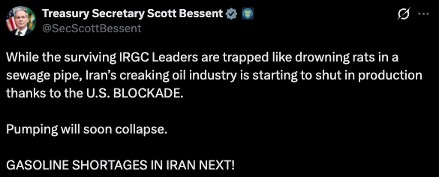
From there it was stovepiped through hawkish think tanks like the Foundation for Defense of Democracies and United Against Nuclear Iran.
Then it landed on the front page of today’s Wall Street Journal…
Iran is scrambling to find new ways to store its oil, hoping to avoid a crippling production shutdown as a U.S. naval blockade bottles up its exports and negotiations to end the war remain deadlocked.
With oil backing up at home, Iran is reviving derelict sites known as “junk storage,” using improvised containers and trying to ship crude by rail to China.
And on Bloomberg’s homepage…
Tankers laden with Iranian oil are clustering off Chabahar, a port in Iran that’s outside the Persian Gulf but just shy of the U.S. blockade line.
Around six to eight supertankers were idling in waters near the port in the Gulf of Oman late last week, according to satellite images and analyses from United Against Nuclear Iran and maritime intelligence firm Windward, with more smaller tankers nearby.
Another Bloomberg story published yesterday put a date on the phenomenon: Iran would reach the point of no return sometime between May 9–18.
More objective observers, patiently examining the evidence and presenting their findings on social media, are reaching a different conclusion.
They’re looking at satellite imagery of still-empty VLCCs, or very large crude carriers, bottled up in the Persian Gulf. They figure Iran can go another two months without cutting production.
Besides, when it comes to cutting production out of necessity, this isn’t Iran’s first rodeo…
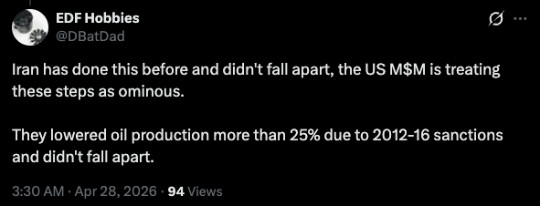
Two months is a long time. It almost gets us to Independence Day weekend — at which time U.S. gasoline prices would be… what?
Two months is longer than the “election math” in the United States probably allows.
Check back with us between May 9–18 and we’ll see who turns out to be right.
In the meantime, U.S. oil futures have sailed up to their highest level in over two weeks.
A barrel of West Texas Intermediate traded as high as $101.50 around 8:00 a.m. EDT… although it’s since pulled back below $100.
Aside from the possibility of a return to a shooting war in the Persian Gulf after a three-week pause, the big story today is the United Arab Emirates announcing it’s pulling out of the OPEC cartel.
The UAE is OPEC’s No. 3 producer — and its government strenuously denies that the decision has anything to do with frustration over years of production cuts spearheaded by its frenemies in Saudi Arabia.
“This has nothing to do with any of our brothers or friends within the group,” UAE Energy Minister Suhail Al Mazrouei tells CNBC. “We’ve been working together for years and years. We have the highest respect for the Saudis for leading OPEC.”
More believable is his claim about the timing: “It will have a minimum impact on the price and it will have a minimum impact on our friends at OPEC and OPEC+.”
Elsewhere in the commodity complex, oil’s gains are translating to precious metals’ losses.
Gold is down over $100 at last check to $4,578 — approaching the lows of a month ago. Chart-watchers think $4,100 is still a distinct possibility as the Midas metal continues to consolidate after the dizzying heights of late January.
Silver, meanwhile, sits at three week lows — a hair below $73.
The risk-off atmosphere is spilling into crypto — Bitcoin back under $76,000 and Ethereum below $2,300.
 Elon: Paid in Planets
“When was the last time a CEO got paid in planets?” asks Paradigm tech-investing specialist Ray Blanco.
“This morning,” he tells us, “Reuters got hold of excerpts from SpaceX's confidential S-1 — the registration statement that goes public next month. Buried in there is Elon Musk's compensation plan.
“It's not a salary. It's a charter.
“200 million super-voting shares unlock only if SpaceX hits a $7.5 trillion market cap and Elon plants a permanent human colony on Mars with at least 1 million people.
“Do the math at $7.5 trillion and that single tranche is worth roughly $340 billion.
“That's not Musk's salary. That's the unlock on one milestone. Hit it, and Elon doesn't just become a trillionaire.
“He practically becomes the King of Mars.”
Ray directs your attention to historical examples: “In 1670, King Charles II handed the Hudson's Bay Company a royal charter granting it dominion over 1.5 million square miles of North America. Sovereignty. Trade rights. Governance.
“The Dutch East India Company got something similar over Asia. So did the British East India Company over India.
“Empire-building moments in human history that started with a charter that handed a private company the keys to a territory.
“The SpaceX board just wrote one for Mars.”
Much more to say in the run-up to SpaceX’s IPO this summer. Stay tuned.
[Friendly reminder: Ray posted these musings a short time ago on the Daily Feed section of the Paradigm Press mobile app. The Daily feed delivers instant insights like these that frequently don’t get published anywhere else.
What’s more, the app is the easiest way to keep track of the buy and sell alerts of your paid publications — no sifting through email. Subscribers like you rave about the simplicity of the app. Download here.]
 Final Vinyl
“Vinyl album sales in the United States increased for the 19th consecutive year in 2025,” say the folks at Statista.
Figures from the Recording Industry Association of America show that sales bottomed in 2006 at less than one million. Last year’s total was 46.8 million — both EPs and LPs.
The last time the number was anywhere near this high was 1988, six years after the introduction of the CD.
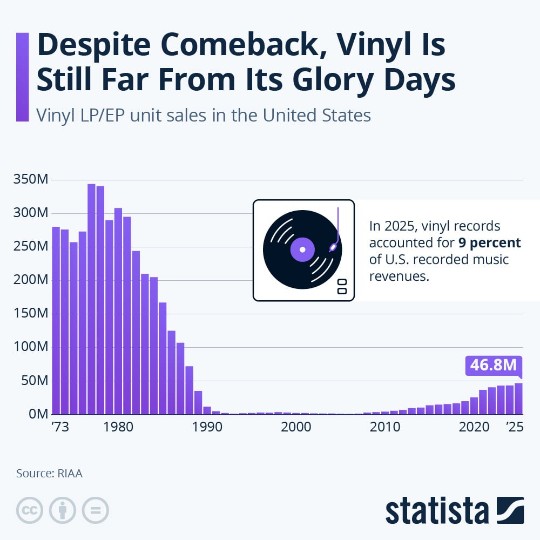
“Physical goods, it appears, still hold value for many people, even in the digital age,” writes Statista’s Felix Richter.
That’s even if the goods go unused, serving as collectors’ items only; figures from Luminate say only 50% of vinyl buyers own a turntable.
It stands to reason. The vinyl revival seems driven mostly by younger folks who grew up on crappy compressed digital audio — MP3 downloads at the start, streaming audio now. They don’t know any better and they’re content to listen to vinyl records on some $50 Chinese-made “Victrola.”
Oldsters know that serious vinyl listening is a costly endeavor. The turntable, the tonearm, the cartridge (preferably from separate manufacturers), a quality record cleaning machine like the Nitty Gritty — too much for your budget-audiophile GenX editor!
 Mailbag: PLTR Wants Your Son
Last week’s exploration of Palantir and its advocacy for a return to the draft prompted the following reader reflection…
“For many years now, I’ve been thinking about the all-volunteer Army, especially after visiting South Korea.
“When I was there in the early 2000s I was told that ‘when Korean men are 15 or 16 they would protest the army and then when they came of age, they had to spend a couple of years in the army, keeping protesters in check. That service would mature them, teach them self-discipline and make them better suited to survive as civilians.
“Looking at our young ‘soyboy men’ today who seem to lack purpose, self-discipline and motivation, I wondered if a couple of years of military service might do them some good.
“In addition to that, it would provide job training and reduce unemployment (especially in the inner cities, where it is most needed). It could be mandatory service in the National Guard at age 18 instead of the ‘real Army,’ and then for those who liked military life (or had few job prospects at home) they could enlist in the real Army at age 20. Or use their newly acquired skills to find a job.
“Or they could go to college a bit more mature and disciplined, ready to learn rather than just party. The program could possibly be designed to address the college debt issue as well.
“This has nothing to do with a ‘warmonger’ attitude but more looking at how ‘men’ are turning out since we instituted the all-volunteer Army.
“I haven’t yet considered how this would apply to young women, never having been one. But a properly designed program might do them some good as well.
“I always appreciate your thought-provoking commentary even when I disagree.”
Dave responds: Thanks for writing. A few thoughts…
South Korea in the early 2000s was barely 15 years removed from military dictatorship. As admirable as its rise to a first-world democracy has been… is it a model to follow?
Here in the United States, men were men and we got along just fine without a peacetime draft until the late 1940s — when the “wise men” surrounding President Truman decided we should become a nation permanently mobilized for war.
So that suggests the problem now lies in society at large.
I get where you’re coming from… but I don’t share your confidence the military can credibly take on a social engineering project and step in where the culture has failed.
The culture needs to heal on its own. No, I have no idea how that would come about!


