
Iran: The Only Thing That Matters Now
 Iran: The Only Thing That Matters Now
 So… the war did not resume over the weekend, despite the massing of U.S. military assets in the Middle East at levels unseen in over two decades.
The ceasefire has held, more or less, since April 8.
In recent days, Paradigm’s macroeconomics authority Jim Rickards has pounded away at a single theme across his publications.
“It’s critical to separate the geopolitical noise and signal coming from the Middle East and the war in Iran right now,” he said in The Situation Report on Wednesday.
“JD Vance’s peace mission to Islamabad is noise. Trump’s claim of bombing Iran into the Stone Age is noise. Iran’s decision to skip the latest peace talks and threaten retaliation across the Persian Gulf countries if Trump resumes bombing is noise. The status of the ceasefire is noise.”
As Jim sees it there’s only one signal amid the noise: “The Strait of Hormuz has effectively been closed for nearly two months.”
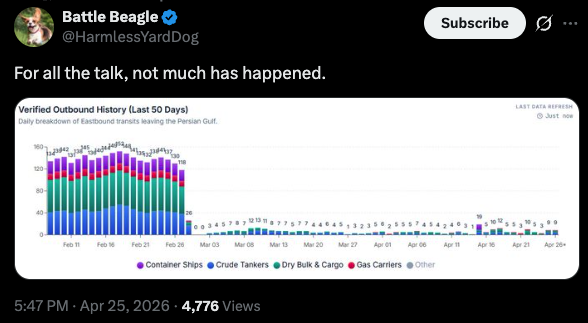
You don’t need to see the numbers on this chart to get a picture of “before” and “after” when it comes to the number of ships exiting the strait under Tehran’s selective blockade.
Nor is there much inbound oil tanker traffic to speak of…
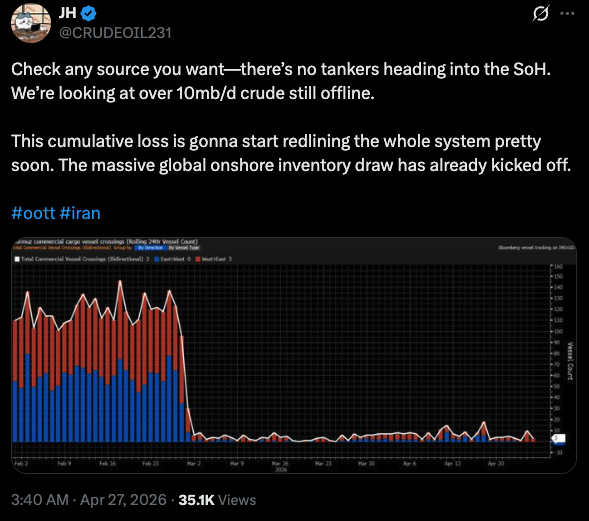
“Oil that has been delivered to South Korea, Japan and other countries in Asia recently came from tankers that left the Persian Gulf before the war began,” Jim adds. “It takes weeks to go from the Persian Gulf to East Asia. That ‘floating pipeline’ has now dried up. The last vessels in the chain have unloaded. Reserves are now being drawn down.
“In a matter of weeks, it will be time to shut down the factories and turn off the lights in much of the industrial world. Poorer countries will face starvation due to an absence of nitrates for fertilizer to grow crops that also come from the Persian Gulf.”
Yes, Americans will avoid the worst of the consequences. Small comfort with gasoline about to jump back over $4 a gallon in many states.
Energy Secretary Chris Wright has forecast a return to sub-$3 gas next year; the president says it will happen much sooner.
“The economics suggest otherwise,” Jim wrote his Strategic Intelligence readers today.
“Gasoline demand is what economists call inelastic. People have to buy it regardless of price because they need it for commuting, shopping and daily life. But there’s no free lunch. Higher fuel costs come out of other spending — dining, travel, discretionary purchases — which quietly weakens the broader economy even as fuel demand holds up.
“The closure of the Strait of Hormuz removes roughly 20% of global oil supply from circulation. Ignore futures prices near $100 per barrel. The spot price for immediately available cargoes is closer to $140 or higher.
“The U.S. won’t face shortages, due to domestic production, but it won’t escape global pricing. Energy is a world market with a world price.”
Jim says there’s one scenario where gas prices would fall — “a sharp slowdown in demand driven by recession. If consumption drops enough, oil prices will fall. But that outcome would come with rising unemployment and a broad economic contraction.
“Lower gas prices would not be a sign of strength. They would be a symptom of something breaking.”
 Spirit Airlines, Troop Transport?
The rationale for the Trump administration’s rescue of Spirit Airlines is coming into view.
As mentioned briefly last week, the Trump administration is set to loan $500 million to Spirit in exchange for warrants that could give Uncle Sam a substantial stake in the firm.
On the surface, the move doesn’t line up with the administration’s previous acquisitions of equity stakes in public companies — MP Materials, USA Rare Earth, Intel and the like all have some sort of “strategic” value to the government. A budget airline? Not so much.
But on Friday, CBS News reported that the White House might resort to the Defense Production Act of 1950 to make the deal happen. “The Pentagon would use Spirit's excess capacity for transporting troops, military cargo or other missions.”
Sure enough, other struggling second-tier airlines want a piece of the action: A consortium of carriers including Frontier and Avelo have approached the government for $2.5 billion in help, according to The Wall Street Journal.
The Journal article didn’t bring up the military angle — but certainly it’s on the table.
And it doesn’t suggest the war is winding down anytime soon, does it?
For a change, the week did not begin with some sort of effort on the administration’s part to suggest peace is at hand, tamping down oil prices.
As a result, West Texas Intermediate futures are up nearly 3% on the day at $97.11 — on the high end of their trading range since mid-April.
The major U.S. stock indexes are in the red, but not by much. The S&P 500 is down 0.15% at 7.154. The losses in the Dow and the Nasdaq are a bit steeper. Big movers include Shell — down 1.3% on news that it plans to acquire Canada’s ARC Resources for $13.6 billion.
Microsoft is down a half percent after word that its ongoing breakup with OpenAI is moving to a new phase: Microsoft’s license to OpenAI’s intellectual property is no longer exclusive. And while OpenAI will continue to fork over a share of its revenue to Microsoft, the flow of funds in the other direction will stop.
➢ Meanwhile, congratulations are in order for PRO-level subscribers to Altucher’s Investment Network. Friday they took 200% gains on POET Technologies after barely a month. (That’s just the stock, not options!)
Precious metals are pulling back modestly, gold at $4,678 and silver at $75.09. Crypto is struggling for the next leg higher, Bitcoin just over $77,000 and Ethereum below $2,300.
Follow-up: Maine Gov. Janet Mills has vetoed a bill that would have temporarily paused construction of large-scale data centers.
We mentioned this bill a couple of Saturdays ago — part of a nationwide backlash driven by the perception that data centers are driving up electric bills.
Mills wanted an exemption for a data center currently under construction in the town of Jay — she said it would bring 800 temporary and 100 permanent jobs — but lawmakers wouldn’t oblige. “I supported the exemption and would have signed this bill if it had included it,” says Mills.
An override in the legislature looks unlikely.
Maine was the first state where such a proposal reached the governor’s desk. It likely won’t be the last. We’ll keep you posted.
 The IRS, Powered by Palantir
Good news: The IRS is cutting personnel. Bad news: The IRS is replacing personnel with AI.
“The agency plans to replace the nearly 30,000 employees it lost to Trump administration cuts with a new army of auditors, one that doesn’t sleep,” writes independent reporter Ken Kilppenstein.
Klippenstein has obtained documents laying out the IRS’ plans to force taxpayers’ compliance with, as one of the documents says, “minimal human contact.”
Key to the plans is software developed by… drumroll, please… the civic-minded folk at Palantir.
The software “allows IRS investigators and auditors to conduct ‘near real-time data analysis’ through a custom tool called the ‘Selection and Analytic Platform,’ or SNAP,” Klippenstein continues.
“What that means in practice is that millions of middle-income Americans who once fell below the threshold of what scarce human auditors could manage are now within reach. The little guy just became a lot easier to monitor at scale.”
As we’ve chronicled in the past, small-business owners and the self-employed are particularly subject to IRS shakedowns. They’re not W2 employees and thus they can be nailed more easily for inflating deductions and (especially) underreporting income.
Go figure: The IRS personnel cuts engineered by Elon Musk and his DOGE boys — one of the few meaningful accomplishments they racked up last year — is clearing the way for tax collection to become more efficient and more ruthless.
 Comic Relief
This is wild — an AI-enabled mashup of 1970s decor, a 1990s Saturday Night Live bit and 2020s doomerism…

 Mailbag: Catch-Up Day
It’s been several days since we’ve had a proper mailbag — and we start with a follow-up to Wednesday’s edition centered on the state of limbo between Washington and Tehran.
In particular, a reader overseas takes issue with the statement by Arta Moeini from the Institute for Peace & Diplomacy: “The current status quo places a greater burden on the Islamic Republic than on Washington.”
“I think that is a very U.S.-centric point of view. While the Strait of Hormuz is closed, most Asian countries, including some close U.S. allies, are close to running out of oil and LNG, and the pressure from those allies will become fierce in the next few days or weeks. European flights are already being cancelled for lack of jet fuel, and even if the strait was opened again tomorrow, it would take weeks or even months for demand and supply to stabilize again.
“In the U.S., as many have pointed out, we are nominally energy sufficient, but if Trump starts trying to meet our allies' needs from U.S. production, we will soon see long lines at the pumps, with gas prices in double digits. If we don't help our allies, they may soon seek allies elsewhere.
“And then there is China, who is hardly an ally, but on whom the U.S. is dependent for many critical items. People talk about rare earths, but even most medical supplies come from China, among many other things we don't think about until the shelves go bare.
“In the end, I suspect that Iran is better positioned to endure another four–eight weeks of the current situation than is the U.S. Beyond that, who knows?”
Dave responds: All good points. We just wanted to put a contrarian line of thought out there for consideration.
I too bristle at the nonchalance with which U.S. media approach the privation facing hundreds of millions of people as a result of this war. And not just in developing countries; depending on who you want to believe, Japan could be in a world of hurt in another 10 days or so. But as long as WTI futures stay under $100, almost no one seems to care…
“As usual, I'm fashionably late to the party, but I wanted to weigh in on the political vitriol issue,” writes one of our semi-regulars.
“A long time ago in a galaxy far, far away... (i.e. when I was in college) I read in a magazine article — something to the effect that the only reason to hate is fear.
“My reaction was ‘That's ridiculous! I KNOW hate and I don't fear the person I hate.’ Soon after, I received a letter from a friend with a single line in it that instantly transformed my hatred for that person to pity.
“After a few years’ deep introspection I had to admit that there was something I had feared. It just wasn't obvious or easy to identify. My friend's letter changed the way I saw that person so that she no longer had the ability -- or more to the point I no longer gave her the power — to affect how I felt about myself. That is what I had feared.
“And so I came to understand that the author of that article was correct: All hatred has fear as its root. Anyone who denies this isn't looking deep enough.
“No matter where they are on the political plot chart, those of your readers who cannot bear any
criticism of their cherished political beliefs or praise for a position they don't share need to ask
themselves what it is they fear to make them so thin-skinned? You don't need me to tell you
that's on them, not you. I'm just saying it to let you know we rational readers know it too,
“So if you are still at a loss for ‘what to do,’ I have an answer for you: You keep doing you. You
aren't responsible for your readers' feelings or inability to confront their own fears.
“Your incites... er... insights and those of other Paradigm editors give me perspectives on the issues I don't get elsewhere. I'm sure a very large majority of your readers agree with me. To those who don't... well, you know how to delete an email without reading it, don't you?
“So, Dave, please don't ‘do’ anything other than what you have been doing.”
Dave: Gee, I forgot the part about “what to do” after the mailbag that went off the rails a week ago Friday.
But after the gracious responses of folks like yourself since, I’ve decided to… keep on keeping on. Thank you kindly.


