
About That Iranian Proposal...
 About That Iranian Proposal…
 So here’s the scorecard: On the eve of U.S.-Israeli airstrikes on Iran, a barrel of West Texas Intermediate crude fetched $66.75. Today, amid a ceasefire, $92.58.
As you’re probably aware, Donald Trump did not follow through last night on his casual threat to commit crimes against humanity — or as he put it yesterday, “A whole civilization will die.”
A fragile two-week ceasefire brokered by Pakistan is now in place.
We’ll get into the terms of that agreement momentarily. For now, suffice to say that whatever you think of Trump, this development is undeniably a good thing.
If you’re a Trump critic and think it was another “TACO” on his part, you’re welcome to believe so. If you’re a Trump partisan and want to believe he engineered a deal for the ages, have at it. The point is we can all breathe a sigh of relief at this outcome.
(Except Mark Levin. By one account he’s been “crying and throwing up on-air.” This too is a good thing.)
The most notable item in Trump’s announcement is this: “We have received a 10 point proposal from Iran, and believe it is a workable basis on which to negotiate.”
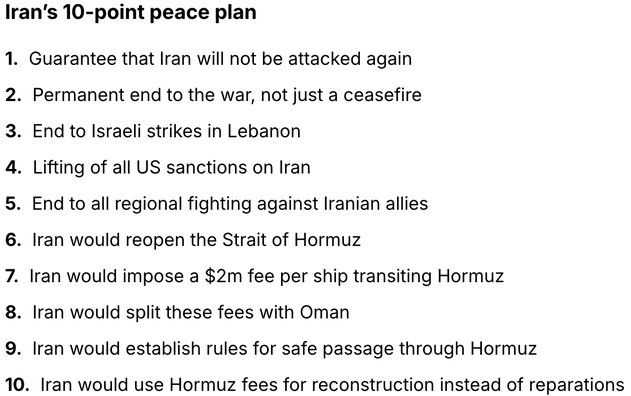
Tehran’s terms have been public for a couple of days. As far as we know, this is a reliable translation…
Hmmm…
Let’s zero in on points 5–10 — seeing as the Strait of Hormuz was open to all before Washington and Tel Aviv launched the war on Feb. 28.
The Associated Press cites “a regional official” as saying Iran and Oman will both charge fees on ships transiting the strait while the ceasefire is underway.
“The strait is in the territorial waters of both Oman and Iran,” says the AP story. “The world had considered the passage an international waterway and never paid tolls before.”
Furthermore, social media statements from Iran suggest that while the ceasefire is in effect, “only about 10–15 ships will be permitted to pass through the Strait of Hormuz with Iran’s approval, in coordination with the IRGC Navy and after payment of tolls…”
For perspective, before the war began the strait accommodated 100–120 ships a day.
For its part the giant shipping line Maersk says it’s nowhere near resuming normal operations: “At this point, we take a cautious approach, and we are not making any changes to specific services,” says a company statement to the Reuters newswire.
Even if the ceasefire holds and leads to some new modus vivendi between Washington and Tehran, it will take months for the supply-chain kinks to work out.
For instance, many of the oil tankers that departed the Gulf region shortly before the war are now approaching their destinations. Once they arrive, that’s it: There’s at least a 40-day gap before the next tankers show up.
And that doesn’t even get into the oil installations that have been blown up… or the disruptions to shipments of liquefied natural gas, fertilizers, helium, sulfur, aluminum…
Less than 18 hours after the announcement, the truce is already looking shaky.
Either U.S. or Israeli jets fired on an Iranian refinery at Lavan Island. Tehran has fired back on a series of targets in the region — including the East-West pipeline that Saudi Arabia counts on to bypass the Strait of Hormuz.
Meanwhile, the Pakistani negotiators say the ceasefire includes a provision for Israel to end its attempted Gazafication of southern Lebanon. Instead, the Israeli military says it’s launched the “largest coordinated strike across Lebanon” in over a month.
And in the bigger picture, Israel’s objective in attacking Iran — not necessarily regime change but merely the destruction of Iran as a functioning nation-state — has not been attained.
But until another profanity-laden Trump tirade on social media accusing Iran of violating the ceasefire, the narrative in the markets is that peace is at hand and it’s party time…
 The Everything Rally
Call it the everything rally: Aside from oil and the U.S. dollar, every asset class is ripping higher on the ceasefire news.
For the record, West Texas Intermediate crude traded over $116 when we wrote to you yesterday. At last check this morning, it’s under $93.
The dollar, relative to other major currencies, is also down: The U.S. dollar index sits at 98.74 — a level that’s been a floor since the war began.
Elsewhere, though, everything is green: In early trading the S&P 500 leaped 2.3% higher. At 6,771 the index has recovered well over half of the losses it registered since late February. Today’s gains in the Dow and the Nasdaq are even stronger.
“Several key sectors are on the move this morning,” Paradigm trading pro Greg Guenthner writes on the Paradigm Press mobile app.
(If you haven’t downloaded the app, it’s the easiest way to access all your paid-subscriber content — along with content we don’t post anywhere else. Download here.)
“The MAGs are cruising here, jumping a collective 4%. That should be good enough to dispel some of the bigger market worries as the MAGS ETF successfully retested its December 2024 highs.
“Software stocks are also jumping this morning, lending more ammunition to those who were looking for a potential double-bottom in IGV. Semis are also rocketing higher. Even the lagging tech-growth stocks are waking up.”
Bonds are rallying alongside stocks, pushing yields lower. The yield on a 10-year Treasury note is under 4.27%, the lowest in three weeks.
Meanwhile, gold has rallied to its highest in three weeks — up $81 to $4,786. Silver has added $3.55 to $76.41.
And crypto is breaking out — Bitcoin at $71,654, Ethereum at $2,235.
“Keep in mind,” says Greg Guenthner, “Bitcoin is still below its March 17 highs following last night’s snapback. It’s been steadily moving lower for six months, but has recently been hammering out a potential floor near $67K.
“If Bitcoin can finally get moving in the right direction here, it will be yet another risk-on signal we can add to the list.”
 California Screamin’ (Fuel Prices)
As noted above, it’s going to take weeks if not months for supply chains to unscramble — and that’s bad news for California.
Even with the shale-energy bounty of the last 15 years, the United States still imports about 8% of its crude from the Middle East. And nearly half of that 8% goes to California.
Time was that California sourced the lion’s share of its crude from either within the state or from Alaska.
But for most of this century, the Golden State has become increasingly reliant on oil from overseas — as you see in this chart from the California Energy Commission.
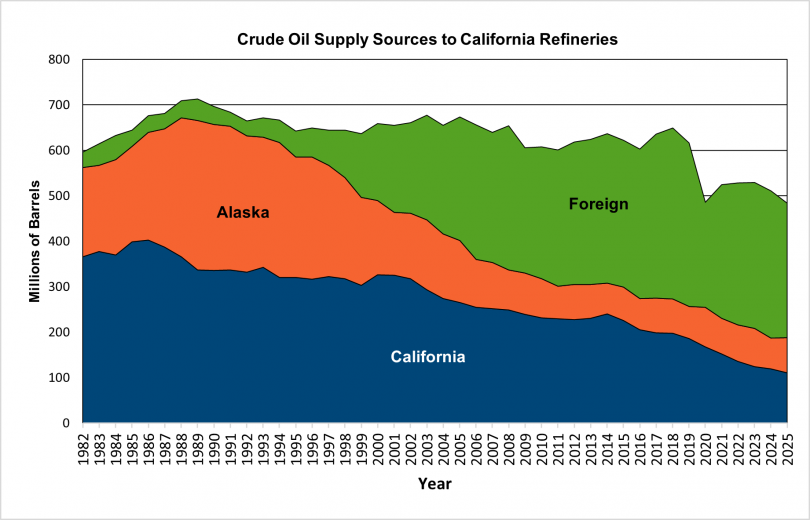
What changed? “California has taxed, litigated and regulated primary oil exploration and production down to bare bones, despite significant hydrocarbon potential in the state,” says Paradigm’s resident oil field geologist Byron King.
“In other words, California has grown in population (well… until the past couple of years, as people left due to toxic politics). And as anyone who has recently been there can tell you — just ask me! — there are way more cars, trucks, trains, airplanes and everything else out there and burning fuel, despite the state’s so-called ‘green’ efforts.”
Between tight supply and high taxes, California gas prices are the highest in the country. And in some spots, diesel has surpassed $8 a gallon.
An additional bottleneck: California also has to import a great deal of refined product — gasoline, diesel, jet fuel — because the number of refineries in California has dwindled from 40 in decades past to six today.
“Until recently,” says Byron, “much of California’s diesel fuel was imported from South Korea (yes, seriously). That is, oil would go from, say, Saudi to Korea, get refined and then move across the Pacific Ocean to California. But considering the Iran war, that’s all coming to a halt.
“Another source of refined products for California is the U.S. Gulf Coast, although it’s a circuitous route via Bahamas (due to the Jones Act — long story) and then a transit through the Panama Canal.
“California is a geographically isolated market. What makes it worse is that many of the refined products in Arizona and Nevada also originate from California. So looking ahead, the West Coast and adjacent states can expect much higher prices for gasoline and diesel fuel.”
➢ Energy stocks are a bargain this morning after the beat-down in crude prices. As long as you steer clear of companies with substantial exposure to the Middle East, Byron says you’ll do well — America’s Chevron (CVX) and Brazil’s Petrobras (PBR), for example. Likewise for the oil services names such as SLB (SLB) and Halliburton (HAL).
 Comic Relief
Recognizing that energy prices will not revert to prewar levels, this is still relevant…

 Mailbag: Turkey, Charlie Kirk
A parenthetical mention in last Thursday’s edition that “after Iran, the war hawks have their sights set on Turkey next” prompts a reader’s objection…
“With that nutty statement (never gonna happen), you have suddenly made me aware of a certain angle I didn’t know you had, and I’m not a fan. I love reading your stuff, but that one did some damage I’m afraid.”
Dave responds: “Turkey is the new Iran,” said former Israeli Prime Minister Naftali Bennett two months ago. Bennett described Turkey’s leader Recep Tayyip Erdogan as “sophisticated, dangerous and he seeks to encircle Israel.”
Former Pentagon official Michael Rubin, now with the American Enterprise Institute, has argued that Israel should arm Kurdish separatists in Turkey — on the grounds that the Erdogan government is “a Hamas-sponsoring, Islamist and increasingly anti-Semitic country.”
Bradley Martin of the Near East Center for Strategic Studies penned an Op-Ed for The Wall Street Journal last month asserting that, “While neutralizing the regional threat posed by Iran, the U.S. and Israel must ensure that Turkey doesn’t take its place.”
No, these aren’t direct calls to topple Erdogan from current U.S. or Israeli government leaders. Still, these are influential voices demanding interventions that if carried out are bound to climb the proverbial “escalation ladder”...
“Wise words by Charlie Kirk,” a reader writes about the conclusion of yesterday’s edition.
“Trump's style of negotiation doesn't work with fanatics who think God is waiting to welcome them when they are ‘martyred’ by their own insanity. This ain't the art of the deal Trump thinks he can always win.
“Yet he keeps raising the stakes. Can he really think the threats will work? Insanity all around! We will never really know why he joined Israel in this war. But it's hard to believe he has a larger goal here — you know, 4D chess LOL.”
From another reader: “Of all the anti-war comments from celebrities the best you can do is Charlie Kirk thanking Trump for his restraint during his first term?
“He had us in Afghanistan for four years. And campaigned to get us out in 2016. And the new CEO of Turning Point has yet to criticize Trump for the new mess he started. Just saying.”
Dave: Not entirely sure what you’re getting at. I cited Charlie Kirk not because he was a perfect embodiment of Ron Paul non-interventionism but because of the respect he commanded and still commands from a wide swath of “the right.”
As you might know, Kirk offered his approval when Trump bombed Tehran’s civilian nuclear sites last June — on the presumption that it was a “one and done” thing.
What might he have said about the events of the last 40 days? One wonders — especially in light of the bits and pieces we’ve learned about how he was losing backing and funding in the weeks after the airstrikes and before his murder.


