Inflation: Three Grim Realities
 Inflation: Three Grim Realities
 On the one hand, Social Security’s cost-of-living adjustment for 2027 will be the biggest in four years.
On the other hand, it’s nowhere near enough to cover a typical senior’s rising cost of living — on average about $75 a month. We say it every year at this time: Don’t spend it all in one place.
As we mentioned at the end of yesterday’s edition, the Social Security Administration has set next year’s COLA at 3.6%.
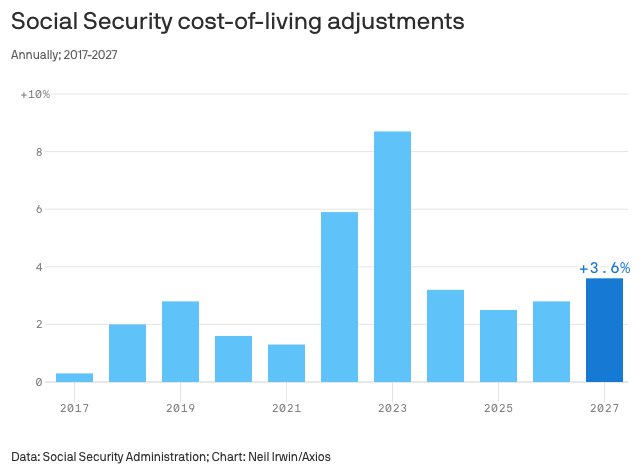
The good news, such as it is, is that this modest increase will not be eaten up too much by rising Medicare premiums. While the numbers aren’t yet final, the Medicare system’s trustees project a 3.25% jump in Part B premiums next year. For most folks on Medicare, that works out to $6.60 a month.
Whether you’re retired or still in the workforce, there are three realities of inflation that you need to grasp…
- Inflation is worse than the official numbers tell you
- Inflation will rule your financial life into the early 2030s
- While you always want market-beating returns, you now need returns that will keep you ahead of a galloping cost of living.
Let’s take them one by one…
Inflation is worse than the official numbers tell you.
We went into some detail about this in August. Since the early 1980s, the feds have routinely monkeyed with the inflation numbers to make them look better than they are. (In part, that’s to keep a lid on those Social Security COLAs.)
Two of the most devious tricks include…
- Hedonic adjustments. If the price of a new car goes up, but the manufacturers add new features to the new models, well then the price of a new car hasn’t really gone up, has it?
- Substitution. If you start buying hamburger because steak is too expensive, well, your price of beef hasn’t really gone up, has it?
Economists who run the numbers the way the feds did before all of these shenanigans say the real-world inflation rate is running north of 11% — not the 3.7% the Labor Department reported yesterday.
Inflation will rule your financial life into the early 2030s.
We’ve been citing the figures regularly for over three years now. Once inflation sails past 5% — as it did in 2021 — it takes a decade on average to get back to “normal” 2% inflation.
That’s based on an exhaustive study of developed economies going back more than 40 years — including two episodes in the United States.
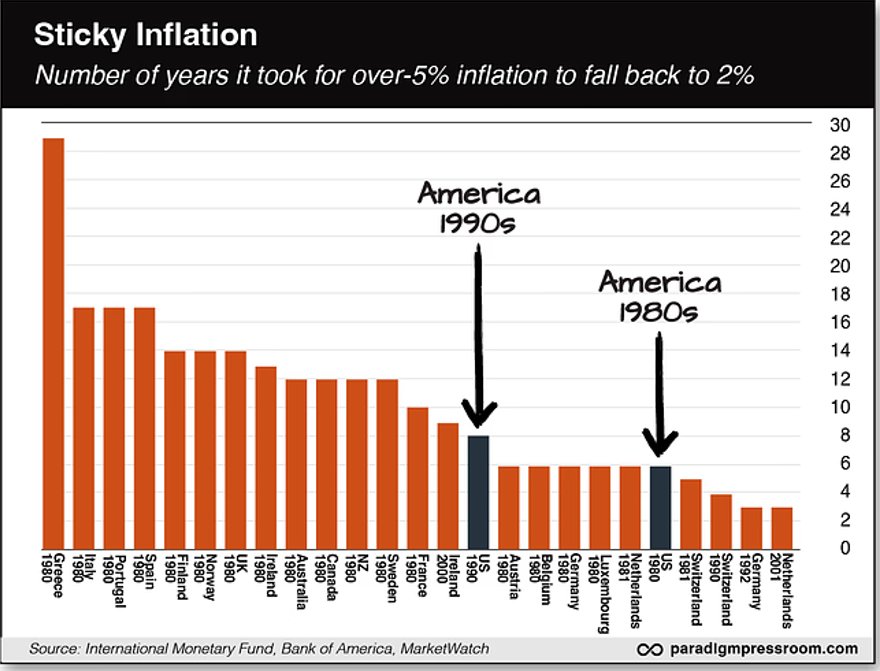
Look at that dark bar on the right. Inflation peaked at a crazy-high 14.6% in the spring of 1980 (when the numbers were still measured honestly). It took six years for the Federal Reserve under chairman Paul Volcker to get inflation back to 2%. And he pulled that off only by deliberately engineering a vicious recession in 1981–82.
But then inflation reared its head again in the late ’80s — peaking at 6.4% in the fall of 1990. Look at the other gray bar. As you can see, it took the Alan Greenspan Fed a full eight years to get inflation back to 2%.
This time around, the clock started in May 2021. Odds are we’ve still got another four or five years to go.
While you always want market-beating returns, you now need returns that will keep you ahead of a galloping cost of living.
Say you’re living off an income of $100,000 right now — and your cost of living rises 4% a year.
After 10 years, you’ll need $148,000 in income just to maintain your current standard of living. After 20 years? $219,000. And after 25 years, you’ll need $267,000.
This is a reality we’re well aware of at Paradigm Press.
Of course we always aim to deliver market-beating recommendations; otherwise you might as well just sit in an index fund, right?
But an environment like now tasks us with an even bigger responsibility — returns that empower you to improve your standard of living even as your cost of living rises relentlessly.
We appreciate the trust you’ve given us — and we know it has to be earned anew each day.
Postscript: The situation won’t be getting better soon based on today’s wholesale inflation numbers.
The producer price index came in way hotter than expected — up 1.3% from August to September. Ouch — the consensus guess among Wall Street economists was “only” 0.5%.
The year-over-year increase works out to 6.3%, the worst since December 2022.
Reminder: These increases feed through to the consumer with a lag — at least two months, sometimes much longer.
 Happy Birthday Three Days Late
For the record: The current bull market is four years and three days old.
The conventional definition of a “bull market” is a sustained gain of at least 20% from a bear-market low.
After a 25% drop, the S&P 500 bottomed on Oct. 12, 2022 at 3,577. This morning it’s at 7,734 — a 116% jump in four years.
How much longer can it last? JC Parets, the newest member of the Paradigm team, points us to research from Oppenheimer: “First of all, this is the sixth-longest bull market over the last hundred years or so.
“The second and most important point is this: Based on the prior five bull markets that were longer than this one, we’ve got another 13 months and more than 20% of upside left.
“That’s just for historical context. What’s happening right now is not unprecedented.”
As for today’s action, the S&P is licking its wounds after recording its worst day since July.
When we left you yesterday the index was down about two-thirds of a percent. By day’s end, that loss swelled to 1.1%. And the Nasdaq slid 1.9%
But as we write today the S&P is up a little less than a quarter percent at the aforementioned 7,734. The tech-heavy Nasdaq, however, has slipped another 0.2%. The Philadelphia Semiconductor Index is down another 1.8% today after a 4.5% drop yesterday.
For Paradigm Mastermind Group readers, yesterday was time to take profits on a handful of AI-adjacent positions. Out of five sells, the smallest gain was 93%. The biggest, 417% on Hut 8 Corp.
“I remain optimistic about the industry’s near-term performance and AI’s long-term potential,” said our Enrique Abeyta — who manages the PMG portfolio. “But after substantial advances, another major move higher requires increasingly ambitious growth expectations to become reality.”
Don’t get Enrique wrong, though — especially after yesterday’s guest edition. As he sees it, the broad market is still OK in light of factors like “historical year-end seasonality, the presidential-election cycle and strong market momentum. Positive earnings revisions provide another source of support, and I expect Treasury yields to ease in the near term.”
But at the same time, “I’m watching the funding requirements facing AI companies, suppliers helping finance customer purchases and the practical challenges of getting data centers built and powered.
“Those issues don’t erase AI’s potential. They do make it important to distinguish promising businesses from stocks whose prices already assume everything goes right.”
Elsewhere, U.S. oil futures are pushing $97 for the first time in nearly four weeks.
The rally from under $88 began nine days ago. There’s been no single news catalyst, just a steady march upward as reality sets in that the many supply disruptions that began earlier this year won’t go away anytime soon.
Checking other major asset classes, bond yields are climbing down — the 10-year Treasury note at 5.1%, compared with a peak over 5.3% just 10 days ago. Yields were overstretched after the big jump in September and were bound to pull back.
Gold held the line on $4,100 overnight and is back up to $4,149. Silver’s back within sight of $57. Crypto’s consolidation continues, Bitcoin at $82,360 and Ethereum at $2,438.
One other economic number of note: Retail sales jumped 0.8% in September. But that was skewed by rising fuel prices. Take that out along with auto sales (notoriously volatile month to month) and you have a much more modest 0.2% jump. Reminder:
These figures are not inflation-adjusted. If they were, you’d find retail sales have been essentially flat since 2021 (when inflation started taking off in earnest.)
 The Next Great AI Investments
If AI still has world-changing potential… but the “obvious” AI investment names are potentially in trouble… what to do?
“Every leap forward in AI seems to require another enormous investment in very non-artificial things,” says Paradigm AI authority James Altucher. “Power plants and chip fabs, miles of fiber and copper, glass, motors, magnets and all the other unsexy stuff required to make the magic happen.”
Looked at another way, the price of AI “compute” keeps falling… but the costs of everything it needs are definitely not.
In a recent dispatch for Altucher’s Investment Network, James laid out three old economic concepts to illustrate why this is the case.
Start with Baumol’s cost disease. Economist William Baumol observed that when some parts of the economy become dramatically more productive, activities that cannot keep pace become relatively more expensive.
A factory can automate and double its output. But in doing so, it will also double the supplies or raw inputs it needs to run at the faster pace.
Over time, the price of inputs and labor tends to rise relative to the price of factory-made goods.
The same logic applies to AI, says James: “We can make code, analysis and all sorts of digital work faster and cheaper. But no matter how intelligent the model becomes, it can’t prompt a gigawatt of electricity into existence. You still have to build the power plant, manufacture the transformer, lay the pipeline and construct the data center.”
The investment implications come into clearer view when you add two other economic principles.
Jevons paradox: When something becomes cheaper, people tend to use more of it, so that total consumption increases. That happened with coal in the 1800s. Today, cheaper AI compute could drive demand high enough to increase revenues and profits even as prices fall.
Moravec’s paradox: Computers can master chess and solve complex mathematical problems, but robots still struggle with simple physical tasks. Giving AI a useful body requires motors, sensors, actuators and other components that must be manufactured.
Put it all together and what does it mean?
Software can scale quickly. Power plants, transformers, cooling systems and specialized manufacturing capacity cannot. The companies supplying equipment, energy and skilled labor could gain pricing power when demand outruns their capacity to deliver.
“I find it funny that, while we debate which jobs AI will eliminate, the AI buildout itself is creating enormous demand for electricians and specialty contractors,” James says. “If you’re an electrician, welder, HVAC technician, pipefitter or anyone else who knows how to actually build all of this, I wouldn’t lose much sleep over ChatGPT.”
The next big AI investment may have little to do with developing a smarter model. It may depend on building something the model cannot: a power plant, a transformer, a cooling system or an electrical grid.
The cheaper intelligence becomes, the more valuable the physical world supporting it may become. It’s a theme that James and all of the Paradigm team will be following the rest of this year and into 2027…
 Costly Candy
You might think the most appropriate trick-or-treating costume this year is a burglar — once you see what you’re paying for Halloween candy
The government’s official inflation figures show candy prices leaping 8.1% year over year — far outstripping the overall consumer price index.
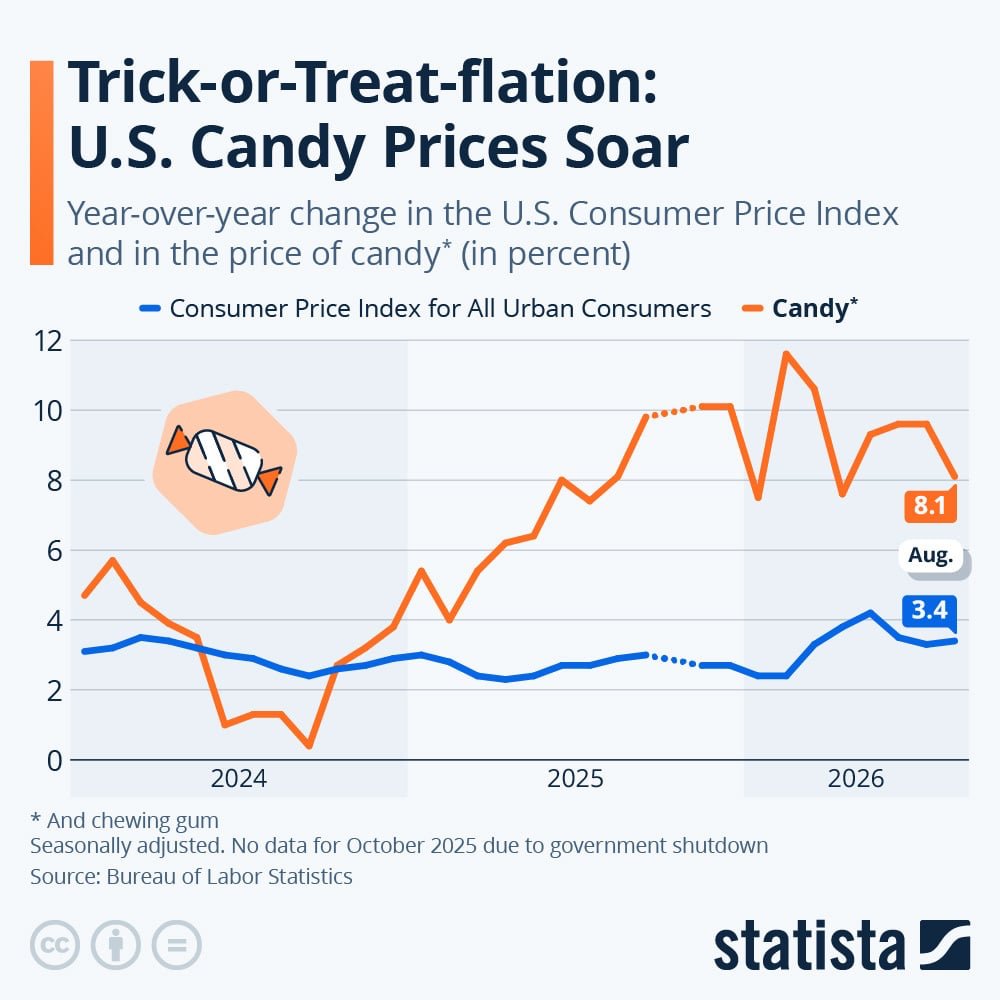
As we’ve mentioned from time to time, bad weather has hurt the cocoa and sugar crops in Africa, Latin America and India.
Candy makers have responded to the raw-materials squeeze with “shrinkflation” — selling a smaller package for the same price.
Not that that’s been any help to Hershey, whose share price is down over 10% year to date. HSY is overexposed to both cocoa prices and a struggling U.S. consumer.
Better off is Mondelez, which has a bigger portfolio of candy and snacks (not just chocolate) and a bigger global customer base. MDLZ is up 16.2% so far in 2026.
 Comic Relief
Is this real? AI? Pre-AI photoshop?
In any event, it’s timely in light of the ongoing labor shortage we mentioned earlier in the week…