
About the Wednesday Wobble…
 About the Wednesday Wobble…
 To the extent the stock market’s performance this week has been stress-inducing, the blame can be laid at the feet of one company — CoreWeave Inc.
Never heard of it? Or maybe you have but you still don’t know what it does?
“CoreWeave is a builder and operator of massive AI data centers,” colleague Davis Wilson writes at our sister e-letter The Million Mission. “It buys thousands of Nvidia GPUs, puts them inside data centers and rents that computing power to companies that need it to build and run AI models.”
Business is brisk. It’s also incredibly costly — GPUs, electricity, construction costs — with a payoff that’s years in the future.
And unlike the “hyperscalers” — Google, Amazon and so on — CRWV doesn’t have a big pile of cash to draw on for its massive capital spending.
As such, “CoreWeave has accumulated roughly $50 billion in debt and other financing commitments as it races to build enough infrastructure to satisfy demand,” Davis says.
Investors were fine with that — until CRWV’s borrowing costs started blowing out.
For a long time, CoreWeave could borrow at rates of 9–10%. But recently its lenders have gotten itchy about whether they’ll get their money back. So they’ve been lending to CRWV at much higher rates to offset their perceived higher risk — over 16%.
Say CoreWeave needs another $20 billion. The annual interest at 9% works out to $1.8 billion. But at 16%, that interest expense nearly doubles to $3.2 billion.
The rest of the AI trade starts coming into question if CoreWeave is not alone in its new predicament.
Thus when CRWV tumbled 15.5% on Wednesday, the Nasdaq took a 2% spill in sympathy.
“Hundreds of billions of dollars are flowing through an enormous supply chain,” Davis says.
“Data-centers buy Nvidia GPUs → Those GPUs require memory from companies like Micron and SK Hynix → They need networking equipment from Broadcom and Marvell → The data centers also need servers, cooling systems and enormous amounts of electricity. The supply chain goes on and on.
“But what happens when financing becomes so expensive that spending slows? That same supply chain works in reverse.”
Having said all that, Davis’ assessment is that “I'm not ready to turn CoreWeave's debt problem into an AI demand problem.”
Data centers are still being built at a blistering pace, protests notwithstanding. Projects currently on the drawing board total $2 trillion — an amount that towers over CRWV’s $50 billion debt pile.
As for CoreWeave’s impact on the broader market this week, “this pullback looks a lot like the countless previous pullbacks we’ve seen since the AI buildout began,” Davis concludes. “Every one turned out to be temporary.”
Looking ahead, AI’s next big test will come toward the end of this month — when the hyperscalers report their quarterly numbers.
Meta will go first, next Wednesday Oct. 21. The following week, Google, Microsoft and Amazon will all report their numbers in a brief stretch on Oct. 28–29. SpaceX reports the first week of November. (Remember, SpaceX is mostly an AI company now.)
This matters to the broad market because according to Nick Riso of our research staff, Wall Street forecasters expect tech/AI to deliver more than three-quarters of the U.S. stock market’s earnings growth next year — 78%.
“When strategists blame this week’s wobble on fears that AI spending is peaking, understand what they’re really saying!” Nick says: “The entire 2027 earnings story rests on a handful of companies continuing to write enormous checks.”
➢ For the record: To the best of my knowledge, CRWV has never been a buy-and-hold recommendation in any Paradigm publication. It has been a trading vehicle, and at times a profitable one — both on the long and short side. At present, CRWV put options are looking strong for readers of Rickards’ Crisis Trader — up 67% in a little over two weeks.
 Roadster Reveal
Shares of Tesla opened the day up nearly 2% — about 12 hours after the reveal of the Tesla Roadster.
As Elon Musk’s spectacles go, it did not disappoint. The aforementioned Davis Wilson writes: “It drives upside down, launches itself over other vehicles using SpaceX-inspired thrusters and goes from 0–60 mph in 0.81 seconds. Musk has been teasing these capabilities for years. Now we’ve actually seen them demonstrated.”

To be sure, not everyone is wowed. There’s Mark Spiegel of the hedge fund Stanphyl Capital. He was one of the hardcore “Tesla shorts” throughout the 2010s — and evidently still is.

But an engineer of your editor’s acquaintance is suitably impressed: “I have a deep respect for how much harder it is to get equipment to work as envisioned than anyone expects. There are always hosts of devils in the details of any complicated engineering problem that involves moving parts. The Roadster seems to break the rules of engineering development (even though it took 10+ years to build).”
Spectacle aside, our Davis Wilson sees something else at play: “SpaceX propulsion technology is now literally being built into a Tesla.
“The technological and financial ties between Musk’s companies continue to grow, which only strengthens my belief that Tesla and SpaceX will eventually become one company.”
Alas, the Roadster glow didn’t last long: TSLA is now down 1.3% on the day, falling in sympathy with the rest of the market.
Oh, and CoreWeave is down 11% on the heels of an oversold bounce yesterday. CRWV shares trade at their lowest levels since May of last year. (The company went public in March of last year.)
As for the major indexes, the S&P is down 0.6% on the day — under 7,700 for the first time this month. The Nasdaq has shed 1.3%, while the Dow is flat.
Congratulations are in order for Ray Blanco’s Catalyst Trader readers who took 120% profits yesterday on Nebius Group after about eight months’ holding time. NBIS is (more or less) in the same business as CoreWeave — and faces some of the same financing obstacles as CoreWeave — so this is a timely sell indeed.
Precious metals are steady — gold at $4,164 and silver at $57.14. Crypto continues losing ground, Bitcoin at $81,314 and Ethereum sinking toward $2,400.
One economic number of note: Industrial production as measured by the Federal Reserve grew 0.7% in September. Utility output was the big driver here, up 3.5%... while mining/energy output grew 0.2%... and manufacturing grew 0.7%. All told, 76.9% of the nation’s industrial capacity was in use last month — 2.5 percentage points below the long-term average going back nearly 60 years.
 Oil Prices, Fake and Real
As the week winds down, U.S. oil futures have exceeded $99 for the first time in four weeks. Brent futures, the world benchmark, trade at $107.47.
This latest jump appears to be a case of traders not wanting to be short going into a weekend, when the markets will be closed — at a time rumors abound that U.S. and Israeli forces might resume attacking Iran.
In any event, we can’t emphasize it often enough: These numbers bear zero relation to the real-world price of physical barrels of oil.
Jim Rickards’ senior analyst Dan Amoss points us to a Goldman Sachs report this week: “‘Dated’ Brent is what refineries buying Brent actually pay (not the front-month price on our screens),” says Dan. “Dated is again near a 30% premium to front-month futures.”
Meanwhile, supply constraints continue to bite: The BBC, drawing on data from the U.K. Maritime Trade Operations agency, counts 12 vessels attempting to transit the Strait of Hormuz that came under Iranian attack during the week of Oct. 5–11.
That’s the highest since the war began. “As the number of strikes has risen,” says the Beeb, “the recovery in oil shipments through the strait seen last month has slowed.”
If there’s still a lid on liquid energy prices, it’s because reserves continue to be depleted. Yesterday the Energy Department issued its weekly U.S. inventory numbers. Wall Street analysts expected a teensy build of 200,000 barrels; instead there was a massive drawdown of 8.5 million barrels. Reserves of distillates — a category that includes diesel — dropped 2.5 million barrels.
Speaking of diesel, remember the much-touted deal President Trump struck with Russia’s President Putin for Russian diesel exports?
Here’s an update from the Russian state media outlet Sputnik: “Russian oil companies are ready to start exporting diesel fuel, and all the necessary procedures will take two–three weeks, Russian Deputy Prime Minister Alexander Novak said on Thursday.”
Two–three weeks? That won’t be any help in time for the U.S. midterms…
 Stats of the Day
We’ve had inflation on the brain this week — especially yesterday. Here’s still another way to look at it.
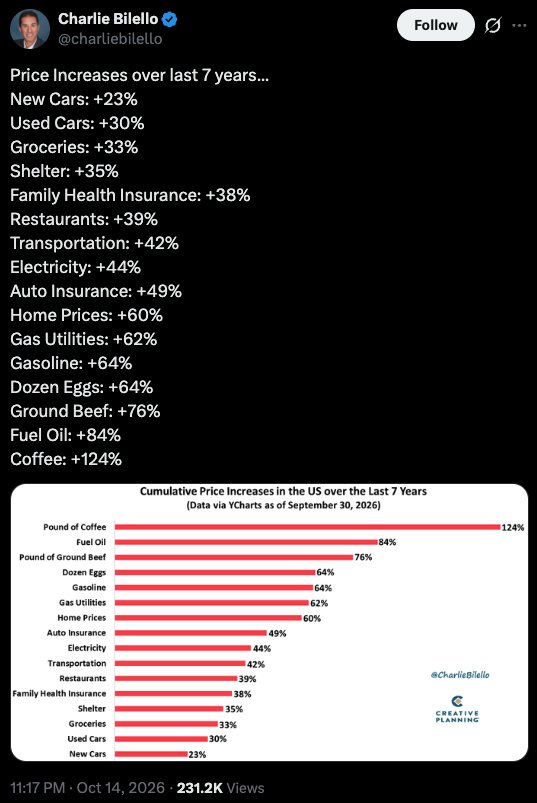
Courtesy of Charlie Bilello, chief market strategist at the Creative Planning firm, here are some of the price increases we’ve been wrestling with since the pre-COVID autumn of 2019…
And those are the official government numbers. No way has the cost of health insurance grown “only” 38%.
 Mailbag: Inflation and Substitution
Meanwhile, yesterday’s inflation topic prompted the following query to the mailbag…
“Dave, has there EVER been another example of ‘fuzzy’ food inflation other than steak and hamburger? I’ve been reading the financial press for 20 years and have yet to hear of any other example of this other than steak and hamburger.”
Dave responds: The steak-and-hamburger example is the one that people can most easily relate to, so that’s why I and other skeptics of the official numbers resort to it.
Per a 2008 white paper, the Bureau of Labor Statistics swears up and down that’s not what it does…
Instead, the BLS uses a formula that implicitly assumes a degree of substitution among the close substitutes within an item-area component of the index. As an example, consumers are assumed to respond to price variations among the different items found within the category “apples in Chicago.” Other examples are “ground beef in Chicago,” “beefsteaks in Chicago” and “eggs in Boston.”...
Taking the white paper at its word, the BLS does not substitute hamburger for steak. But it does substitute top sirloin for a ribeye. Or red delicious for honeycrisp. Or a Corolla for a Camry.
That said, there’s a variant on the consumer price index called “chained” CPI. And it does substitute hamburger for steak. It even substitutes mass transit for personal cars. And yes, it understates your real cost of living even more than the commonly cited “CPI-U” number.
Year after year, the Obama White House’s budget blueprint proposed using chained CPI to calculate the annual Social Security cost-of-living adjustment — but the idea never got anywhere with Congress.
Chained CPI did, however, find its way into the Trump tax cut legislation in 2017 — as well as the “Big Beautiful Bill” of 2025 that made the 2017 rates permanent.
For nearly a decade, chained CPI is what’s been used to adjust the tax brackets from year to year. That has the effect of bumping you into a higher bracket sooner than might occur otherwise.
Pretty weedsy, I know. Point being there’s a reason these fudged numbers exist — so that politicians and bureaucrats can put them to use at a time that suits their agendas.


