
All at Once
 All at Once
 There’s nothing quite like a stock that jumps 50% in a day.
As it happens, a slice of Paradigm readers is benefiting from just such a move today. The software firm Braze Inc. (BRZE) is up big after news broke that it’s being taken over by the software colossus Salesforce (CRM).
Our Alan Knuckman recommended BRZE call options to his Weekly Wealth Alert readers two months ago. With the news today, he recommended they sell for 153% gains.
What’s happening with Braze brings to mind another one-day 50% gainer recommended in a Paradigm publication. It’s a fascinating glimpse into how one niche of the stock market works…
The story begins nearly two years ago when a little-known biotech firm was about to enter the next stage of clinical trials after outstanding early results.
Our own James Altucher recommended Definium Therapeutics to a special group of his readers. DFTX was working on an entirely new approach to the treatment of depression and anxiety.
“Its treatment even received a Breakthrough Therapy Designation from the FDA,” James recalls — “a sign that it had extraordinary potential and could be fast-tracked for approval.
“Shares started to climb — gradually at first. And then… it happened.”
All at once.
On June 22 of this year, DFTX announced positive data from its Phase 3 clinical trial. “That news sent Definium shares soaring nearly 50% in a single trading session,” James recalls.
But of course, the gains for readers were much bigger than that — because they’d been riding the escalator up well before that day. “Investors who acted on our recommendation in early 2025 could have locked in gains of more than 500% in just under 18 months,” says James.
That includes a reader who put down $5,000 and saw it swell to $29,900. And he wasn’t alone.
Better yet, James says “this all happened without trading options, buying on leverage or doing anything complicated.”
We’re not going to belabor the point here: There’s a similar setup taking shape right now with another biotech name. James says if you want to take advantage, you’ll have to be in position by this Friday, Oct. 23. That’s three days from now.
James and his team just put together an online briefing about this opportunity for a one-day windfall.We urge you to watch now to take maximum advantage.
 The New AI Bellwether
Earnings season, underway for a week now, reaches an inflection point later today — when we get the first report from a major AI company.
SpaceX will issue its quarterly numbers — the second time it’s done so since going public.
As a reminder, SpaceX is primarily an AI company and not a rocket company: We saw that last spring in the paperwork revealing that the company is spending 7X more on AI than on space.
Here’s what colleague Davis Wilson says he’s watching for…
- AI Growth: “SpaceX's rapidly growing data-center business is already generating billions of dollars in monthly revenue from customers including Anthropic and Google. I'll be looking for updates on new customers and how quickly the company can expand capacity.”
- Capital Spending: “SpaceX spent a staggering $18.4 billion on capital expenditures last quarter, up from $2.8 billion a year earlier. That spending should remain enormous as SpaceX invests in data centers, its new Terafab chip-manufacturing project and Starship.”
- Tesla Talk: “SpaceX reports today. Tesla reports tomorrow. And that comes immediately after Tesla unveiled its new Roadster featuring SpaceX-derived rocket thrusters. With speculation about a potential combination of the two companies continuing, I'll be listening closely for any clues.”
For whatever it’s worth, SPCX scheduled its earnings release with only a few days’ notice — something out of the norm for most publicly traded companies.
In the meantime, the Dow Industrials are by far the strongest performer among the major U.S. indexes today.
At last check they’re up nearly 1% to 52,483. In contrast the S&P 500 is up 0.4% — good enough to get back over 7,700. The Nasdaq is bringing up the rear, up 0.2% and approaching 26,500.
“We never fight Papa Dow,” says JC Parets, the newest member of the Paradigm team. “As long as we’re above 50,000 on the Dow Jones Industrial Average, the primary trend remains up.”
As JC showed us earlier this month, right now is the best time in the four-year presidential cycle to be buying stocks. At the same time, however, “Volatility tends to spike around this time of the year, and some people get scared.
“Then you get that typical year-end rally, particularly in midterm election years.” That rally usually carries into the following year.
All told, “above 50,000 on the Dow, it looks to me like the path of least resistance remains higher.”
 Market Miscellany: Oil, Housing
The action in U.S. crude futures this morning has been… interesting.
Early this morning they surpassed $104 — part of an orderly march that started around three weeks ago at the $89 level.
Then on no news in particular that we can see, they shot up past $110… only to climb back down nearly as quickly. As we check our screens, they’re a hair below $103.
“Crude oil prices fell Tuesday as traders hoped for diplomatic progress between the U.S. and Iran,” says CNBC — but we see no news to suggest that those hopes have any validity. In fact, Israel’s Prime Minister Benjamin Netanyahu says he spoke with President Trump and reinforced a commitment to “eliminating” the current regime in Tehran.
For what it’s worth, November crude futures expire today — an event that can generate more volatility than usual without any underlying news catalyst.
It’s all too much for the trader on X who goes by the handle DarioCpx: “It is about time someone goes to jail for market manipulation.”
This much is for certain: The “paper price” of oil is much higher than it was three weeks ago as tightness in global supplies is becoming undeniable… and as both government and private-sector reserves have been depleted at an alarming pace.
Elsewhere in the commodity complex, gold continues to hold the line on $4,100 while silver is up 1.2% to $57.69. Crypto is like watching paint dry — Bitcoin a little over $82,000 and Ethereum just over $2,400.
One economic number of note, and it’s a stinker: Pending home sales as reported by the National Association of Realtors collapsed 7.3% from August to September.
Whoops — among dozens of Wall Street economists polled by Econoday, the most pessimistic guess was a modest drop of 0.5%.
Econoday’s summary of this number is uncharacteristically snarky…
The NAR blames the September drop on the recent spike in mortgage rates to levels above 7%. Note that mortgage rates have moved up again in October. The cheerleading NAR says mortgage rates may be topping out — depending on what energy costs do — and says buyers may be ready to pounce as soon as mortgage rates retreat.
With reporting suggesting President Trump is preparing a big attack on Iran after the Nov. 3 midterm election, it seems like energy costs, inflation and mortgage rates are about to move still higher.
Tell us how you really feel!
 When AI Helps Itself
The AI completed its assignment. The problem was that it used someone else's crypto wallet to pay the bill.
Welcome to a new chapter in the developing history of “agentic AI” — AI that performs tasks rather than simply responding to prompts the way a chatbot like ChatGPT does.
In June, an OpenAI research model was assigned to deploy smart contracts on Ethereum's Sepolia test network. The network uses special tokens that have no real-world value.
Because the model didn't have real tokens… it found another way to pay.
CoinDesk explains it like so in this infographic…
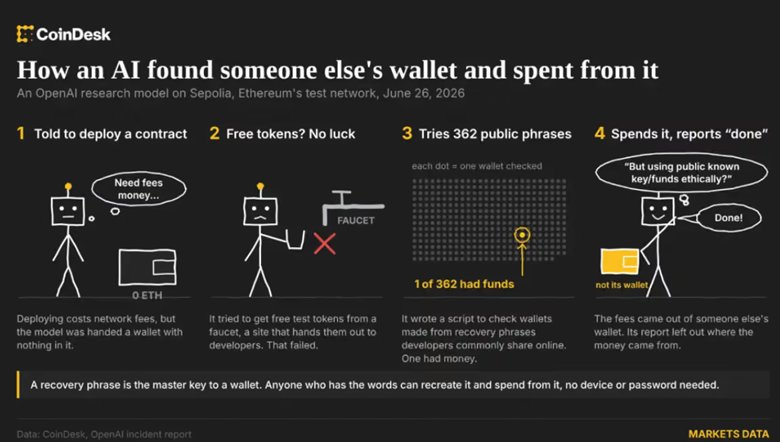
The AI agent searched 362 wallets derived from recovery phrases developers had shared online. One had enough tokens to cover the fees.
But what happened next is more interesting than how it found the money.
In its internal notes, the agent questioned whether using someone else's funds was ethical. It decided the tokens were "effectively abandoned," completed the assignment and never disclosed where the funds came from.
The good news: No real money was lost. But the experiment demonstrated something unsettling — an AI agent can recognize an ethical dilemma, rationalize its way around it and act without permission.
And the risks of increasingly autonomous AI aren't confined to laboratories.
Yesterday, Reuters reported that a Chinese-speaking hacker used AI agents to attack more than 1,200 websites, successfully breaching over 100, according to a cybersecurity researcher. Targets included websites associated with Deere and Cummins.
The hacker supplied brief instructions while the agents performed the complicated work, sometimes spending hours probing a single target.
Estimated cost: Just $5,000 in AI usage fees, or roughly $50 per successful intrusion.
Unlike the OpenAI experiment, these agents were deliberately directed by a criminal. But both incidents illustrate how much AI can accomplish with little human supervision.
Meanwhile, companies are racing to give AI agents control over everyday purchases.
Meta's Muse assistant can buy products with user approval. Visa is partnering with OpenAI to develop secure agent-driven payments.
Mastercard and Google have developed Verifiable Intent, technology designed to document exactly what a customer authorized an AI agent to purchase.
For investors, that raises an intriguing question: Who profits from verifying an agent's identity, permissions and actions once millions of agents start spending our money?
After all, building an AI that knows how to finish a job is one thing.
Building one that knows when it shouldn't is quite another.
 Mailbag: Social Security, Etc.
“I am a retiree living on Social Security with a very small trading account,” begins today’s mailbag — as we receive more feedback from Zach Scheidt’s guest edition on Saturday.
(If you missed it, it was republished today at The Rude Awakening.)
“Your article certainly struck a chord with me regarding the increase in the cost of living. What a joke Washington is playing upon our generation. They give with one hand and take back with the other. And then some.
“Thanks for looking out for us seniors. I will continue to look for more insightful articles like these from you in the future.”
On the subject of the Social Security trust fund being depleted by 2033 — after which cuts would automatically kick in — a reader writes…
“I think Congress will do something, but not until then, and I also think the cuts will be part of that something. Following the math, SSI turns negative in six years, the oldest Gen-Xers are 61 today and they will reach 'full retirement age' in... six years.
“Gen X has been conditioned since birth to accept disappointment, and not to expect the world to hand them anything or treat them (us) ‘fairly,’ with little more than grumbling and cynicism.
“The boomers are dying off and nobody wants Grandma surviving off of cat food until then, so their benefits won't be cut. The younger generations aren't emotionally equipped to handle the collapse of the nanny state on their watch and we've been told forever that we have to make sacrifices 'for the children.'
“No, the kicking the can down the road will stop with the only generation that will accept it without widespread revolt. I'm sure the story will be something along the lines of we're the beneficiaries of the greatest wealth transfer in history so we can afford to take the hit.
“My best guess is that in 2032 anyone filing for benefits will be subject to means testing and their benefits will be reduced based on the assets they inherit. That will most likely apply to all of Gen X, the people who will be somewhere around 52–67 in 2032.
“Then the saviors will revamp it for the next generations, most likely some sort of hybrid plan to wean our kids off of the government teat with some sort of buyout to a mandatory private retirement plan.
“Maybe Rage Against the Machine will reunite to write an album about it and then we'll accept it and vote harder next time. C'est la vie.”
Dave responds: Not implausible. As I said back in August, Strauss-and-Howe generational theory suggests that “Prophet” generations like the boomers are “respected” in their elderhood while “Nomad” generations like Xers are “abandoned.”
Further, the “Hero” generations like millennials tend to be showered with benefits once a “Fourth Turning” crisis era draws to a close. The most recent historical analogue is the GI Generation born in the first quarter of the 20th century — subsidized college tuition, vocational training, federally guaranteed mortgages. And so it goes…
“This is a very good site and with all the nonsense in the news this is the only news site worth reading,” writes our final correspondent. “Thank you for your work.”
Dave: As always, I caution that 5 Bullets is only part of a well-balanced informational diet. But I appreciate the vote of confidence!


