
Elon Musk’s Very Busy Week
 Elon Musk’s Very Busy Week
 It’s been a busy few days for Elon Musk. In no particular order, the following things have taken place…
- Musk offered to pay TSA workers for the duration of the current dispute between the White House and Congress over Homeland Security funding. The White House said no — in part because SpaceX’s status as a federal contractor might lead to someone challenging the arrangement in court
- Musk is demanding a judge in Delaware step aside from a shareholder lawsuit against Tesla — claiming the judge “supported” a post on LinkedIn that poked fun at him
- After OpenAI announced it’s junking its Sora video-creation platform, Musk said he’s “doubling down” on video at xAI. ”The next Grok Imagine release will be epic.”
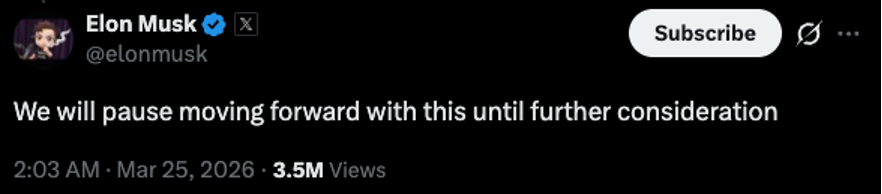
Oh, and yesterday Musk very publicly shot down a plan announced by one of his top lieutenants at X — aimed at cutting cut off the revenue flow for overseas users who are constantly s***posting about U.S. politics for clicks.
Also yesterday, Tesla dropped a new video about its Optimus robot — aimed mostly at attracting more tech talent to work on the project ahead of mass production this summer.
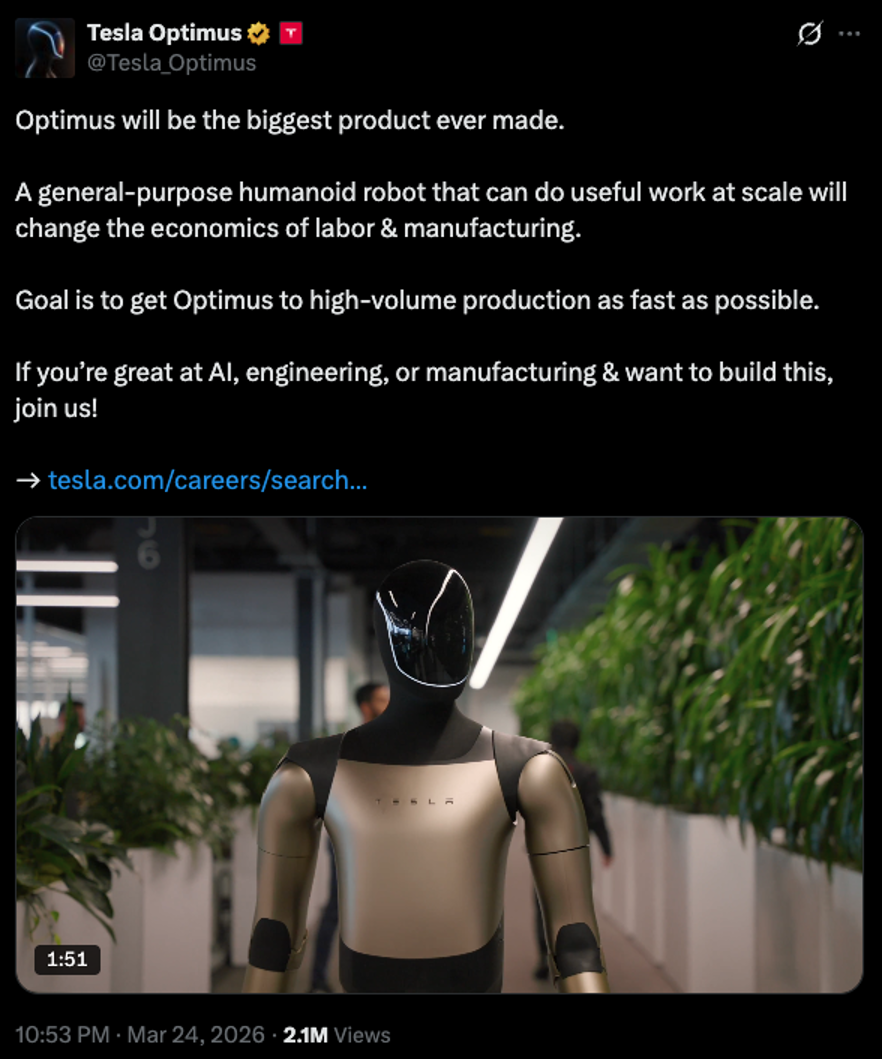
"We are getting very close to the human functionality and form factor," says a current employee in the video. Tesla released postings for over 100 Optimus-adjacent jobs.
And none of this even accounts for SpaceX’s pending IPO.
As mentioned here yesterday, the firm might file its IPO prospectus as early as this week — what’s shaping up to be the biggest IPO in history. Smaller space-oriented firms that are already publicly traded basked in the glow — Firefly Aerospace and Rocket Lab both rising over 10%.
“The SpaceX IPO will tell the world this is a trillion-dollar market,” says Paradigm’s tech investing specialist Ray Blanco — in attendance this week at the Satellite 2026 conference in Washington, D.C. And not just the obvious applications. “Everyone is planning on space compute and space data centers.”
 “Irrational Optimism”
“Irrational optimism” is the word of the day at CERAWeek — an annual gathering of the oil industry’s movers and shakers in Houston. So says Karim Fawaz, an analyst with S&P Global.
As Fawaz sees it, Donald Trump’s jawboning about the progress of the war is doing an effective job of keeping a lid on the oil price.
Yesterday was a case in point, with Trump’s remarks about Iranian leaders being ready to talk. A barrel of West Texas Intermediate tumbled 2% to $90.48 — even though word was already arriving from Tehran that the mullahs rejected a 15-point ceasefire proposal from Washington.
Writing on X, Fawaz chalks it up to normalcy bias — and dread. “The alternative is so daunting to think about, with consequences so grave, that many are choosing optimism even without a solid foundation.”
But now, with the president telling Tehran to “get serious soon, before it is too late,” crude is up nearly four bucks today to $94.28.
The action in crude both yesterday and today is mirrored in the major U.S. stock indexes: At last check the S&P 500 has given up all of yesterday’s gains and then some, down more than three-quarters of a percent to 6,539. The Dow’s losses are more modest, the Nasdaq’s steeper.
Too, with the war now about to enter its fifth week, Mr. Market might be tumbling to the phenomenon we’ve cited regularly, captured by the remark of a cynic on X we cited Tuesday: “The pattern is consistent: escalate on Fridays [in the evening] when energy markets are shut, pivot to dovish talk on Mondays to carry the market through the week.”
Precious metals, you ask? Not pretty — gold down 1.5% to $4,437 and silver getting clobbered 4%, now $68.26. The floor on gold is $4,100 — a level last seen in November and tested briefly on Monday.
Crypto is stuck in the mud, Bitcoin just under $69,000 and Ethereum at $2,067.
Lest we forget, jitters remain in the bond market.
On the heels of a lousy auction of 2-year Treasury notes Tuesday, the government auctioned 5-year notes yesterday. Once again, demand was tepid at best — pushing the yield up to 3.98%.
Checking the benchmark 10-year Treasury, it’s approaching 4.39% — once again testing highs that go back to last summer. Uncle Sam’s borrowing costs are going nowhere but up.
That said, there’s no panic in the bond market. The MOVE Index — a measure of volatility for bonds similar to the VIX for stocks — sits at 97.6. Real panic doesn’t set in until the MOVE approaches 140.
 Gas Pains
While oil gets all the headlines, we can’t overlook the disruption to the market for liquefied natural gas.
“The closure of the Persian Gulf cuts off about 20% of global LNG exports,” says Paradigm macroeconomics authority Jim Rickards. “Producers in the Gulf including Iraq, Abu Dhabi and Kuwait have run out of storage capacity and are now slashing production. Saudi Arabia has closed the Safaniya, Zuluf and Abu Safa oil fields because of Iranian drone attacks.
“Kuwait’s Mina Al-Ahmadi oil refinery, which processes 730,000 barrels of oil per day, has been struck by Iranian missiles several days in a row. Saudi Arabia’s giant Ras Tanura refinery complex, which handles 550,000 barrels per day, has also come under attack.
“The damage to Qatar’s Ras Laffan LNG export facilities from Iranian missiles and drones is so extensive that 20% of its capacity may be offline for years. Ras Laffan produces 20% of the world’s LNG. The war is not over and the damage may get worse before the war ends.
“This is not a marginal impact. The global price of LNG has already risen over 60% since the war began and may double from that base level in the days ahead. The world may soon reach a point where no LNG is available at any price because it has all been purchased by desperate users.”
Yes, as we said earlier this month, American producers of LNG stand to benefit big-time.
Jim recommended call options on one of them yesterday for readers of his premium advisory Insider Intel.
 Free Speech Victory (Such As It Is)
Chalk up a modest victory in the battle against internet censorship and the feds’ attempts to strong-arm the tech giants.
“The Justice Department has settled a lawsuit over allegations that the Biden administration pressured social media companies to remove or suppress speech,” reports The Hill.
We should back up a bit: In the summer of 2024 the Supreme Court decided a case called Murthy v. Missouri. Several of the plaintiffs were physicians who dissented from the conventional wisdom about COVID — and who got hushed up by the likes of Facebook and Twitter.
They sued the feds — presenting a compelling case that those companies acted under government pressure. But in a depressing 6-3 ruling we chronicled at the time, the high court ruled that the plaintiffs lacked “standing.” That is, there was no smoking-gun email that said, Take down this exact individual’s post or else.
However, the ruling didn’t dismiss the case altogether; it only denied the plaintiffs from getting a preliminary injunction against the feds while the lawsuit itself was being decided. The case was then sent back to lower courts.
This week, the Justice Department reached a settlement with the plaintiffs’ lawyers that brings the case to a close.
“It was a victory, even if we did not get everything we wanted in the settlement,” says one of the plaintiffs — Aaron Kheriaty, a former psychiatry professor at the University of California Irvine.
As he writes on his Substack page…
… the settlement prohibits the U.S. Surgeon General, Centers for Disease Control and Prevention (CDC) and Cybersecurity and Infrastructure Security Agency (CISA) from threatening social media companies into removing or suppressing constitutionally protected speech on Facebook, Instagram, X (formerly Twitter), LinkedIn and YouTube. It also bars these government authorities from directing or vetoing the companies’ social media content moderation choices.
The disturbing documents uncovered during Murthy v. Missouri revealed the existence of a pervasive “censorship industrial complex” — a central theme in our annual censorship issues of 2023 and 2024.
Of course, there’s a new administration in charge now. But as we chronicled in our 2025 censorship issue, the threat to free expression remains. It’s just taking a different form.
 Japan’s TP Scare (and a ’70s Flashback)
The blockade of the Strait of Hormuz is causing all manner of supply-chain disruptions in Japan — but a toilet paper shortage is not one of them.
About three-quarters of the country’s oil supply transits the strait. The cutoff of supply is definitely going to bite — but by and large the trouble does not extend beyond petroleum-dependent products.
No matter: There are scattered reports about runs on toilet paper, prompting the country’s Ministry of Economy, Trade and Industry to post the following on social media…
Regarding the distribution of toilet paper in light of the situation in Iran and other matters, toilet paper is almost entirely produced domestically. The raw materials are domestically collected recycled paper and pulp, with almost no dependence on the Middle East, so there will be no direct impact. There is also sufficient capacity to increase production, so we ask that you use sound judgment based on accurate information before buying any.
Then again, the SoraNews24 site informs us that fear of TP shortages is more or less ingrained into the collective Japanese psyche — thanks in part to what happened during the oil shock of 1973, when Japan was among the countries embargoed by Arab oil producers.
As a goodwill gesture to customers strapped by rising prices, a supermarket in Osaka put toilet paper on sale — marked down 31% from the regular price. TP flew off the shelves as a result. The article goes on…
The spectacle of so many people buying toilet paper at once caught the attention of the media. However, by the time a Mainichi Shimbun reporter came down to check it out, they only saw the regularly priced paper on the shelves. As such, they reported it as if people were hoarding toilet paper merely as a result of the oil crisis rather than just pouncing on a really good price.
And thus began a wave of panic buying — not just of toilet paper but also salt, detergent, feminine hygiene products...
… and the story doesn’t end there. The panic spread to the United States — decades before the COVID TP fright of 2020.
It originated with a congressmember from a timber-intensive part of Wisconsin, Harold Froehlich. Based on some government contracting documents he encountered, he warned that “the U.S. may face a serious shortage of toilet paper within a few months.”
That by itself wasn’t enough to inspire panic buying. The problem was when Froehlich’s remark became fodder for Johnny Carson’s monologue one night on The Tonight Show. (You have to be of a certain age to get a couple of the references…)
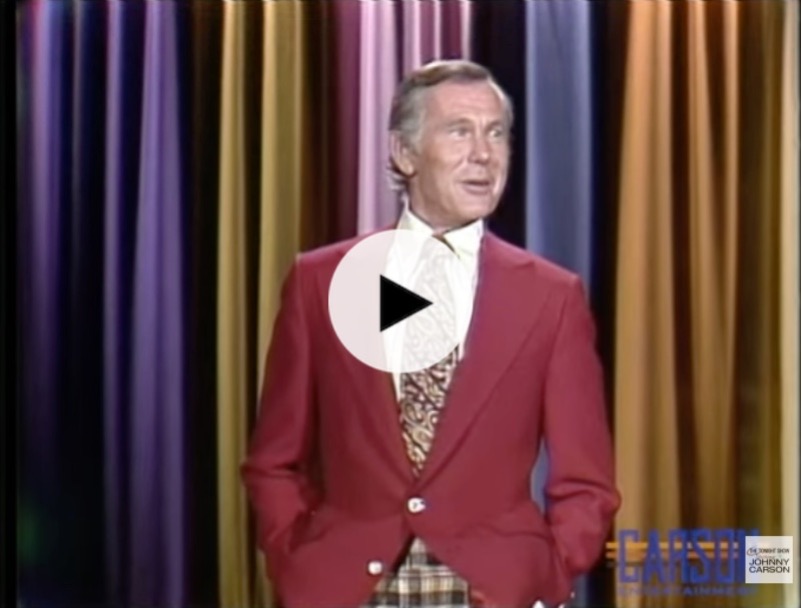
The hoarding was severe enough that at least one manufacturer — Scott — had to ration its wholesale shipments to retailers. Supply was no problem — only demand.
In time, Carson felt compelled to apologize on-air. “I don’t want to be remembered as the man who created a false toilet paper scare.”
At least nothing of the sort is happening here again. Well, not yet…


