
Wartime Sacrifice
 Wartime Sacrifice
 This boomer billionaire has an important message for the little people about wartime sacrifice.
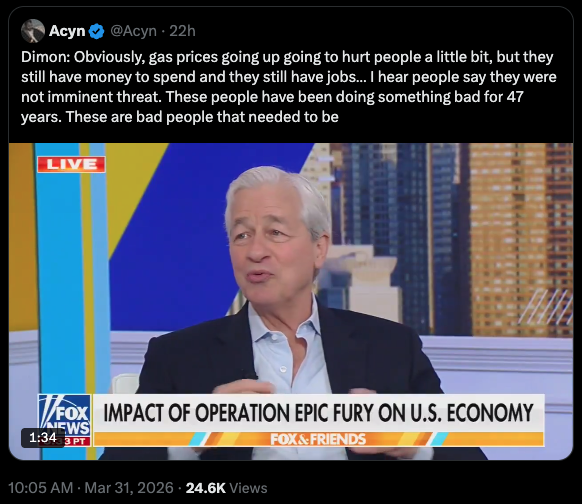
Say this much: JPMorgan Chase CEO Jamie Dimon has balls to go with his billions.
He oversees a bank that was lavished with bailouts in the aftermath of the 2008 financial crisis… copped pleas to five federal felony counts between 2014–2020 (three of them involving market-rigging)… and conducted business with the financier and sex offender Jeffrey Epstein long after supposedly dumping him as a client.
A real model citizen there.
So yes, Mr. Dimon, please tell us in flyover country how we should be grateful for our $4-a-gallon gasoline to transport us to the second and third jobs we need to to make ends meet!
As it happens, JPM shows up on a new “hit list” of U.S. corporations supposedly in the crosshairs of Iran’s Islamic Revolutionary Guard Corps.
The IRGC issued a statement yesterday after U.S.-Israeli airstrikes killed a member of the IRGC’s general staff. We’ve seen a couple of translations. This one seems reliable…
From now on, for every assassination, an American company will be destroyed.
Our repeated warnings about the necessity to stop terrorist operations were ignored, and today, following your terrorist attacks and those of your Israeli allies, several Iranian citizens were martyred.
Since the main element in designing and tracking assassination targets are American ICT [information and communication technology] and AI companies, in response to these crimes, from now on the main and effective institutions involved in terrorist operations will be our legitimate targets.
We advise the employees of these institutions to immediately leave their workplaces to preserve their lives. Also, residents of areas around these terrorist companies in all countries of the region, within a one-kilometer radius, should leave their homes and workplaces and seek safe places.
Companies actively involved in terrorist designs will be subject to retaliatory action for every assassination.
And then came a list of 18 companies. And a deadline…
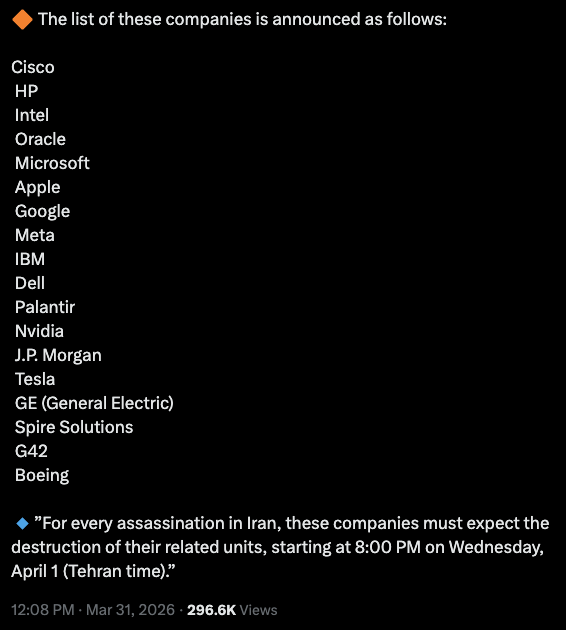
That deadline translates to 12:30 p.m. on the U.S. East Coast. In other words, it’s already passed by the time you’re reading this.
“We are taking steps to safeguard and support our workers and facilities in the Middle East and are actively monitoring the situation,” said a spokesperson for Intel — the first company on the list.
CNBC sought comment from every company on the list. JPM declined.
For whatever it’s worth, social media is rife with reports of short-dated put options on the companies in question, expiring today.
 The “War Is Almost Over” Rally
The narrative in corporate media today is that oil is down and stocks are up because the war is almost over.
“Stocks are higher to start the month as optimism around Iran war ending grows,” says a CNBC notification.
Donald Trump will deliver a big televised speech at 9:00 p.m. EDT tonight. Ahead of the speech he declared once again that Tehran is asking for a ceasefire. Once more, Tehran denies it. (Trump said the ceasefire request came from Iran’s “new” president; Iran has had the same president for nearly two years.)
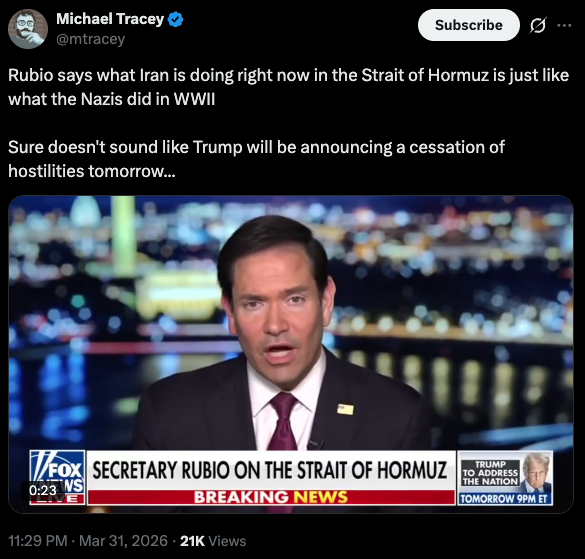
This much we know for sure: Comparing the enemy with Nazis doesn’t seem like the sort of rhetoric you engage in when an end to the conflict is at hand…
But hope springs eternal: A barrel of West Texas Intermediate is back under $100, sinking toward $99 in fact.
And the major U.S. stock indexes are solidly in the green once more today — the S&P 500 up nearly 1% at 6,589. The Dow’s gain is a little weaker, the Nasdaq’s a little stronger.
“We need to watch to see if this recovery is the real deal, or just a short-lived relief rally,” says Trading Desk editor Greg Guenthner. “Now that we’ve seen a sharp move off the lows, we’ll need to see continued upside follow through to confirm that this is indeed a significant low.
“What does that entail? For starters, I’d like to see continued afternoon strength in the averages. We need buyers stepping in during power hour (between 3:00 and 4:00 p.m.) to continue to push stocks higher into the close. Gap-up moves followed by late-day reversals aren’t going to cut it — and could likely lead to more chop. Every day doesn’t need to be like yesterday. But in order to build investor confidence again, we can’t have a bunch of ugly retracements.”
The precious metals rebound is gathering momentum — gold up another $100 and only $16 away from $4,800, while silver has crested $75.
Crypto is trying to get traction, Bitcoin approaching $69,000 and Ethereum back over $2,100.
The big economic number of the day is the ISM Manufacturing Index: Chalk up three-straight monthly readings over 50, suggesting a growing factory sector. The March number is 52.7 — better than expected and indeed the strongest performance since August 2022.
 War Disruptions
“The Chinese economy appears better positioned amid the oil supply shock than its global peers,” says a new report from Goldman Sachs. Better than the United States, too.
The report says crude oil and liquefied natural gas made up 28% of China’s primary energy consumption during 2024 — “one of the lowest in the world.” Meanwhile… nuclear, hydro, wind and solar make up 40% — up from 26% a decade ago.
What’s more, if China’s crude imports fell to zero, its crude reserves are good for well over three months of consumption (assuming government reserve figures are accurate).
Put it all together and Goldman’s economists figure the supply shock wlll knock about 0.2 percentage points off China’s GDP growth — compared with 0.4 for the United States.
Once more, the mainstream is playing catch-up on a major theme — the helium shortage resulting from Iran’s selective blockade of the Strait of Hormuz.
“The global supply of helium — the natural-gas byproduct better known for keeping party balloons aloft — is being squeezed by a halt in natural-gas exports from Qatar, the source of about a third of the world’s total,” The Wall Street Journal reported on Tuesday.
Gee, you don’t say: Paradigm natural resource pro Matt Badiali tipped us off here in 5 Bullets almost two weeks earlier — including the impact on everything from semiconductors to MRI scanners.
There is one tidbit in the Journal article that advances the story: Helium has a limited shelf life. Because stored liquid helium absorbs heat, it eventually turns back into gas and can escape its containers. That process starts between 35–48 days after helium goes into liquid storage.
Clock’s ticking…
 Artemis, SpaceX and a Slew of Space ETFs
We desperately need something fun and celebratory. Fortunately, as an 8-year-old Floridian tells the BBC, “People going up to the moon is kind of cool.”

About 400,000 people will be jamming Florida’s Space Coast for NASA’s launch attempt of Artemis II this evening at 6:24 p.m. EDT. On a 10-day test flight, four astronauts will aim to fly around the moon and perhaps even travel farther from Earth than anyone has before.
About six hours ahead of the scheduled launch, Elon Musk — always with a knack for timing — filed the IPO for SpaceX.
It’s one of those “confidential” IPO filings — which means we learn about it only because someone tells the media the paperwork has been sent to the Securities and Exchange Commission. That’s allowed for “emerging growth companies” under the JOBS Act of 2012.
Thus, the contents of the filing — especially the company’s financial performance — won’t become public until 15 days before the roadshow in which companies planning to go public try to woo potential investors.
(Although in the case of SpaceX, Musk is looking to have potential investors come to him — visiting the company’s facilities such as its Starbase near Brownsville, Texas.)
The Wall Street Journal previously reported that SpaceX hopes to raise as much as $80 billion with this offering. The company could be valued at $1.25 trillion.
The space buzz is such that “three new space ETFs launched last month,” says Paradigm tech specialist Ray Blanco.
March 5 brought the launch of MARS by Roundhill. Then came VanEck with an ETF with the ticker JEDI. And finally Tema debuted NASA — the first space ETF with direct SpaceX exposure.
“The ETF product cycle is one of the most reliable institutional confirmation signals in all of finance,” Ray says. “Fund companies don't build dedicated vehicles around a theme unless the allocator class — the pension funds, the wealth advisers, the endowments — has decided the sector is durable enough to justify permanent capital flows.
“And the mechanism is self-reinforcing. Every new space ETF becomes a passive bid underneath the stocks in that fund.
“Money comes in, managers buy the holdings. It's mechanical. NASA launches with SpaceX as the hook, which pulls in a whole new wave of retail and adviser capital. And those investors discover the public pure plays sitting right underneath — names that may be still relatively small-cap and thinly traded.
“That's a structural supply/demand imbalance in the making. Wall Street isn't debating whether the space economy is real anymore. The machinery is already in motion.”
 Mailbag: “Just What Did I Pay For?”
We heard from still more readers who want to get a thing or two off their chests, following our mailbag sections yesterday and the day before.
“When I signed up for Rickards’ Strategic Intelligence, I thought I was getting some information that would help identify some companies that the investor may want to consider. Instead all I get is someone pitching over a long redundant video that urges me to buy someone else’s subscription annually, usually at $1,500.
“Unless I am missing something I really don’t know what I paid my $250 for.”
Dave responds: If all you’re getting are sales pitches for our high-end advisories, something is seriously wrong.
For a $250 pro-level subscription to Rickards’ Strategic Intelligence, you should be getting monthly issues complete with at least one investment recommendation (often two or three)… updates at least twice a week from Jim and his team… twice-a-month briefings for pro-level subscribers only… and regular conference calls for pro-level subscribers only.
I’m sure there are more benefits — those are just the ones off the top of my head. If you’re missing out on any of those things, please get in touch with our customer care team. Use this web form or call 1-844-731-0984.
And to the reader who accused us of “pump and dump”... we never engage in such practices.
If you bought a stock recommended in Altucher’s Investment Network and the share price happens to be down from the time of recommendation, follow the guidance from James and his team.
If they still have conviction in the stock’s long-term viability, it will be listed as either a “buy” or “hold” on the portfolio page. If they personally hold a position in that stock, we disclose that up-front. More to your point, if they believe it’s time to sell, they will tell you first before selling their own position.
That’s the policy at all our publications — because it’s the only honest way to do business.


