
It’s Not Just Oil That’s Messed Up
 It’s Not Just Oil That’s Messed Up
 “What comes out of the Persian Gulf is more than oil,” Jim Rickards wrote this week to his Strategic Intelligence readers.
We hit on this fact on Day 10 of the war. Now at Day 26 it merits our attention once more.
“About 20% of the world’s liquid natural gas (LNG) comes from the region,” Jim says. “It is also a major source of synthetic nitrates used as fertilizer — an input that is indispensable to farmers in developing economies like India and Brazil. Without nitrogen fertilizers for the coming planting season, hundreds of millions of people may face severe food shortages.”
And while famine might not hit the United States, Americans will still feel the impact.
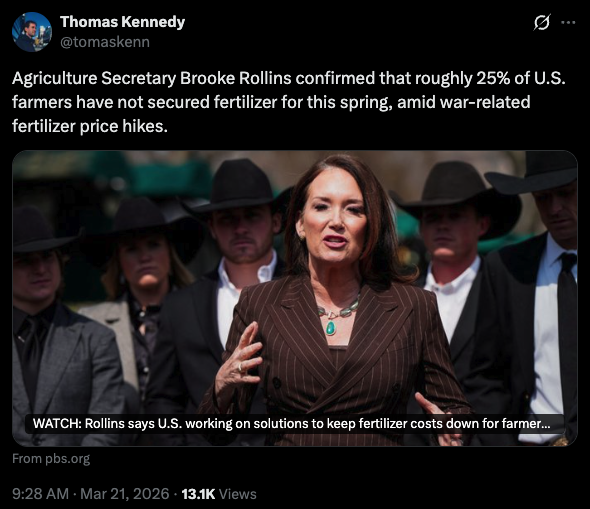
“Oil itself is about more than gasoline,” Jim adds.
“In refined form, it produces jet fuel (kerosene), diesel fuel (for trucks, trains and heavy equipment) and a wide range of distillates used in plastics, lubricants and industrial processes. Natural gas is used in some vehicles, but primarily for home heating and electricity generation.
“When you look at gas prices — up roughly 33% in the past month for regular grade — the inflationary impact of higher oil prices is obvious. But the effect extends far beyond the pump. Everything you buy is transported by truck, train, plane or ship, all of which depend on oil distillates or electricity generated largely from natural gas.
“In short, higher energy prices mean higher prices for nearly everything.”
Diesel prices are now over $5 a gallon — up 44% since January.
“Markets still expect the war to be resolved quickly, with a return to normal traffic through the Strait of Hormuz. Neither expectation is realistic,” Jim goes on.
The “productive conversations” the president mentioned on Monday that moved markets?
According to Iran’s semi-official news agency Fars, Tehran formally rejected a 15-point ceasefire proposal from Washington this morning… and said any talks at this time would be “illogical.”
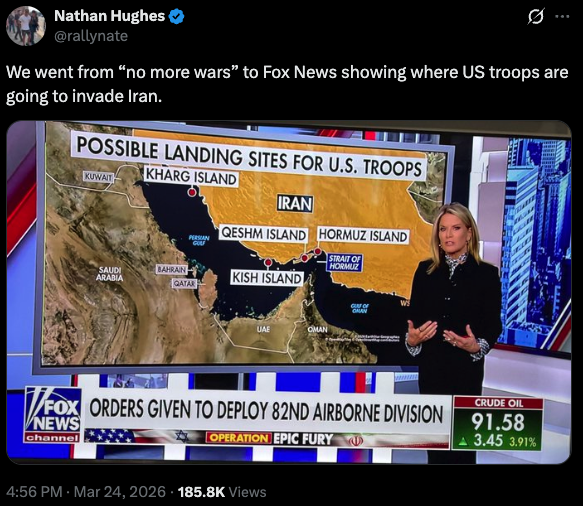
The longer the Strait of Hormuz remains shuttered, the worse the trouble becomes.
“Shortages would emerge not only in crude oil but also in refined products,” Jim says. “And restarting production is not as simple as flipping a switch. It can take weeks to restore output, and prolonged shutdowns risk permanent damage to well pressure and flow rates.
“The situation in LNG may be worse. Damage to Qatar’s Ras Laffan export facilities from Iranian strikes could leave a significant portion of capacity offline for years. Ras Laffan alone accounts for about 20% of global LNG supply.
“Investors may be bracing for higher prices. What they are not fully accounting for are outright shortages, industrial shutdowns, long-term infrastructure damage and breakdowns in the systems that support global energy markets.”
 Markets Today: Oil Retreats, Bonds Stressed
Stocks are rallying, oil is falling… and the mainstream has settled on a narrative that U.S.-Iran negotiations are nigh, despite what you read in Bullet No. 1.
Really, the action isn’t that dramatic. The S&P 500 is up a half percent, approaching 6,600. The gains in the Dow and Nasdaq are a bit stronger.
Meanwhile a barrel of West Texas Intermediate is down 2% to $90.48 — even as certain Middle East grades are trading for $170 and higher. True, there’s a “war premium” on those grades… but an $80 premium continues to be beyond the pale for many observers on social media.
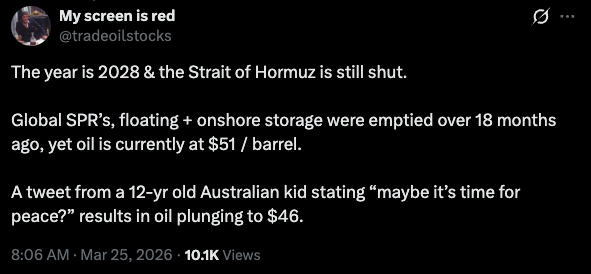
An additional constraint on global oil supply: According to new calculations by the Reuters newswire, at least 40% of Russia’s crude export capacity is offline “following Ukrainian drone attacks, a disputed attack on a major pipeline and the seizure of tankers.”
Precious metals are back on the rally tracks — gold up nearly $80 to $4,552 and silver up $1.37 to $72.48. Crypto remains range-bound, Bitcoin still over $71,000 and Ethereum just under $2,200.
Meanwhile, there’s trouble brewing in the bond market.
The U.S. Treasury auctioned a batch of 2-year notes yesterday. It went “miserably,” to use the words of a strategist at Capitol Securities Management.
“Reports of Pentagon plans to deploy roughly 3,000 soldiers from the Army’s 82nd Airborne Division to the Middle East were blamed Tuesday for a weak $69 billion sale of 2-year Treasury notes,” says MarketWatch.
“Typically, 2-year auctions go largely unnoticed beyond the dealers and buyers involved in the roughly $30 trillion Treasury market. It’s often a place where safe-haven seekers and corporations can park cash for a while and earn a bit of yield. The auction starts and buyers line up.”
Not yesterday. Weak demand translates to rising rates… and the 2-year yield soared 0.096 percentage points to 3.926% — the highest in nearly eight months.
The stress spilled over into the benchmark 10-year note, where yields jumped back over 4.4%.
For the moment, that stress is receding, the 10-year back under 4.32%. All eyes now are on an auction of 5-year notes this afternoon…
 SpaceX Makes Waves, a Competitor Makes Moves
Just as happened during SpaceCom in Orlando in January… major SpaceX news is breaking during this week’s Satellite 2026 gathering in Washington, D.C.
Back then it was SpaceX’s merger with another Elon Musk company, xAI. Now Bloomberg and Reuters report that SpaceX is looking to file its IPO prospectus as early as this week.
“I'm watching it break in real-time, surrounded by the people building the industry it's about to put a price tag on,” says our Ray Blanco from the convention floor.
“The market is about to officially value space-based connectivity at over a trillion dollars. And I've spent the last two days on the ground with the companies riding that same wave.”
Ray met up with the guy building the biggest rival to SpaceX’s Starlink satellite venture — Scott Wisniewski, president and chief strategy officer at AST SpaceMobile (ASTS).
 And Ray (on the right) has the photo to prove it…
“While every headline was about SpaceX, I was standing on the exhibit floor with the man running commercialization for the company I believe will dominate direct-to-device connectivity from space,” Ray writes on the Paradigm mobile app.
As Ray said in yesterday’s edition, ASTS has the advantage of existing partnerships with all the major wireless providers. What’s more, it has the technology enabling you to make satellite calls using the phone you already have in your pocket.
The company’s next big step is the BlueBird 7 satellite launch just five days from now aboard Blue Origin's New Glenn rocket. By year-end, as many as 60 similar satellites will be in orbit.
“The SpaceX IPO tells the world space connectivity is a trillion-dollar market. I agree. ASTS is how I'm playing it.”
 OpenAI: The Real Story About Sora
The big story in AI today is not what the media are making it out to be.
OpenAI, the privately held company behind ChatGPT, has shut down its AI video-making platform called Sora.
Sora burst on the scene less than two years ago — wowing users with its ability to make realistic-looking videos that were once the province of Hollywood studios with sophisticated CGI capabilities.
From the get-go, copyright was an issue: Users were pilfering existing videos and using Sora to edit, remix and otherwise modify them. The furor was such that in December, OpenAI struck a $1 billion content partnership with Disney — under which ChatGPT users got access to Disney and Marvel characters to create their own AI-generated images and videos.
So much for all that: Less than four months later, Sora is toast and OpenAI will wind down the DIS partnership.
But the real story is where OpenAI says it’s directing its resources instead.
The money and brainpower that the company was dumping into Sora? It’s being diverted to the two things that Paradigm’s experts have said mark the new frontier in AI — robotics and AI agents.
Or as OpenAI said in a statement to the BBC, it’s focusing on endeavors “that will help people solve real-world, physical tasks.”
With this shift, OpenAI is acknowledging there are limits on available capital, on computing power and on energy. Scarce resources have to be devoted to efforts that will enhance productivity — rather than time-sucks like a video of SpongeBob running away from the cops.
By the way, you can still use ChatGPT to make still images. That doesn’t soak up nearly as much computing power or energy.
➢ Meanwhile, Disney probably isn’t out any money. The $1 billion DIS was going to “invest” in OpenAI? As Paradigm trading pro Enrique Abeyta told us at the time of the announcement in December, OpenAI was paying DIS not in cash but with warrants to buy OpenAI stock. “Those are likely well in the money and Disney would only put the $1 billion investment in IF they were so — in fact — while Disney WOULD be investing $1 billion into OpenAI, they likely would be making much more money than that.”
 Mailbag: Medicines and the Strait of Hormuz
“Drugs through the Strait of Hormuz?” writes a perplexed reader after Saturday’s edition about still another supply-chain snag resulting from the war.
“Sorry, but no matter how cross-eyed I look at a world map, I can't find a reasonable shipping track from India to the United States through the Strait of Hormuz. Did you maybe mean the Bab al-Mandab Strait between Yemen and Djibouti? At least that makes some sense. Geography can be tricky when you're being shot at.”
Dave responds: Ummm… We thought it was self-evident that the issue isn’t with the finished products from India, but rather with some of the ingredients that go into those drugs. (Medical-grade plastics also transit the Strait of Hormuz.)
Among the potential shortages that are looming — antibiotics, diabetes drugs like metformin, blood pressure meds and even cancer therapies.
As the saying goes, actions have consequences…


