
Markets Love a Villain
 Markets love a villain.
This week’s villain, according to the mainstream narrative, is Greenland — or rather, the idea that the U.S. administration’s trade posture is spooking global investors. That story is neat, politically satisfying… but wrong?
Yesterday, Treasury Secretary Scott Bessent said something revealing — and far less convenient — when asked about the sudden volatility in global markets.
The Japanese bond market had a six-standard deviation move for the past two days. That would be in their 10-year bonds. I’ve been in touch with my economic counterparts in Japan, and urged them to take the necessary measures to stabilize their bond market.
But that’s spilling over into all bond markets. German yields are up. French yields are up. U.S. yields are up. Again, it’s mostly the Japanese bond market. It’s got nothing to do with Greenland.
Of course, Bessent is speaking in the administration’s self-interest. But what if he’s right?
To understand why he might be, you have to look past headlines and into the scaffolding of global markets — specifically, the quiet role Japan has played in financing risk around the world.
 “For years, global markets have been floating on something they barely talk about,” writes Sean Ring, editor of The Rude Awakening. “No, not earnings. Or productivity. Try this: cheap yen.”
For decades after Japan’s 1989 stock market collapse, the Bank of Japan held interest rates near zero, turning the yen into the world’s cheapest and most predictable source of borrowing.
Global investors borrowed yen, converted it into other currencies including dollars and euros and invested in higher-return assets abroad.
The power of this yen carry trade was the cheap, steady funding behind it. As long as borrowing costs stayed low and stable, the trade worked.
But that stability is now under strain.
Recently, Japan’s 10-year government bond yield has surged to 2.34% — a level not seen in over 25 years.
“To Americans used to 4–5% Treasuries, [that] might not sound dramatic,” Sean adds, “but in Japan it’s seismic.”
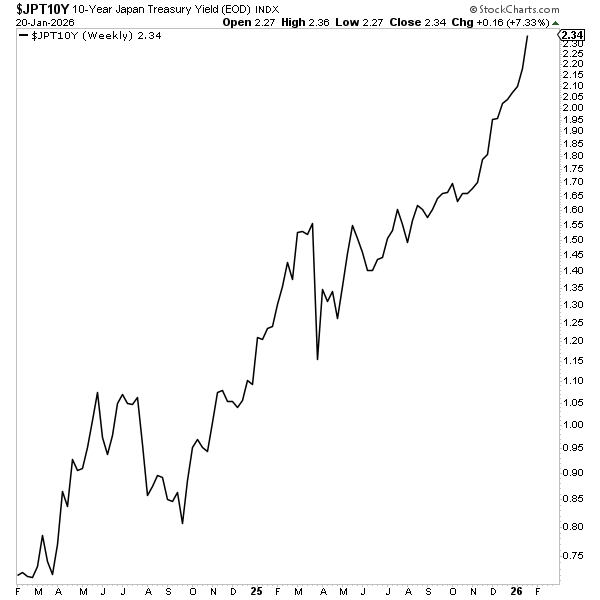 Sean: “This is not the gold chart. It’s the Japanese 10-year yield.”
Japan carries public debt well north of 250% of GDP. Its fiscal system functions because interest costs have long been suppressed. But when yields rise, markets start asking questions that haven’t mattered in years.
“Borrowing in yen is no longer free,” Sean writes. “What’s worse is that it’s no longer predictable.” That uncertainty is lethal to leveraged trades.
Complicating matters further, Japan is dealing with a weak yen.
Higher bond yields usually strengthen a country’s currency. But despite rising yields, the yen remains historically weak as markets weigh Japan’s shifting fiscal policy.
Notably, the yen carry trade relies on thin margins. Investors borrow cheaply in one currency and invest elsewhere, assuming exchange rates won’t move sharply against them. The real risk isn’t that the yen stays weak — it’s that it suddenly strengthens.
If that happens, borrowing costs jump immediately. Losses appear quickly. Brokers issue margin calls, demanding fresh cash or collateral to offset losses. Positions are closed under pressure.
When carry trades unwind? “They die,” Sean says. “Violently.”
An unwind of the yen carry trade spreads far beyond Japan. It shows up in portfolios everywhere. Estimates of yen carry trade exposure run into the trillions of dollars; even a partial unwind can move markets fast.
And the sequence of events follows a typical pattern:
- Japanese bond volatility spikes
- Funding assumptions break
- And leveraged traders face margin pressure.
They sell whatever they can — not because something is wrong with those assets, but because those assets are liquid. “U.S. equities… Emerging-market ETFs… Crypto,” Sean says. “They just happen to be the piggy bank.”
This is why these episodes seem arbitrary. “Earnings didn’t collapse. Consumers didn’t suddenly stop spending.” Instead, a hidden spigot quietly turns off.
 The 2024 Warning Shot
If this all feels familiar, it should. In the summer of 2024, global markets seized up after a Bank of Japan rate hike — and, more importantly, signals that more tightening could follow.
After a quarter century of near-zero rates, many investors had built portfolios on the assumption that yen funding would always be available. When that assumption wobbled, assets around the world were sold to close positions.
As our managing editor Dave Gonigam wrote in the aftermath, the subtext from Tokyo was essentially: “We’re really sorry about screwing up global markets for three days.”
The Wall Street Journal that day: “A week after Japan’s top central banker shook up global markets with comments about raising interest rates, one of his deputies walked them back [and] promised not to raise rates when markets are unstable.”
That reassurance worked. Selling pressure eased. Markets stabilized. What didn’t change was the underlying dependence on cheap yen funding.
This isn’t about Japan “screwing up” the world. “Japan is the match, not the gasoline,” says Sean.
“The gasoline is global leverage built on cheap funding” in a market already “priced for perfection,” Sean says wryly — where assets are expensive, the reward for taking risk is thin and many investors are crowded into the same trades.
“Wall Street,” Sean concludes, “never prices this stuff in until it has to.”
That’s why Bessent’s comment matters. If this volatility were truly about Greenland or tariffs, you’d expect a contained reaction.
What we’re seeing instead is broader stress — the signature of funding problems, not trade headlines.
When the quiet engines that support risk assets start to sputter, markets test them. Hard. That doesn’t mean collapse is imminent. It does mean a hidden support beam is cracking.
The U.S. stock market’s in recovery mode today. The three major indexes have flipped to green, with the Dow up 0.60% to 48,785… the S&P 500 up 0.50% to 6,830… and the tech-heavy Nasdaq up 0.35% to 23,035. (As we understand it, Trump says U.S. military intervention in Greenland is off the table.)
For the most part, commodities are likewise in green territory. The price of oil’s up 0.65% to $60.75 for a barrel of West Texas crude. At the same time, gold’s marching higher: up 1.65% to $4,845.70 per ounce. Silver, on the other hand, has pulled back 1.60%, but still above $93.
The crypto market, however, is getting clobbered. Bitcoin’s down 1.35% to $88,300 while Ethereum’s slipped 2.50% to $2,920.
 China’s Cold Reality
China can build all the solar panels it wants. But the country still runs on coal.
In 2024, coal supplied about 60% of China’s primary energy, with oil around 20% and natural gas around 9–10%, according to the IEA and EIA.
- China’s dependence on coal is not merely large — it’s historically unprecedented. The country now burns about 56% of all coal consumed globally, roughly twenty times the combined usage of the European Union
- Since 2000, China has tripled its coal consumption. The increase alone over that period is eight times larger than total U.S. coal use today.
Whatever China’s climate ambitions may be, its energy system remains overwhelmingly carbon-intensive.
And yet Western media coverage routinely portrays China as a climate leader.
This tendency has intensified since Donald Trump returned to the White House, as comparisons between U.S. rhetoric and Chinese industrial policy have become a narrative device.
In late September, for instance, major media outlets framed China’s incremental climate gestures as meaningful progress “next to Trump’s retreat.” Early this month, Foreign Policy went further, asking whether China could “replace an absent America in the climate fight.”
One passage from that article neatly captures the prevailing view: Chinese officials, it argues, “never bought the argument that emissions reductions would cause economic harm,” instead embracing clean technology as a defining industry of the 21st century.
The problem is not that this statement is false. It’s that it’s incomplete to the point of being misleading. Chinese officials never feared economic damage from emissions reductions — because they have never meaningfully reduced emissions.
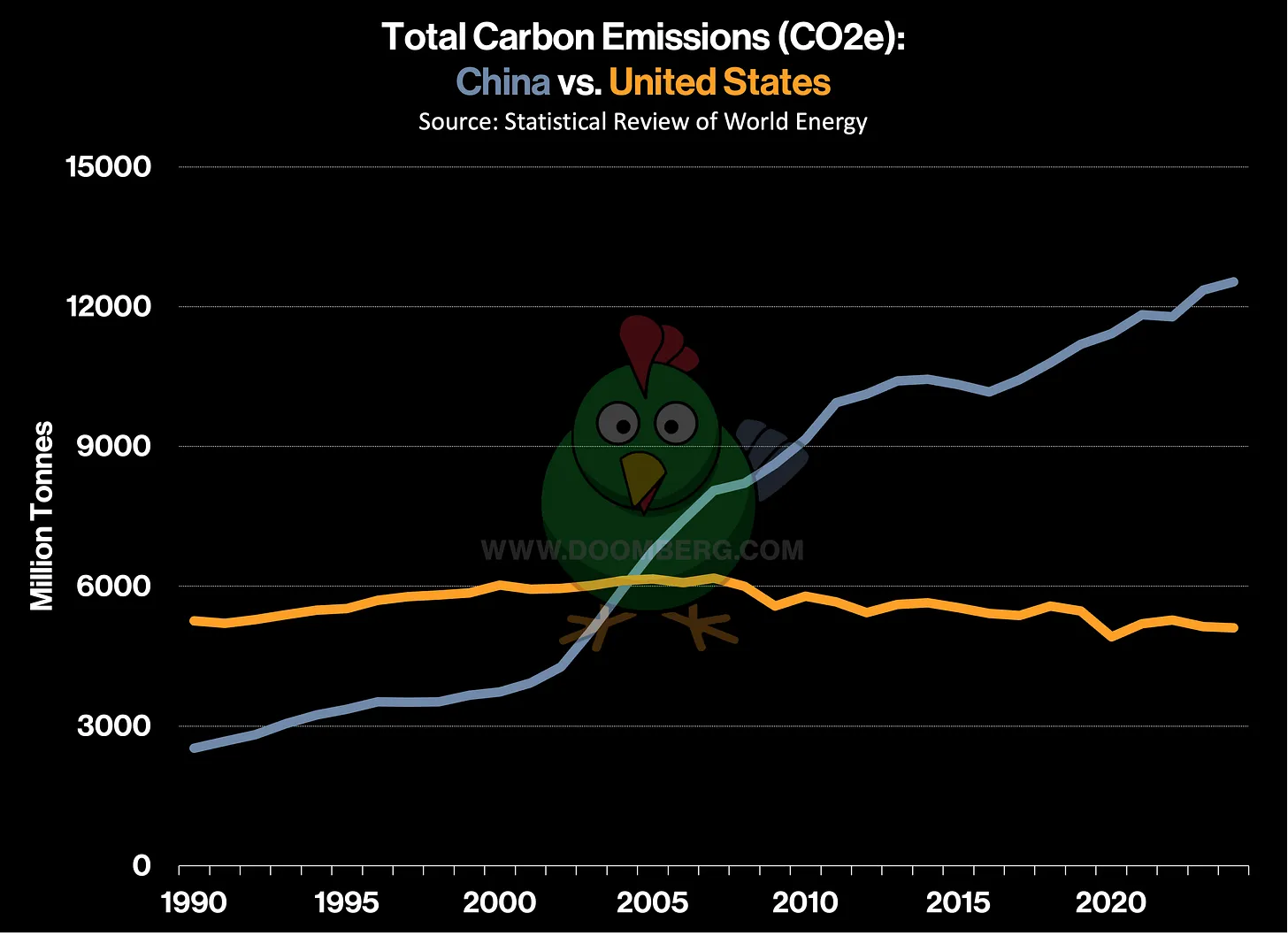 Source: Statistical Review of World Energy, Doomberg
On the contrary, China has continued expanding coal production, approving new coal plants and increasing total fossil-fuel consumption even as it dominates global manufacturing of solar panels, batteries and wind turbines.
The confusion deepened in October, when the British think tank Ember released its midyear review of global electricity trends. Headlines quickly followed, proclaiming that renewables had overtaken coal in global power generation and that China’s “clean energy growth” was driving an irreversible transition.
But Ember’s claims apply narrowly to electricity generation, not total energy use — and only over a six-month window. Coal remains indispensable to China’s industrial economy, heavy manufacturing, steelmaking and chemical production. Electricity statistics do not capture those realities.
China is building renewables at scale. It is also burning more coal than the rest of the world combined. Both can be true at the same time — and they are.
 Quiet Luxury?
First-class is supposed to be the airline’s show pony — the partitioned place where things are more refined and faintly aspirational.
Which is why the meal shared by X user and imaging scientist Peyman Milanfar didn’t land. Flying first-class on United Airlines, Milanfar posted a photo of what was described as a “salad.”
The bowl was full — no shrinkflation here — but the contents were gravely unappetizing…
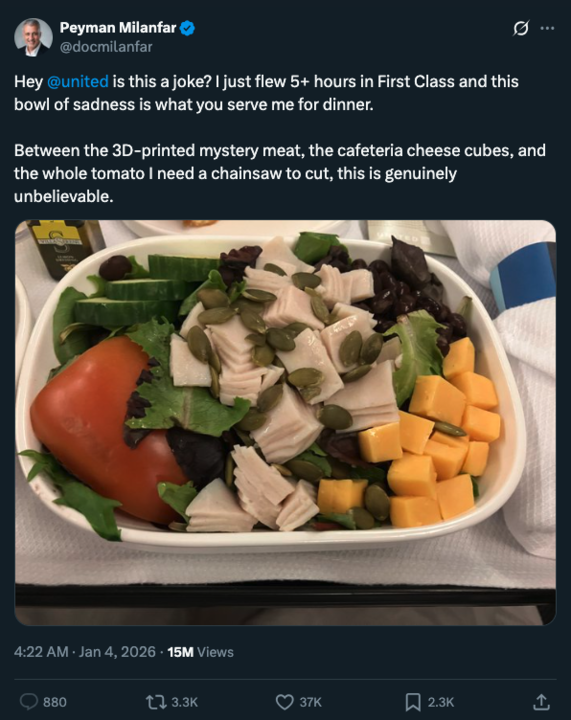
In an era of higher fares, airline food has become emblematic — a reminder that paying more no longer guarantees better. Starting with the meal.
 Trump’s Report Card
“Reading The 5 had me recapping 2025. It’s been a mixed bag for me,” says our first contributor today.
“Bad:
- I work for a government contractor. DOGE activities resulted in many cancelled contracts, and the company laid off 20% of its workforce
- Despite the above, the government is still spending way more than it receives in revenues
- Lots of large pendulum swings with markets
- Where is the accountability for the sins of the past?
“Good:
- Lower taxes
- Enforcement of immigration laws
- Lower gasoline prices (not so much with anything else, though).
“Generally, I have been OK financially because I got lucky and avoided the layoff ax, but it was close. I just don’t understand how DOGE caused all that uproar yet the government is still spending like a drunken sailor.
“People in the U.S. have to suffer immensely, I guess, before they actually vote out the fraudsters in Congress.”
“A high-energy, business-savvy patriot without career political baggage has replaced a ruinous puppet as leader of the free world,” writes an optimistic contributor.
“America's future — including AI and reshoring — appears unprecedentedly bright, despite China, Russia and Iran. Investing in Rickards’ opportunities has proven very beneficial.”
We love hearing that Rickards’ trades have made a measurable difference! And we’re thrilled by the volume of your replies, grading Trump’s presidency, one year into his second term.
If you didn’t get a chance to write in, feel free — the inbox is always open.


