
The Bad News Budget
 The Bad News Budget
 It’s an article of faith in the halls of government and corporate boardrooms alike: If you want to “bury” bad news, you release it late on a Friday afternoon — and then go home.
Nosy reporters calling with follow-up questions will get only voicemail. Meanwhile, everyday people are gearing up for the weekend and paying less attention to the news. Website page views go way down. In the pre-internet era, newspaper readership was always lowest on Saturdays.
So if you have no choice but to reveal something uncomfortable, you do it at the close of business on a Friday.
And so it goes with the release of Uncle Sam’s final budget figures for fiscal year 2026, which concluded Sept. 30.
The numbers came out late Friday afternoon. Thus there was no mention in the print edition of Saturday’s Wall Street Journal.
To the extent the media gave it any oxygen at all, it was to belabor the obvious. The deficit came in just shy of $2 trillion — up 12% from FY 2025. The only time it’s been higher was with the blowout COVID spending of 2020 and 2021.
But there are more interesting — and alarming — facts and figures to unpack in this bad-news budget.
Total federal spending reached $7.4 trillion in FY 2026. Adjusted for inflation, this figure is the third-highest in history — exceeded only by the COVID years of 2020 and 2021.
That’s mind-bending: After adjusting for inflation, the 2026 figure exceeds even the blowout spending of 2024 — when Democrats were pulling out all the stops to hold onto the White House.
Meanwhile, the 2026 deficit clocks in at 6.2% of GDP. The number has hovered around 6% every year since 2023. Aside from World War II, the 2008 financial crisis and the COVID pandemic, the number is never this high.
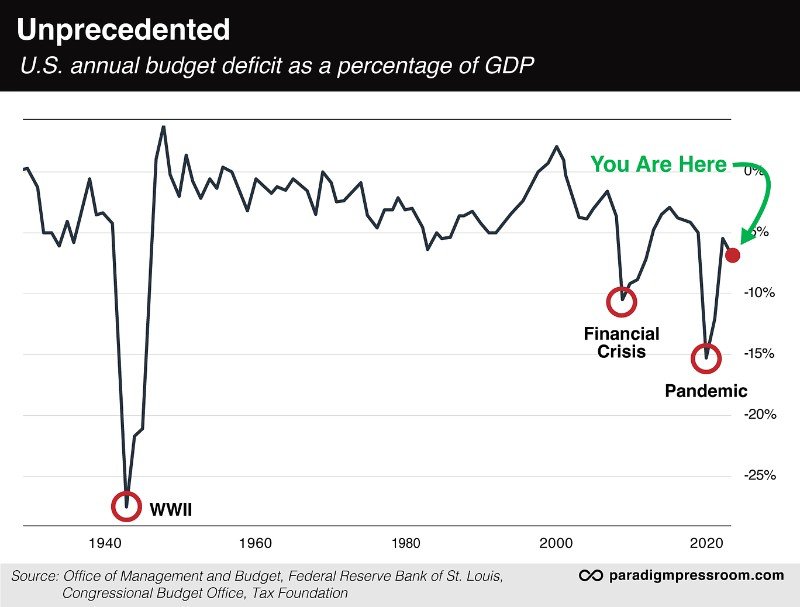
Treasury Secretary Scott Bessent came into office with his much-touted 3-3-3 plan — the first plank of which was to shrink the deficit to 3% of GDP by the end of Trump’s term. Your editor was skeptical he’d ever get there — and now Trump’s term has only 27 months remaining.
The investment takeaway is that medium- and long-term Treasuries are a loser.
Yes, rates are over 5% and that looks attractive in theory. But with binge spending like this, inflation will continue to wreak havoc on the economy and on your household.
Assuming annual inflation of 3% (and that might be conservative), the $1,000 you plunk down now on a 10-year T-note will have only $744 in purchasing power at the end of 10 years.
Back in the inflationary 1970s, Treasuries were known on Wall Street as “certificates of guaranteed confiscation.” We’re headed back to those days.
And then there’s the disaster of health care spending.
Spending by the Centers for Medicare and Medicaid Services totaled $2.735 trillion during FY 2026 — out of a total federal budget of $7.396 trillion.
That’s 37.0% of the entire federal budget. Thirty-seven cents out of every dollar spent by Uncle Sam is on the health care system.
That’s up from 35.4% the previous year — and 32.9% the year before that. An increase of four percentage points in only two years.
For perspective, it was “only” 25% when Obamacare began taking effect in 2010.
As we explored in depth last year, sooner or later something in the system is going to break catastrophically. The money just won’t be there for treatment of conditions like heart disease, stroke, cancer, diabetes, obesity and arthritis.
The stresses are already coming into view: Earlier this year a fright rippled through health insurance stocks when the Trump administration proposed holding its 2027 compensation for Medicare insurers at 2026 levels.
In the end, the administration relented and settled on a 2.48% increase. But this issue is going to rear its head every year from now on.
The financial planning takeaway: If you’re on a Medicare Advantage plan right now, it’s not too early to start thinking about what your world will look like when the system can no longer sustain these plans and your only option is a more costly Medicare supplement or “Medigap” plan.
 The S&P 500’s “Group Project” Problem
Remember those school projects where two students did all the work and everyone got a good grade? Wall Street has a version of that right now.
The S&P 500 holds roughly 500 companies, but a handful of technology giants are carrying most of the load.
In September, the index slipped just 0.45%. Its equal-weighted counterpart, tracked by the Invesco S&P 500 Equal Weight ETF (RSP), fell about 5%. That's more than 10 times the decline.
Meanwhile, more than 40% of S&P 500 stocks have recently traded at least 20% below their 52-week highs.
With the S&P 500 still trading near all-time highs, some folks are calling this a “stealth bear market” because a few large companies are pulling up the index.
Apple and Nvidia together represent roughly 16% of the index’s value. Wall Street calls this weak market breadth. A few giants are masking considerable weakness elsewhere.
History offers a reason for concern.
In 1999, Microsoft and General Electric dominated the market. Both posted big gains that year before later losing more than half their value.
But narrow leadership doesn't automatically mean another crash is coming. For evidence, look at RSP.
After September’s drop, RSP has climbed back from its low near $207 to around $215. It is still only about 4% below its recent high.
That’s not a market in free fall.
A sustained break below the September low near $207 would be more concerning. Until then, the weakness under the surface is a warning — not the last word.
It may also be an opening. While money keeps chasing the same AI names, profitable companies with growing dividends are getting less attention. Some will stay overlooked for a while. History suggests the current leaders will not stay the only stocks worth owning.
Just like school, a few overachievers may get all the attention, but that doesn’t mean the rest are doing nothing.
As for today’s action, it’s the tech giants outperforming again.
Thus the S&P 500 is up nearly three-quarters of a percent on the day — back over 7,700. But RSP is down about 0.2%.
The Nasdaq is up 1.5% at last check, while the Dow is flat.
Gold is down a bit but still holding the line on $4,100; silver is up 20 cents and back over $57. Bitcoin sits more or less where it did on Friday, a little over $82,000; Ethereum is just over $2,400.
After we hit “send” on Friday’s edition, U.S. oil futures sailed over $101 for the first time in nearly a month. This morning they’ve pulled back slightly but remain over $100.
The jump coincided with the release of a report by the UK Maritime Trade Operations agency stating that it is “struggling to accurately report the true number of attacks” on ships in the Strait of Hormuz — because a “majority” of vessels coming under attack are refusing to acknowledge they were attacked.
One economic number of note: We haven’t looked at homebuilder sentiment in a while, but oof — the Housing Market Index from the National Association of Home Builders clocks in for October at 29.
For perspective, any number under 50 suggests a homebuilder sector that’s contracting. For further perspective, the number hasn’t been this low since 2012, when the industry was still climbing out of the 2008 bust.
 Smaller Appetites for Big Brands
Americans are becoming less willing to pay extra for name brands.
PepsiCo, Hershey and Clorox all trade well below their highs. All three built businesses around products that could command a premium. But shoppers are now watching the price tags.
A study last June by consulting firm PricewaterhouseCoopers found that 21% of U.S. households included a GLP-1 user — up from 9% in January 2025. Among current users surveyed, 61% said they were buying fewer sweets and 56% fewer salty snacks.
Those numbers aren't welcome news for Reese's and Doritos. But weight-loss drugs can't explain it all.
Store brands are gaining ground as shoppers look for lower prices. In the first half of 2026, store-brand unit sales grew 0.2%, while national-brand unit sales fell 0.5%, according to the Private Label Manufacturers Association. Store brands captured a record 23.8% of units sold across the categories tracked.
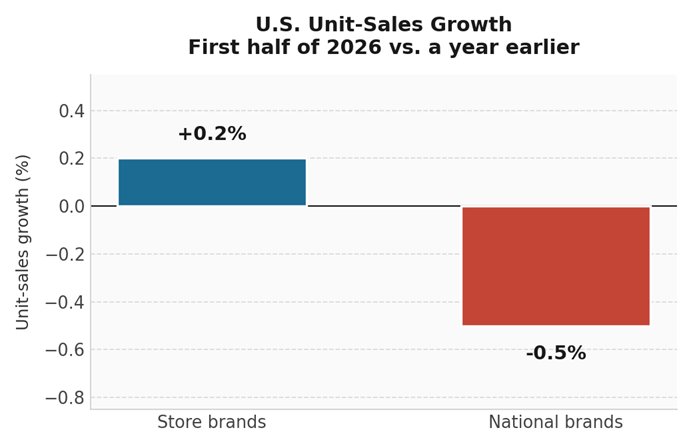
Source: PLMA/Circana, six months ended June 14, 2026
Hershey has leaned on higher prices. In the second quarter, its North American confectionery business recorded roughly 14 percentage points of price realization, while volume fell about 10 points.
As we noted last week, rising cocoa costs have already taken a toll on Hershey. Now higher prices are also discouraging some purchases, although shipment timing contributed to the decline.
PepsiCo tried the reverse. It cut suggested retail prices on Lay's, Doritos and other snacks by up to 15%. Its latest quarterly report showed growth in North American savory-snack volume and volume market share.
Mondelez (MDLZ) has had better luck with volume. The corporate name may not ring a bell, but Oreo, Ritz and Cadbury certainly do. In Q2, volume and product mix contributed 1.2 percentage points to its North American organic sales growth.
CEO Dirk Van de Put is also relatively unconcerned about GLP-1 drugs. In February, he estimated they could reduce Mondelez's worldwide sales volume by just 0.5–1.5% over a decade, assuming U.S. adoption reaches 10–20%.
Van de Put may be right. After all, American consumers account for only part of Mondelez's worldwide business.
Weight-loss drugs don't change how much bleach a household needs. Yet Clorox, too, is struggling with higher costs and value-conscious shoppers.
A famous brand can survive a bad quarter. Whether it can keep charging a premium is another matter.
 Comic Relief
The evolution of the workplace, in two pictures…

 Mailbag: Income Investing, Curbing Debt
“Nice article,” a reader writes after Zach Scheidt’s guest edition on Saturday.
The article prompted another reader to inquire: “So does that mean you're going to send trades that are less expensive, for the retired fixed-income crowd?”
I take it to mean that the subscription fees for our high-end services are beyond this reader’s means at this time. Rest assured Zach has income-generating ideas every month in one of our entry-level newsletters, Rickards’ Strategic Intelligence.
The wild growth in consumer price inflation since 2019 cited in Friday’s edition prompts a reader to write…
“I have wondered how it is that I happen to actually feel much more financially secure today than I did seven years ago.
“The answer is that during that period I took care to gradually eliminate all debt. While the change in net worth is hardly relevant to daily living, the effect of having eliminated all interest expenses has been huge. Now my net worth is actually increasing a bit every month. It feels fuzzy good.
“Thanks to reading the editors at Paradigm, my investing is also profitable. Thank you for all of the effort you dedicate to bringing together excellence in financial publishing. Over the years I have read many sources of financial opinion. It is the 5 Bullets that has consistently published important insight for me, every business day.”
Dave responds: Aw see, now you’re making me feel “fuzzy good.” Thanks for your kind feedback.


