
2026 Preview: Abundance and Volatility
 2026: Abundance, Crypto and Volatility Collide
 Last week in Baltimore, we put Paradigm’s best minds in one room with a single mission: Figure out what actually matters for investors in 2026.
Not the safe consensus calls. Not the recycled talking points. The real fault lines — the ideas that make people uncomfortable before they make money.
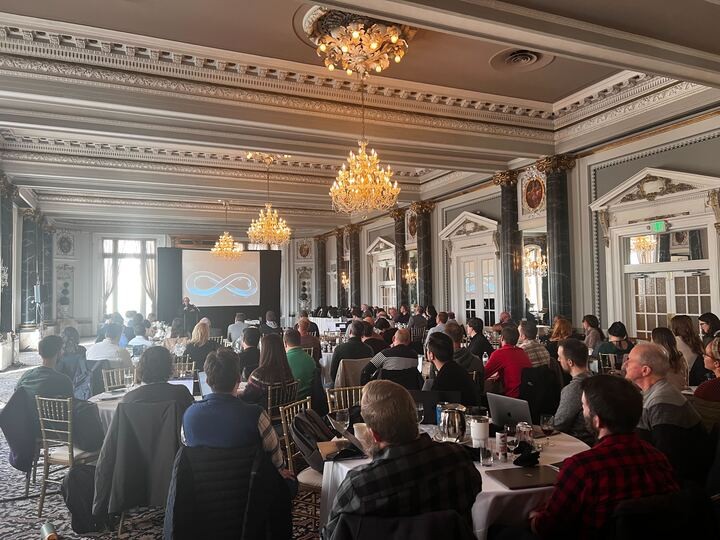
Paradigm’s team at the historic Belvedere Hotel in Baltimore (Dec. 11, 2025)
What followed was not a polite roundtable. It was a series of bold, sometimes unsettling forecasts that challenged almost every assumption Wall Street is leaning on today.
Here are three that stood out — and why they matter more than you might think…
Paradigm’s science-and-technology investor Ray Blanco flipped a familiar narrative on its head. Rather than focusing on collapse or crisis, Ray outlined a year defined by abundance.
One of his boldest calls: a renewed space race in 2026, what he describes as America’s next “Sputnik moment.” The driver this time isn’t nationalism, but infrastructure — specifically data centers moving into orbit.
Projects like Nvidia’s reported “Starcloud” concept are early examples of what Ray believes is coming next: orbital compute powered by continuous solar energy, reduced cooling costs and structural advantages that Earth-bound systems simply can’t match.
If it works, the implications ripple through AI, energy and national security.
Ray’s second prediction could be even more transformative. He’s tracking developments that point toward a functional cure for Type 1 diabetes. “Not treatment. Not management. A cure,” he emphasizes.
Ray is watching companies like Vertex (VRTX) and Sana Biotechnology (SANA) closely, with a preference for Sana’s “superior” approach, which aims to retrain the immune system rather than suppress it. If successful, the medical — and market — consequences would be profound.
The third pillar of Ray’s outlook is macro… and counterintuitive. He believes the economy is drifting toward deflation through abundance, not collapse. AI and robotics increase productivity. Reshoring and tariffs eventually stabilize supply chains.
Meanwhile, demographics quietly do the heavy lifting. An aging population, low birth rates and net-negative immigration reduce long-term demand across housing, health care and consumer goods.
Ray points to the Great Deflation of 1873–1896 as historical context — a period when prices fell for decades even as innovation accelerated and living standards improved.
The takeaway: Deflation doesn’t have to be destructive. Sometimes it’s the price of progress.
Chris Cimorelli, AKA Mr. 10X, zoomed out — then drilled down. His starting premise was simple: “Bitcoin is the best trade of the last century.”
But his real focus isn’t Bitcoin itself. It’s Bitcoin Cash (BCH) — a 2017 blockchain fork designed to preserve Bitcoin’s original purpose as peer-to-peer electronic cash. “Same 21 million cap,” Chris explains. “Same DNA. Different execution.”
Today, Bitcoin Cash hovers around $500 and sits just outside the crypto spotlight. Chris thinks that changes in 2026.
His thesis is that institutional investors — already stretched trying to gain meaningful crypto exposure — won’t be able to ignore BCH much longer. Especially if Bitcoin itself continues higher.
In his framework, a move in Bitcoin toward $150,000 creates a powerful opportunity for Bitcoin Cash. At minimum, he sees the potential for BCH to triple or quadruple. In a more aggressive scenario, he sees room for significantly more upside.
His blunt forecast: “2026: BCH 10X.”
Whether or not that exact number materializes, Chris’ core argument is that Bitcoin’s evolution into digital gold leaves room — and demand — for Bitcoin’s blockchain.
For his part, Paradigm’s chart hound Greg Guenthner asked: “Where’s the volatility?”
His answer: It’s coming. “We’re somewhere in the middle of the AI bubble,” Greg says. “That doesn’t mean it pops tomorrow. But it does mean the ride gets rougher.”
After years of relatively smooth upward momentum, he sees volatility returning in force — especially in the middle of 2026. Greg is watching Q2 and Q3 closely. A brewing malaise on Main Street and midterm election seasonality all point toward “volatility spikes.”
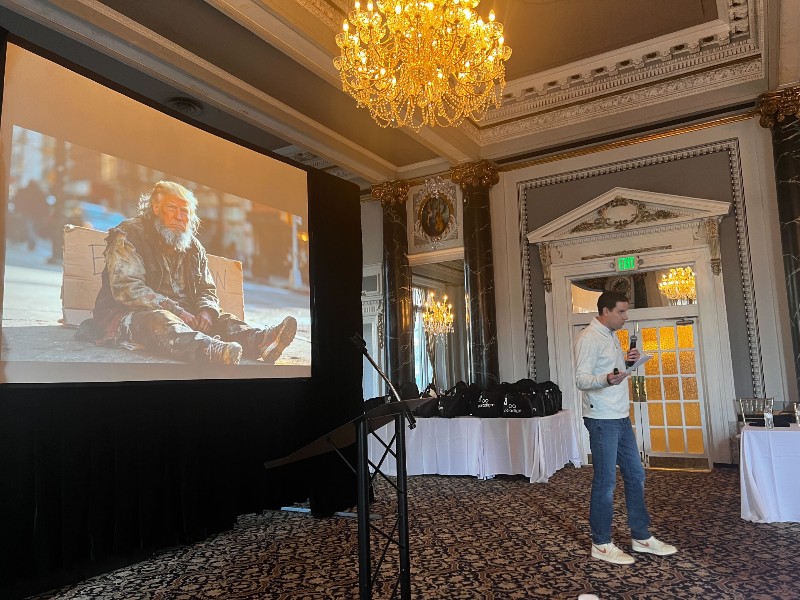
Greg Guenthner’s prize-winning presentation: “Polls look bad for Team Trump — Ohio and Iowa just flipped”
Greg highlights, in particular, structural changes at the Federal Reserve, noting a new Fed chair plus a shifting mandate could alter how markets price risk.
His bottom line for investors: “It’s about to get weird.” Stocks may still trend higher overall, but Greg doesn’t expect a straight line. Instead, he sees a target-rich environment — one where volatility creates opportunity for traders willing to stay flexible.
Bonus: Paradigm’s pro trader Enrique Abeyta reinforced Greg’s point with a history lesson. During the 1998 tech boom, he notes, the Nasdaq index suffered multiple corrections of 10% or more — driven by the Asian Financial Crisis and the LTCM collapse — even as it marched toward its eventual peak.
The lesson? Big secular bull markets don’t move in straight lines. They shake out weak hands first. And 2026, if our Baltimore summit is correct, will have plenty of thrills and spills.
 Labor Market Loses Momentum
November’s jobs report points to a cooling labor market. The unemployment rate increased to 4.6%, up from 4.4% in September and well above January’s 4.0% level. It’s the highest unemployment reading, in fact, since September 2021.
A wider gauge of joblessness, which captures discouraged workers and those forced into part-time roles, also moved higher, reaching 8.7% — a level not seen since August 2021.
The data also incorporated delayed figures from October, when total payrolls declined by 105,000 jobs after a surprise increase the prior month. Most of that drop came from the public sector, where government employment fell sharply as previously announced layoffs took effect. Government payrolls continued to edge lower in November.
The Bureau of Labor Statistics warned that fallout from the government shutdown is still affecting official numbers, raising the likelihood of uneven data in the months ahead.
All three major U.S. stock indexes are in the red so far today. The Big Board’s down most (-0.43%) to 48,215 while the S&P 500 is down 0.30% to 6,795. The tech-heavy Nasdaq, meanwhile, is down slightly to 23,050.
As for commodities, crude’s at its lowest level since 2021 — down 2.25% to $55.50 for a barrel of West Texas Intermediate. Similarly, precious metals have also slipped into red territory: Gold’s price has slipped to $4,335 per ounce while silver’s down 0.20% to $63.45.
Crypto, on the other hand, is attempting to scrape back some losses. Flagship crypto Bitcoin is up 2.25% to $87,780, and Ethereum’s up 0.65%, just under $3,000.
 The First AI Model Trained in Space
Starcloud says it has trained an AI model in orbit for the first time — a proof-of-concept that some machine learning might eventually run off-planet.
Last month, Nvidia-backed startup Starcloud launched a satellite carrying an Nvidia H100 GPU, a chip roughly far more powerful than any compute previously sent into orbit. Once deployed, the satellite trained NanoGPT, a model created by OpenAI founding member Andrej Karpathy, using the complete works of Shakespeare.
The result? A model that speaks in Shakespearean English — and, more importantly, one that proves large-scale AI training can happen out of this world.
Starcloud didn’t stop there. Its Starcloud-1 satellite is now also running Gemma, Google’s open large language model based on Gemini, marking “the first time in history that an LLM has been run on a high-powered Nvidia GPU in outer space,” according to CNBC.
“Greetings, Earthlings! Or, as I prefer to think of you — a fascinating collection of blue and green,” the satellite wrote, reports CNBC. “Let’s see what wonders this view of your world holds.”
The company’s ambition is bigger than clever demos. Starcloud wants to show that space can support full-scale data centers as power grids, water systems and permitting processes increasingly constrain terrestrial facilities.
Starcloud CEO Philip Johnston tells CNBC orbital data centers could run at a fraction of the energy cost.
“Anything you can do in a terrestrial data center, I’m expecting to be able to be done in space,” Johnston says. “And the reason we would do it is purely because of the constraints we’re facing on energy terrestrially.”
The International Energy Agency, for instance, projects global data-center electricity demand will more than double by 2030.
Johnston adds Starcloud-1’s ability to run Gemma shows that complex models can operate reliably in orbit.
“This very powerful, very parameter-dense model is living on our satellite,” he says. “We can query it, and it will respond in the same way that when you query a chat from a database on Earth, it will give you a very sophisticated response.”
In a statement to CNBC, Tris Warkentin, product director at Google DeepMind, says “seeing Gemma run in the harsh environment of space is a testament to the flexibility and robustness of open models.”
 How SpaceX Plans to Pay for Orbit
While startups like Starcloud test what’s possible, SpaceX is laying the financial groundwork to scale orbital infrastructure.
According to Reuters, SpaceX has opened a secondary share sale valuing the company at roughly $800 billion, as it prepares for a potential IPO as early as 2026. In a Dec. 12 letter to shareholders, CFO Bret Johnsen says the company is positioning itself for a public listing.
“We are preparing the company for a possible IPO in 2026,” says Johnsen. “Whether it actually happens, when it happens and at what valuation are still highly uncertain, but the thinking is that if we execute brilliantly and the markets cooperate, a public offering could raise a significant amount of capital.”
That capital, Johnsen says, would help ramp Starship’s flight rate and support projects including “deploy artificial intelligence (AI) data centers in space,” alongside moon and Mars ambitions.
But the driver behind SpaceX’s valuation is arguably Starlink. Reuters reports SpaceX expects about $15 billion in revenue in 2025, rising to as much as $24 billion in 2026, with most of that coming from Starlink’s satellite-internet business.
Musk reinforced that point himself, writing on X that “valuation increments are a function of progress with Starship and Starlink and securing global direct-to-cell spectrum that greatly increases our [market].”
Put differently, Starlink’s cash flow is what makes Starship — and future orbital infrastructure — economically credible. Starship may enable space-based computing. But it’s Starlink’s scale, revenue and global reach that justify the investment needed to get there.
 The Definition of “Slop”
In November, Amazon Prime Video began testing AI-generated video recaps, billed as a slick way for viewers to catch up on major plot points without rewatching entire seasons.
Think “Previously on…” but with machine efficiency and cinematic polish. What could possibly go wrong? Quite a bit, as it turns out.
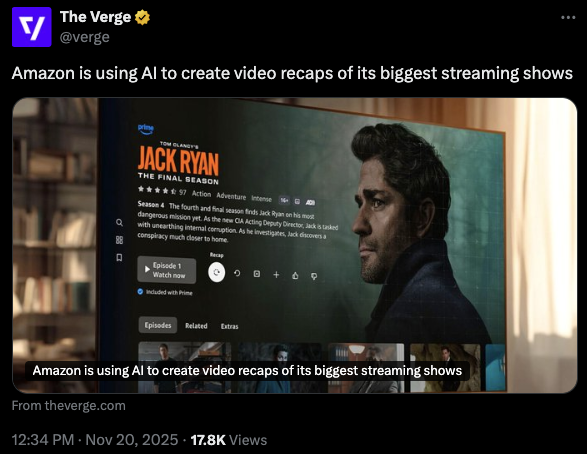
Welp, that didn’t age well…
Fans quickly noticed the AI recap for Amazon Prime’s hit show Fallout Season One seemed only loosely inspired by the source material.
One scene featuring Walt Goggins’ character Ghoul, for instance, was labeled a “1950s flashback,” presumably because it looked retro. But Fallout fans know the integral difference between the show’s midcentury aesthetic and its setting: year 2077.
For newcomers to the series, it was confusing at best and misleading at worst. Not long after fans pointed out this and other inconsistencies online, the AI recap quietly vanished.
This episode now joins a growing list of AI run amok. Apple paused an AI notification tool earlier this year after it repeatedly mangled news alerts, for example. And Google’s AI Overviews have been mocked for confidently wrong answers.
The machines, it seems, are excellent at sounding sure. Less so at accuracy.
In related news, Merriam-Webster crowned the word “slop” its 2025 Word of the Year, citing its growing use to describe low-quality, mass-produced AI content.
Timely.


