
AI’s “Really Weird Math”
 AI’s “Really Weird Math”
 We pick up today where we left off with last Thursday’s Bullet No. 1 — the probability that ChatGPT maker OpenAI will blow up before it ever goes public.
Or “the OpenAI-pocalypse,” as coined by Paradigm trading pro Enrique Abeyta.
Every few weeks, there’s a new “tell” about what’s coming. Last week it was a Wall Street Journal report revealing the company’s revenue grew 18% from the first quarter to the second — a respectable figure were it not for the fact it’s a fraction of the growth booked by OpenAI’s main competitor Anthropic.
If OpenAI had disclosed that information as a publicly traded company, “shares would have gapped down 30%,” says Enrique — who’s been on alert since late last year for a moment when everyone realizes the company is mostly hype and hot air.
That moment has not arrived yet — but something will trigger it sooner or later.
It comes back to the complexity theory championed by our macro maven Jim Rickards — or as he popularized it, “avalanche theory.”
“A single snowflake can turn a seemingly stable snowpack into a roaring avalanche that destroys everything in its path. Once the snowpack is arranged in an unstable way, a single snowflake can unleash carnage. Of course, a single snowflake is so small you never see it coming.”
Those revenue numbers last week were just the latest snowflake among many.
Today we’ll examine a few other snowflakes that continue piling up…
In January, OpenAI confessed to its own vulnerabilities in a paper with the obscure title “Ending the Capability Overhang.”
“The company boasted that ChatGPT had 800 million users, an impressive figure, yet only
50 million (6.3%) were willing to pay for the service,” writes fund manager Daniel Oliver at Myrmikan Capital.
“Of those paid users, the top fifth percentile used the service seven times more intensely than the median paid user.
“In other words, of the 800 million users, only 5% of the 6.3%, or 2.5 million users, demonstrate that they are getting any real value out of the $20 per month service.”
Per an article in Fortune two months ago, OpenAI booked $13 billion in revenue last year… and $21 billion in losses.
Further, CNBC reported six months ago that the company expects revenue through 2030 to total $280 billion… while it plans to spend $600 billion during that same period. (And that’s scaled back from a previous plan to spend $1.4 trillion.)
Unfortunately, bad things that might happen to OpenAI won’t necessarily stay contained to OpenAI.
More from Oilver: “Microsoft (market cap $3 trillion) reports $627 billion in back orders, half of which is just from OpenAI.
“The company has not yet hit the bond market for financing its foray into AI, but it has engaged in questionable accounting. For example, Microsoft invested $13 billion into OpenAI in 2023, but reportedly $10 billion of that figure was in the form of credits for OpenAI to use Microsoft’s cloud services. Microsoft then counts the use of those credits as revenue.”
Sounds crazy, right? But that’s routine when it comes to the industry’s “really weird math” described in a new book by author Cory Doctorow.
Under the partnership between these two companies, “Microsoft gives OpenAI ‘tokens’ that OpenAI can spend to access the computers in Microsoft’s data centers,” he writes.
“OpenAI books these tokens as investment revenue, at face value. This is some very funny accounting. The tokens Microsoft invests in OpenAI can only be redeemed for Microsoft data center access…
“The really weird math comes after OpenAI redeems its tokens with Microsoft to power ChatGPT and its other products: Microsoft books [those transactions as] AI-related revenue to its cloud-computing division.”
Doctorow uses the analogy of an ice cream parlor with video-game machines in the back. “To play these, you need tokens that you can get from the cashier in exchange for dollars. But the cashier likes you, so they give you $10 worth of video-game tokens to play, which you promptly pump into the Galaga machine.
“Using Microsoft and OpenAI’s funny accounting, the ice cream parlor has ‘invested $10’ in you (by giving you $10 worth of funny-money tokens), and then the ice cream parlor ‘earned $10 in revenue’ (when you pumped the tokens into the machine).”
We’ll reiterate a point we made on Thursday, a truism related by the investment newsletter legend Doug Casey: “Events that are inevitable aren’t necessarily imminent.”
So for now we’ll give Daniel Oliver the last word — suggesting that even the key players know on some level that something has the potential to end badly.
“The most telling comment from Microsoft’s [most recent] earnings call was from CEO Satya Nadella: ‘All of us are reading this 1873 as the book to be read.’
“Liaquat Ahamed’s latest book, 1873, tells the story of the burst of the railroad investment bubble and the ensuing ‘first great depression.’”
➢ As for Doctorow’s book, it’s titled The Reverse Centaur’s Guide to Life After AI. I won’t go to the trouble of explaining a “reverse centaur” today. I’ll almost certainly circle back to this book in a few days, seeing as I’ve barely started it.
 Markets Today: The Pros vs. the Mom and Pops
An intriguing divide is emerging in the U.S. stock market, says Paradigm analyst Zach Scheidt.
“Right now, professional investors are nervous, and retail traders are excited,” Zach writes for Altucher’s True Alpha. “The gap between those two camps is a solid litmus test for what we can expect in the coming months.
“Professionals tend to fixate on valuations, future earnings and growth rates. They answer to benchmarks and committees. They move slowly and they hedge their bets.
“Retail traders look at stories. They get fired up about a trend, they can move fast and they can concentrate their positions in a way the big institutions never could.
“Now, we'd rather be the nimble individual trader any day of the week. That's the whole edge of trading your own book. But it still pays to understand why the professionals are uneasy.”
Zach points to Snowflake Inc. (SNOW).
“The stock trades north of $300,” he says. “At that price, you're paying more than 100 times what the company is expected to earn next year, and still around 90 times what it's projected to earn two years out. That's the kind of valuation that only works if the growth story keeps getting more exciting from here, not less.
“This is what froth looks like because it doesn't even mean the stock can't keep running. Names like this can stay expensive far longer than anyone expects. But the risk baked into a valuation like that is real, and it's exactly the sort of thing that has the professional crowd sleeping with one eye open.
“None of that is a call to short Snowflake. We're pointing at it because it's a clean example of the exuberance running through parts of this market right now. Know what you own, and know what you're paying for it.”
As for the major U.S. stock indexes, they’re a mixed bag.
At last check, the S&P 500 is down more than a third of a percent to 6,745. The Nasdaq is down two-thirds of a percent, while the Dow is up slightly.
Recent winners in the Paradigm portfolios include a huge 547% gain in less than six weeks on ConocoPhillips call options in Rickards’ Insider Intel (more than enough to offset a loss on Venture Global).
On the short side, readers of Rickards’ Crisis Trader booked 85% gains on Thor Industries put options.
Mason Sexton has racked up a string of short-term stock wins in The Map — including 22% in a month on the big silver ETF SLV, and 18% on the “neocloud” name Nebius Group in only a week.
Elsewhere, bond yields are inching down for the moment — the 10-year note back under 4.7% and the 30-year bond at 5.23%.
Gold is soaring again — up 1.5% to $4,673, another high last seen in mid-May. Silver’s gain is more modest, but it’s still knocking on the door of $69 for the first time since June.
Crypto is moving from strength to strength — Bitcoin now only $150 away from the $80,000 level, the highest in over three months. And Ethereum has crested $2,500.
Two big events loom this week: Nvidia’s earnings report after the closing bell Wednesday, and Federal Reserve chair Kevin Warsh’s maiden outing addressing the annual confab of central bankers in Jackson Hole, Wyoming Friday. Watch this space…
 Hormuz Hallucinations
U.S. crude futures are down nearly 2% to $85.36 — perhaps still under the sway of Axios reporter Barak Ravid.
Over the weekend, Ravid posted a story citing “three U.S. officials” claiming that 40 oil tankers hauling 16 million barrels of crude transited the Strait of Hormuz on Friday — escorted by the U.S. military on the southern side of the strait near the coast with Oman.
The claim doesn’t remotely square with independent monitors like the analytics firm Kpler, which recorded zero tankers departing the strait Friday.
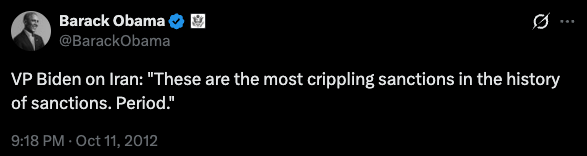
Later today Treasury Secretary Scott Bessent will formally roll out the Trump administration’s “Economic D-Day” plan of sanctions targeting Iran, supposedly so severe they’ve “never been seen in the history of the economic isolation of a country.”
Your editor expressed skepticism about that on Friday — which was reaffirmed over the weekend when someone started recirculating this tweet from Obamatime…
Meanwhile, the U.S. government’s Strategic Petroleum Reserve sits at 289.7 million barrels — the lowest since 1982.
For perspective, the SPR was over 400 million just before Donald Trump and Benjamin Netanyahu launched the Iran war six months ago. In fairness, it was over 600 million before Joe Biden started draining it to save the Democrats’ midterm election prospects four years ago.
A scary chart from Bank of America’s been making the rounds this morning. It shows the combined total of both private-sector inventories and the SPR, measured in days of available supply.
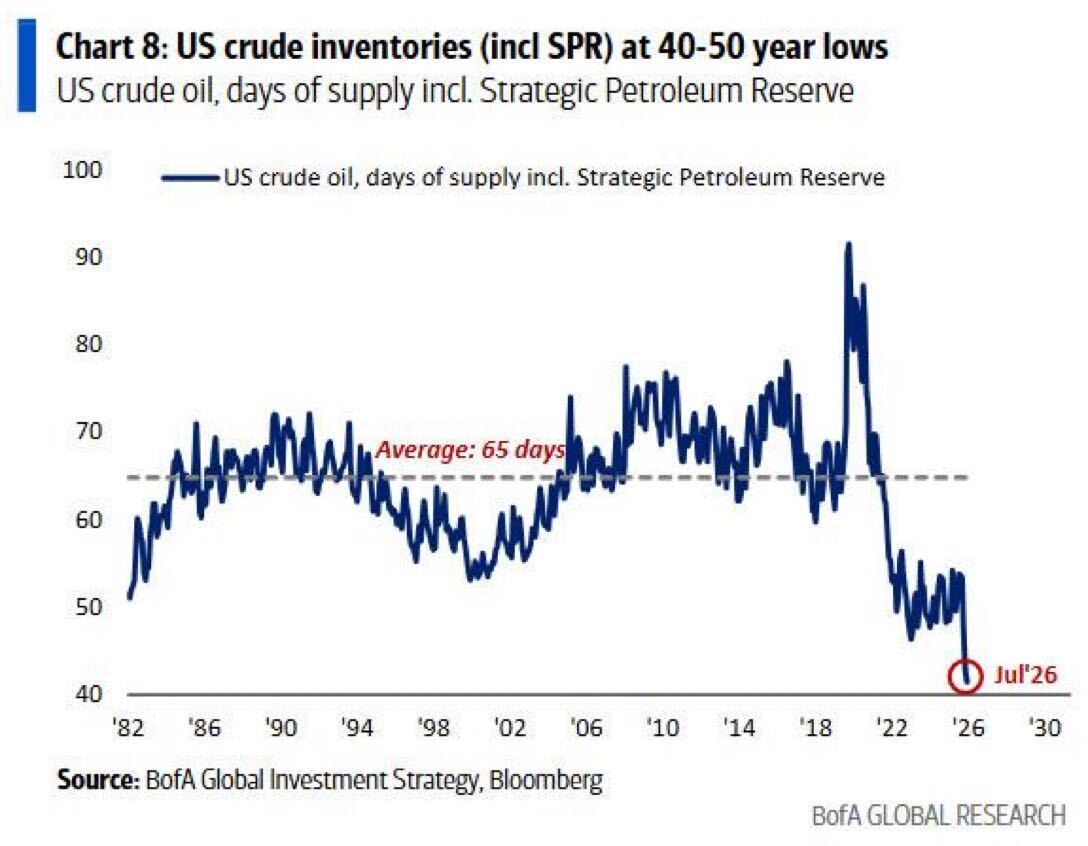
Yikes. The biggest squeeze right now is in diesel prices — which feed through everything that’s transported by truck. And right now diesel prices are about 20 cents a gallon away from their all-time high under Biden.
Meanwhile, we might be looking at the highest Labor Day gasoline prices ever.
 Thought for the Day
Here’s another chart making the rounds today. What do Chinese leaders know that American leaders don’t?

Reminder: Those are the publicly disclosed gold holdings of the People’s Bank of China. The real number is likely twice as high, maybe more.
 Mailbag: Power Outages, Scrambled Political Lines
“While the outcome of long-term power outages would be devastating, I believe this to be somewhat misleading,” writes a reader after Friday’s edition.
“History shows that our cities are capable of complete chaos within hours. Just look at the riots in LA, Minneapolis, Portland and Seattle to name a few.
“The Northeast outage in the 1960s started about 5 p.m. with a transmission line failure. If a series of simultaneous outages started in the major cities at 6 or 7 p.m. (EST) on a hot weekday night, you would have full-scale riots by midnight.
“Too many people would consider this the ‘perfect shopping opportunity,’ much like a hurricane evacuation in New Orleans. Commuters would be struck during rush hour. First responders would be overwhelmed with rescues and not available to respond to the rioting, looting, etc.
“God knows what would happen if this was extended for just.one or two days. Typically, power companies can get their systems energized within hours. However, this usually depends on power from neighboring power companies. That method would not be available if they could not transmit power due to line outages. .
“By major cities I am thinking about New York, D.C., Atlanta, Houston, LA, San Francisco, Denver and Seattle.
“You would not even need to hit the substations, but instead hit the major transmission lines feeding those cities, to start the outages.
“Scary thoughts. I worked in the power business for 40 years in the Northeast and South.”
“Your three hot-button issues — data centers, flock cameras and U.S. aid to Israel — all seem designed to divide the conservative base,” a reader writes after the conclusion to last Thursday’s edition.
“Maybe so, but surely there are others that tie the left in knots. Here are three — communists taking over the Democratic Party, men in women’s locker rooms and amnesty for illegal aliens.
“Thanks for allowing me to balance out your list.”
Dave responds: Maybe I wasn’t clear. I was talking about issues that divide both partisan camps and that have the potential to scramble the usual loyalties.
For instance, here in Michigan, the Democratic nominee for governor is weighed down with a lot of data-center baggage — seeing as her husband is VP of the firm developing an enormously controversial project.
Meanwhile it’s fair to say the Democratic contest for U.S. Senate in the Great Lakes State turned on the issue of U.S. aid to Israel — or to be more precise, the unwarranted influence of pro-Israel donors.
There used to be a saying about how politics makes strange bedefellows. You don’t hear it much anymore; too many elites are too invested in exploiting the red-blue divide.
But at the grassroots, some interesting coalitions are coming together. Could even be market-moving before all’s said and done. We’ll be watching…


