
Baby Formula Blackmail
 Baby Formula Blackmail
 Aries-Reign Peterson lived for only 79 days.
Born premature on Jan. 30, 2018, he got by on breast milk at the start — “thriving and growing for several weeks,” recalls his mother, Anika Hunte.
According to a lawsuit filed by Hunte against Abbott Laboratories (ABT), the boy’s health started going downhill as soon as he was given a formulation of Similac made specifically for preemies. And it got worse after doctors added a Similac fortifier.
Then came the diagnosis: Necrotizing enterocolitis, or NEC — an inflammation of the intestinal tissue, a condition that kills on average one premature baby every day in the United States. Aries-Reign went on life support and died on April 18.
Hunte’s lawsuit is among hundreds now making their way through the courts — all of them alleging that Abbott’s preemie version of Similac raises the likelihood of NEC. One of those cases resulted last year in a $500 million judgment against Abbott.
In response, Abbott has gone to Capitol Hill “to press for a law that would throw out all pending suits and shield it from any future ones,” according to an infuriating Bloomberg article.
Here’s the plot twist: Abbott says if Congress doesn’t accede to its wishes, it will pull the Similac preemie formula off the market.
Alternatively, Abbott is proposing the federal government take over sales and distribution of the product.
It’s an odd tack to take given the company’s insistence there’s nothing wrong with the product.
“Numerous studies and NEC authorities have made clear that preterm infant formula does not cause NEC,” says a statement given to Bloomberg by Abbott PR flack Scott Stoffel. “It’s the absence of human milk that increases NEC risk rather than anything harmful in formula — a product that’s been helping infants thrive and survive for nearly 50 years.”
Fine. If the studies and authorities say there’s nothing to back up a link between the formula and NEC, rely on those studies and authorities in court and let the chips fall where they may. You shouldn’t need special favors from Washington.
Make no mistake: What Abbott wants is the same sort of sweetheart deal the makers of the COVID jabs got.
Weeks before the first lockdowns in March 2020, the feds invoked the Public Readiness and Emergency Preparedness Act of 2005 — offering a liability shield against any developers of a future COVID shot.
“For the next four years,” said a CNBC article in December 2020, “these companies ‘cannot be sued for money damages in court’ over injuries related to the administration or use of products to treat or protect against COVID.”
That was during the first Trump administration. A year ago, on its way out the door, the Biden administration extended those protections through 2029.
Yes, there’s a government-instituted compensation fund — but getting money out of it is like getting the proverbial blood from a stone.
Per Bloomberg, Abbott’s lobbyists “are pushing for a similar fund that would give a payout to people who claim harm from its products, but would bar them from suing Abbott in court, according to a one-pager the company has given congressional staff.”
The liability shield made its way through a House committee during the summer, but its future is murky.
No, there’s no obvious investment angle here. ABT shares have gone nowhere this year; they don’t look attractive either on the long or short side.
As an old colleague once said, sometimes we go in search of new investment ideas — and all we find instead is outrage.
 Every Time This Happens, the Market Rallies
“The recent action by the Federal Reserve to cut their benchmark fed funds rate with the S&P 500 near all-time highs is relatively rare,” says Paradigm trading pro Enrique Abeyta.
Indeed it’s happened only 10 times since 1994. “One year later the stock market has been up 100% of the time!” he says. And per figures from Bespoke Investment Group, the average gain is 14.9%
Curiously, eight of these 10 instances have occurred under the current Fed chair Jerome Powell. “The other two,” Enrique says, “were under Alan Greenspan during the last technology bubble” in the 1990s.
Historical data like this affirms Enrique’s position that the AI boom is destined to end badly — but not yet!
In the meantime, it’s one of those four days each year when weirdness can ripple through the stock market.
It’s a “quadruple witching” Friday, when four types of derivatives all expire at once — stock options, stock futures, index options and index futures.
But there’s no evidence of weirdness at the moment. At last check the S&P 500 is up 0.9% on the day at 6,835. The Dow’s rally is weaker, the Nasdaq’s stronger.
In the commodity complex, silver is on track to end the week in record territory, the bid currently $67.21. Big brother gold is also looking stout at $4,350 although it hasn’t experienced the furious run-up that silver has in recent days. Crude is up 41 cents to $56.56.
The major cryptos are treading water, Bitcoin a little over $87,000 and Ethereum at $2,961.
 TikTok: The Final Chapter
It appears the TikTok deal is nearly across the finish line.
As mentioned here on Wednesday, the Trump administration has issued repeated extensions of the deadline set out by federal law for TikTok’s Chinese owners to either sell to American buyers — or shut the platform down.
Yesterday, TikTok CEO Shou Zi Chew sent a memo to his staff: Parent firm ByteDance has signed binding agreements with a group of buyers.
Per the memo, the new ownership lineup looks like this…
- ByteDance will retain a 19.9% stake
- Oracle (ORCL) will own 15%
- The U.S. private equity firm Silver Lake will own 15%
- MGX, an investment fund owned by the United Arab Emirates government, will own 15%
- The remaining 30.1% will be held by affiliates of existing ByteDance investors.
Presumably that latter category includes Pennsylvania billionaire and GOP donor Jeff Yass.
Under the old ownership structure, he owned 7% of TikTok parent ByteDance. By many accounts he persuaded Donald Trump to oppose the TikTok ban when it was rushed through Congress in the spring of last year.
Perhaps in the fullness of time it will emerge that Yass was the glue on the TikTok deal — which is set to be concluded on Jan. 22.
Before we close the book on this story, it’s worth briefly revisiting a couple of angles discussed in this space at the time the TikTok ban was moving through Congress last year…
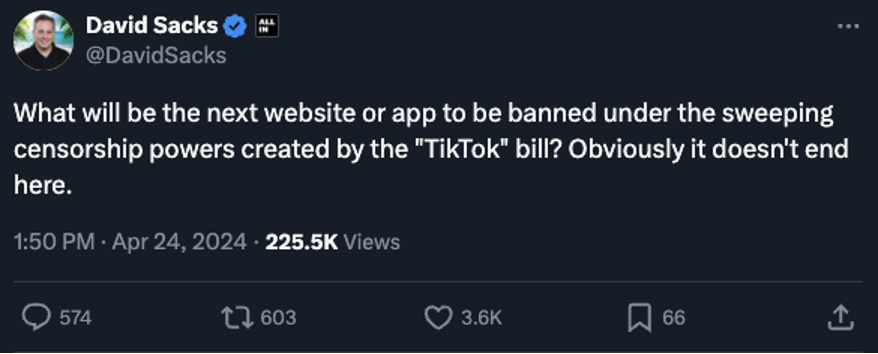
First, the law grants sweeping powers to the president to ban apps and websites that he determines to be controlled by a “foreign adversary” — not just TikTok.
Donald Trump’s future AI-and-crypto czar warned as much at the time.
Second, the number of new TikTok users plateaued roughly two years ago. And most of those new users are folks in their 30s and 40s.
Perhaps Larry Ellison — the Oracle co-founder who’s been the “face” of this deal — will come to regret his acquisition?
 Comic Relief
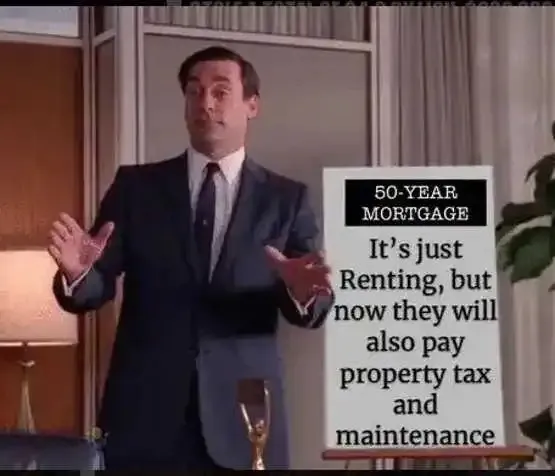
Because it appears the Trump administration is still enamored with the idea of a 50-year mortgage…
 Mailbag: Second Jobs, “Echoes from Hell”
We heard from a handful of readers after our item in Wednesday’s edition about a record number of Americans working second and third jobs.
“Our family employs college students with primary school education focus (preschool, kindergarten, early grade school) as babysitters for our young boys.
“Many of them stay on and help with our family (or with others) even after graduating with a full-time teaching position because the salary isn’t enough to make ends meet. These young teachers earn $35,000–45,000/year and they have to pay for their own school supplies, travel, etc…
“It’s a demanding job, underpaid and underappreciated and most have to take on a second job tutoring, babysitter, etc.… in order to survive.”
“In the early ’60s the minimum wage for us high school graduates was $1.00 per hour,” writes another.
“To pay my way through college, I had to have as many as four part-time jobs during the school year and at least one extra part-time job plus a full-time job during the summer (refused to borrow money for college).
“Since then inflation makes $1 per hour back then equivalent to about $13 today, which is still below the poverty level of about $17 today and why so many now work two jobs.
“Easy to see why the birth rate is so low for married couples and why many singles are renting rooms from homeowners.”
Still, for some people working more than one job is a choice.
“I work as an insurance agent about 40–50 hours a week. This job more than covers our living expenses.
“I also run 200-plus head of cattle mostly on the weekends. My wife and I have six rental properties as well.
“My side hustle is grinding stumps on the side for spending money.
“I enjoy the physical work outside the office, and it provides a nice additional source of income.”
“Dave's article about the 58-year hypothesis and its link to various historical events was very informative and insightful,” a reader writes after yesterday’s “Echoes from Hell” edition of 5 Bullets.
“From an English professor's perspective, Bravo! Keep up the good work.”
The section of the issue dealing with the Tet Offensive drew a couple of impassioned responses.
“I get very tired of hearing that we lost the WAR with Vietnam; the Military did NOT lose the War; the politicians are the ones that lost the war. McNamara and his numbers math plus all the restrictions on what could be bombed was ridiculous.
“How do I know? I was there in 1968 and flew 120 Reconnaissance missions in an RF-4C and had access to all the Top Secret information. Whether or not we should have even been in the war in the first place is another issue.”
“We did win Tet,” says another, “and had the NVA beat after Linebacker II, then gave it away in peace negotiation followed by Congress pulling the funding for our allies; 58,000 dead while many at home got rich and we created a great debt. They beat us because of TV, weak leadership and terrible war plans.”
Dave responds: This isn’t the first time I’ve pointed it out, but there are interesting/disturbing parallels between Vietnam and Ukraine.
Richard Nixon won the presidency in 1968 in part by touting a “secret plan” to end the Vietnam War.
It turned out the plan was to fight the war for four more years… then send Henry Kissinger to Paris to sign a peace deal at the start of his second term that was no different than the one he could have gotten at the start of his first.
Donald Trump, meanwhile, promised to end the Russia-Ukraine conflict on “Day 1” of his presidency. Yet the war still rages, with a steady pipeline of U.S. aid to Kyiv and Trump threatening to amp up the sanctions on Moscow.
For the sake of young Ukrainians being sent into the meat grinder, let’s hope this time the war isn’t dragged out all the way until January 2029.


