
The Boomer Freak-Out of 2026
 Echoes From Hell
 We’re devoting all 5 of today’s Bullets to a very different kind of prediction for 2026.
We’ve already begun rolling out the Paradigm team’s forecasts for next year: On Tuesday, Emily hit a few highlights from our editors’ gathering last week in Baltimore.
As was the case a year ago, we’ll be sharing even more highlights in video form between now and year-end. (The videos won’t be lengthy and they won’t have a sales pitch at the end. You’re welcome.)
But today we’re doing something off the beaten path.
It’s not a prediction as much as an exploration of a weird historical pattern.
Maybe you’re familiar with the expression, “History doesn’t repeat exactly, but it does rhyme.” (There’s no evidence Mark Twain ever said it, by the way.)
Well, strap in for a one-of-a-kind rhyming exercise today…
You’ll find it intriguing no matter your age. But you’ll find it especially relevant if you were born between the years — give or take — 1958–1962. That is, a late-wave baby boomer.
Here we’ll dip into the life’s work of the historian and demographer John J. Xenakis. If you’re familiar with Strauss-and-Howe generational theory… well, Xenakis took it to a whole other level.
Critics would say his writings are all over the map — and they have a point. He was one of those people that Bill Bonner — the founder of Paradigm’s parent firm — would label as “one-third genius, one-third crackpot, one-third incomprehensible.”
Xenakis died last January at the age of 80. His “Generational Dynamics” website is still up and running with an active message board run by his followers.
In a 2008 article, Xenakis described what he called, simply, “the 58-year hypothesis.” I call it “Echoes from Hell.”
When you read the following two paragraphs, there’s a chance you’ll think they belong in the “one-third crackpot” bucket. But try to reserve judgment for the moment…
Suppose that you're a child, between 5 and 10 years old. You're living a happy life… Then something horrible happens — a national event that's so terrible and so unexpected that it changes your life completely. It causes deaths around you or starvation around you… It's an event that's so traumatic to you that you will remember it vividly for the rest of your life… And not just you. Every person around your age goes through the same trauma…
Now let's move ahead to the time 58 years after the traumatic event… You’re 63–68 years old. Something strange happens... Something happens to make you fear that the event is going to happen again. The same anxiety grips all the other 63–68-year-olds across the country. Maybe the anxiety is well-founded, maybe it isn't, but the people in your age group panic, and the panic spreads to younger people who are influenced by your concerns.
Outlandish, right? But Xenakis furnished several examples of these “Echoes from Hell” across the previous several decades…
- The 1976 swine flu panic — which turned out to be nothing. It occurred 58 years after the trauma of the 1918 Spanish flu
- The brief but violent 1987 stock market crash — 58 years after the devastating 1929 crash that ushered in the Great Depression
- The 2006 Lebanon War, an overreaction by Israel to a minor provocation by Hezbollah — but it took place 58 years after the epochal Arab-Israeli War of 1948.
As Xenakis saw it, the most vivid illustration of the 58-year hypothesis was the start of the Iraq War.
As he wrote in 2008, “Most people, including myself, have assumed that the 2003 ground invasion of Iraq was triggered by 9/11.
“The 58-year hypothesis provides an alternate explanation, indicating that it would have occurred anyway, even if the 9/11 attacks hadn't occurred.”
Why? Because 58 years earlier, “America used weapons of mass destruction on Hiroshima and Nagasaki in 1945, bringing WWII to an immediate end,” he wrote, “and causing widespread fear that weapons of mass destruction would one day be used on Americans.”
Eerie, huh?
Especially when you think about the bipartisan consensus of politicos who lined up behind the war and were then in their early 60s.
Dick Cheney was vice president. Joe Biden was chair of the Senate Foreign Relations Committee. Trent Lott, Senate minority leader. Mitch McConnell, Senate Republican Whip. Dennis Hastert, House speaker. Dick Gephardt, House minority leader…
Likely as not every one of these Silent Generation figures had that black-and-white footage from Hiroshima seared into their childhood memories — followed by duck-and-cover drills as teenagers.
They were a uniquely receptive audience for the neoconservative ideologues peddling the worst lies about Iraqi WMDs — such as Richard Perle, also in his early 60s at the time.
To be clear, not every world-changing event triggers an “Echo from Hell” 58 years later.
There was no panic about a rerun of the Cuban Missile Crisis in 2020 — or a rerun of the JFK assassination in 2021.
But there’s a high probability of some sort of panic during 2026 — some sort of mass apprehension striking late-wave boomers now in their early-to-mid 60s — thanks to the sheer volume of shock events that afflicted the nation 58 years earlier.
Perhaps you’ve already done the math in your head by now…
 1968
1968
What happened in 1968? What didn’t happen in 1968?
It was a year of epic strife and conflict not just in the United States but worldwide. Wikipedia’s page chronicling the year is accompanied by a photo montage of sundry traumas — relieved only by the phenomenal “Earthrise” photo from the Apollo 8 spaceflight.
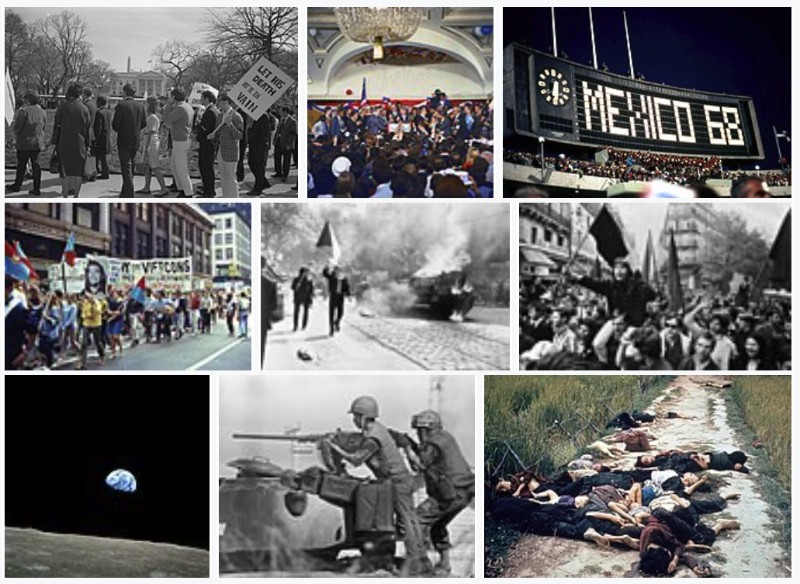
Perhaps the two biggest traumas came within 63 days of each other — the assassinations of Martin Luther King Jr. and Robert F. Kennedy.
There’s a long Reddit thread about MLK’s murder with much input from people who were roughly ages 6–11 at the time.
“I was watching TV in the afternoon when the bulletin interrupted my cartoons,” recalls one. “I was too young to understand but knew bulletins were important, so I ran and told my mom and told her. She started crying.”
It is not at all hard to imagine this particular Echo from Hell reverberating in 2026 — not after the attempt on Donald Trump’s life last year and the murder of Charlie Kirk this year.
The fact that such events are now livestreamed to a device you carry in your pocket? That makes them far more visceral than 1968. Which means the apprehension of 2026 could be far more palpable.
The Vietnam War loomed large in 1968 — and here there’s ample room for Echoes from Hell in 2026.
MLK was killed on April 4, 1968 — exactly one year after his “Riverside Church” speech in New York, where he declared his opposition to the war.
RFK was killed on June 5, 1968 — moments after his victory speech in the California Democratic primary. His campaign was gaining momentum on the back of his opposition to the war.
Twelve weeks after RFK’s murder came the Vietnam-fueled meltdown during the Democratic National Convention in Chicago.
The war — and the draft — drew 10,000 protesters to the city. They were met by 23,000 police and National Guardsmen. Mayor Richard J. Daley amassed such a huge force partly out of fears that he and other Democratic Party leaders might be subject to assassination themselves.
According to a 50-year retrospective published by The Guardian in 2018, "[a]fter four days and nights of violence, 668 people had been arrested, 425 demonstrators were treated at temporary medical facilities, 200 were treated on the spot, 400 given first aid for tear gas exposure and 110 went to hospital. A total of 192 police officers were injured."
While 2026 is not a presidential election year… it’s not hard to imagine the potential for trouble in the streets. Or at the very least, a collective boomer apprehension about trouble in the streets…
 The Tet Offensive of 2026?
And then there’s what was happening in Vietnam itself — namely the Tet Offensive.
There’s a lot of mythology surrounding the Tet Offensive — the event that perhaps marked the turning point in the Vietnam War.
Starting on Jan. 30, 1968, the Viet Cong and the North Vietnamese army launched a series of surprise attacks throughout South Vietnam.
Wikipedia characterizes the result as a “tactical victory” for the United States and South Vietnam… and a “military defeat” for the Viet Cong and North Vietnam.
But that’s not how it’s remembered in the public consciousness. Tet was the beginning of the end. The majority’s perception that Vietnam was a losing proposition? It began with Tet.
Still, the minority’s perception was likewise off base. To this day, you run into Americans who say incredulously But our side WON the Tet Offensive.
Which is true. But it didn’t matter. What mattered was that for nearly a year, American leaders had lied to the American people about the capabilities of the Viet Cong and North Vietnam.
In April 1967, President Lyndon Johnson called Gen. William Westmoreland home from Vietnam to deliver an upbeat message about the war’s progress to a joint session of Congress.
He called Westmoreland back to Washington again in November.
“I am absolutely certain that whereas in 1965 the enemy was winning, today he is certainly losing,” Westmoreland said in a speech at the National Press Club. “We are making progress. We know you want an honorable and early transition to the fourth and last phase [of the war]. So do your sons and so do I. It lies within our grasp — the enemy’s hopes are bankrupt.”
In other words, American leaders had built up the expectation that North Vietnam and the Viet Cong were incapable of launching something on the scale of the Tet Offensive.
When they did anyway, everyday Americans were shocked by the images they saw on TV and the accounts they read in the papers.
Tet broke LBJ’s hopes for reelection. Two months after it happened, he announced he would not run for another term.
The potential for this particular Echo from Hell during 2026 is enormous.
For sure, Venezuela’s military is a ragtag outfit — but it’s certainly capable of getting off a few lucky shots against U.S. aircraft or even a destroyer.
And while Donald Trump went to great lengths to tell the American people last June that U.S. bombing “completely obliterated” Iran’s nuclear program… there’s a high likelihood Israeli leaders will seek to drag U.S. forces into a new phase of their conflict with Tehran next year.
 The Prague Spring of 2026?
But maybe the most concerning echo from 1968 is the “Prague Spring.”
In that year, the Communist Party of Czechoslovakia undertook a series of reforms — loosening the limits on speech and travel, for instance. A large swath of the populace spontaneously came out onto the streets, demanding even more freedoms.
Leaders of the Soviet Union never looked kindly upon a client state that showed signs of breaking away from their orbit. Days before the Democratic Convention opened in Chicago, Moscow sent more than a half-million Soviet, Bulgarian, Hungarian and Polish troops into Czechoslovakia to crush the Prague Spring.
Back in Washington, LBJ already had plenty on his plate. He recognized there was no core U.S. interest at stake in Prague — certainly nothing worth risking World War III over.
The death toll was relatively small — less than 150 — but Moscow got the desired result. Czechoslovakia would remain behind the Iron Curtain for two more decades.
“We are Russia’s next target. And we are already in harm’s way,” NATO Secretary-General Mark Rutte said in Berlin a week ago today.
It was a bombastic speech, even by the standard of European leaders in the 2020s.
“Russia has brought war back to Europe, and we must be prepared for the scale of war our grandparents and great-grandparents endured.”
Really? Rutte is the former Dutch prime minister. Is he suggesting his country will be occupied by Russian troops the way German troops did 80-odd years ago? Or that much of Rotterdam’s city center will be reduced to rubble? Or that Moscow will cut off food supplies to the Netherlands as Berlin did, starving tens of thousands?
It’s preposterous. But it jibes with the alarmist rhetoric of Western elites about how Vladimir Putin has designs on conquering and occupying all of Europe (even as they crow at the same time that Putin’s troops are bogged down in eastern Ukraine).
And it also jibes with the 58-year hypothesis. Rutte is a bit young — he’s not yet 60 — to fit neatly into the hypothesis. But he has elder siblings who surely remember watching the Prague Spring unfold on the family TV in real-time.
Other European leaders who readily resort to Putin-Hitler analogies — such as British Prime Minister Keir Starmer — are right in that 58-year sweet spot.
LBJ didn’t think the Prague Spring was worth risking war between nuclear superpowers. But today’s European leaders are feeling desperate.
Not just Rutte and Starmer, but Merz in Germany and Macron in France… they’re all unpopular and under fire. War fever is how they think they can keep the restive masses in line.
In an interview last weekend with radio host John Batchelor, Johns Hopkins historian Michael Vlahos said European leaders seek to foment “a sense of crisis comparable to the original Cold War that would cement their position in power, allow them to invoke emergency powers at home and thus nix any political electoral surge by the so-called ‘far right.’”
They know they can’t win a head-to-head conflict with Russia… and yet, “they have to go down that course, and they will beat the drum just as loudly as they can and they will attempt to pull off false flags to basically sink any possible U.S.-Russian agreement over Ukraine.”
The problem with cold-war fever is that one miscalculation on either side can turn a conflict hot in an instant.
How likely is that in 2026? “A lot of it depends on the courtier circle around Mr. Trump,” says Vlahos — “because there are plenty of fire-breathers in the Trump administration.”
 1968… Gold… and 2026
At this point you’re probably thinking This is all very interesting and even disturbing — but what are the investment implications?
Well, that takes us to one more thing that happened in 1968.
It wasn’t a trauma per se — nothing that lingers in the synapses of today’s 60-somethings. But as long as we’re revisiting the events of that tumultuous year, it’s worth briefly examining the saga of the London Gold Pool.
Paradigm’s macroeconomics maven Jim Rickards told the story in the July 2023 issue of Rickards’ Strategic Intelligence…
[By] the late 1960s the largest Western gold holders (U.S., West Germany, U.K., France, Italy, Belgium, Netherlands and Switzerland) formed what was called the London Gold Pool. The purpose was to maintain the price of gold at a fixed value of $35.00 per ounce. The understanding was that the members would contribute physical gold and cash to the pool. When the price of gold was below $35.00 per ounce they would buy gold to prop up the price. When gold was above $35.00 per ounce, they would sell gold to lower the price. It was a simple open market operation.
Over time, the price of gold consistently traded above $35.00 and the pool was forced to sell increasingly large amounts of gold in the market to suppress the price. In 1968, the pool collapsed because the members were losing too much gold and were also losing confidence in the ability of the U.S. to uphold the $35.00 price on its own.
The London Gold Pool was the first of many efforts by Western power brokers to keep a lid on the gold price. (I described some of the more recent efforts in 2019.)
None of them has worked over the long term. Gold sailed to secular highs of $800 in 1980 and $1,900 in 2011. After bottoming at $1,050 right around this time 10 years ago, gold has rallied to well over $4,300 this morning.
It’s not a stretch to say that all those precious metals manipulation schemes will fail for good in 2026 — especially as you look at the “silver squeeze” that’s taken place this month.
As Jim Rickards wrote his readers on Monday, “private institutional investors have gold allocations of below 2.0% of total assets. If that expanded to a mere 4.0% allocation, there’s not enough gold in the world at today’s prices to fill those orders. That dynamic alone could send gold prices above $10,000 per ounce in the year ahead.
“The gold bull market is real, and the action has just started. It’s not too late to join the gold parade.”
Besides, gold is widely seen as a hedge against societal and geopolitical turmoil.
If the events of 1968 are destined to deliver us “Echoes from Hell” in 2026… a precious metals position will serve you very well indeed.
P.S. Lest we overlook more immediate events…
The big market story today is the release of the official inflation numbers, a few days behind schedule thanks to the “partial government shutdown.”
The official inflation rate for November came in less than expected at 2.7%. It’s the first decline in the inflation rate since April.
But given the fact that Labor Department statisticians went for six weeks without collecting any survey data, they engaged in even more guesswork and conjecture than they usually do. “I think you largely just put this one to the side,” says one Wall Street economist to The Wall Street Journal.
Amid that backdrop, the major U.S. stock indexes are getting a bit of traction — the S&P 500 up over two-thirds of a percent at last check to 6,737.
Gold is holding firm at $4,330. And while silver has shed a buck, it’s still over $65 — which was an all-time high on Tuesday. Crude is up 1% but still depressed at $56.55.
Crypto is trying to get its bearings after another whacking — Bitcoin under $86,000 and Ethereum just over $2,800.
Thanks for indulging us with a rather unusual single-topic 5 Bullets. Back to regularly scheduled programming tomorrow…


