
Locked out of the American Dream
 Locked out of the American Dream
 The financial media are flailing around — trying to make sense of the nonsensical.
Case in point: This morning’s Wall Street Journal…
Call it the glass half-full market.
In recent weeks, government data has been mixed, showing disappointing job gains and robust economic growth. But U.S. investors are focusing on the positive side of things, piling into bets that suggest they have strong confidence that the economy will keep powering forward.
The Dow Jones Industrial average is off to its best start to a year since 2003…
As related here on Friday, the December job numbers were mediocre. Actually, most of 2025’s job numbers were mediocre.
But at the same time, “the economy” as measured by gross domestic product is going gangbusters. Shortly before Christmas, the Commerce Department reported that GDP grew during the third quarter at an annualized 4.3%. And if the “GDPNow” figures crunched by the Federal Reserve Bank of Atlanta are any indication, the fourth quarter was even stronger.
So what gives?
After all, you’re probably sick and tired by now of hearing about a strong economy while you or people you know are struggling…
The problem lies in what the media and the politicians and Wall Street call “the economy.” It has zero relationship to what you and I think of as the American Dream — an ever-improving standard of living and the aspiration that your kids will live a better life than you.
When they talk about the economy, they mean GDP — a statistical abstraction that has nothing to do with your own prosperity.
Here’s how preposterous GDP is — and this is an illustration spelled out years ago by Bill Bonner, the founder of Paradigm’s parent firm: If you mow your lawn, and your neighbor mows his lawn, that has no effect on GDP. But if you pay your neighbor $40 to mow your lawn, and he pays you $40 to mow his, GDP miraculously grows by $80!
But it’s much worse than that, as the venture capitalist Peter Thiel pointed out in 2022.
Compare American life in the 1950s, he said, with American life now. If “you shift an economy from a single-income household with a homemaker to one with two breadwinners and a third person who’s a child-carer,” he said, “statistically you have three jobs instead of one and therefore you have more GDP, and you will exaggerate the amount of progress that’s happened.”
In other words, it took only one income back in the day to support a middle-class standard of living. Now it takes both parents, scratching and struggling. But if you’re an egghead economist, it’s all good because “the economy” as measured by GDP is bigger.
Actually, if you dig into the latest GDP report, there’s some useful insight that the mainstream mostly overlooks. It reveals why so many people feel locked out of the American Dream.
The report dug into consumer spending habits — which on the surface, were strong.
But beneath the surface you find a huge disconnect among the top 10% of income earners and everyone else.
Demographer Neil Howe elaborated during his most recent podcast: “You’re talking about, at the high end, spending out of asset gains.
“This is one way in which, among many, we see equity markets driving the economy. You know, you think it’s supposed to be the other way around, right?... But here’s one more case in which it’s really, without these asset gains, you would not have the top 10% spending like that.
“Then, the bottom end — borrowing, right? The increase in buy-now, pay-later plans. The overall savings rate declined from 5.0% to 4.2%.”
Apart from the COVID calamity, the savings rate hasn’t been this low since the run-up to the 2008 financial crisis.
No savings, no ability to build for the future — and no American Dream.
The American Dream of prosperity accessible to all has turned into a nightmarishly stratified society…
- A top 0.1% elite that’s amassed a greater and greater share of overall wealth during the first 25 years of this century
- The next 9.9% who can still live comfortably
- Another 40% below that top 10% who have retirement accounts and some home equity, but by and large live paycheck-to-paycheck — even if they command six-figure household incomes
- And a bottom 50% who have no investments, no home equity — and no hope.
Now, perhaps, you have a better understanding of why “the economy” as defined by the Establishment can be “strong” — but few people are happy.
Our ethos at Paradigm Press is to empower you to move up a level from wherever you are now. It’s still possible to overcome the blunders and deceits of the politicians and Wall Street types.
 Fed Pressure and Precious Metals
For all the caterwauling you see in the media, nothing has fundamentally changed now that Federal Reserve chair Jerome Powell is in the Justice Department’s crosshairs.
Late Friday, the DOJ delivered subpoenas to Fed headquarters at the Marriner Eccles Building in Washington.
As it happens, renovations to the Eccles building appear to be at the center of the investigation: Did Powell lie to Congress last summer when he said the renovation plans are not as lavish as reported by the New York Post?
“There’s no VIP dining room, there’s no new marble,” he said. “There are no special elevators. There are no new water features, there’s no beehives and there’s no roof terrace gardens.”
Which, according to a subsequent Post story, “directly contradicted the project’s own planning documents, which were signed off on by government pen pushers in 2021 — and which haven’t been revised since.”
Last night, Powell issued a video statement — really, it looked like a hostage video — in which he said the subpoenas were aimed at intimidating the Fed into lowering interest rates faster than it has to date.
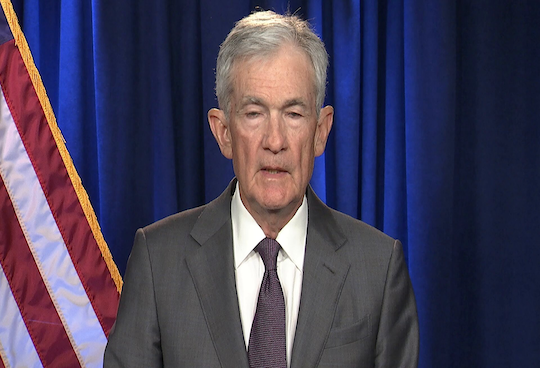 Maybe he was blinking “We’re doomed, buy gold!” in Morse code?
To hear the mainstream tell it, the stock market fell at the start of today’s trading because of the Trump administration’s threat to the Fed’s “independence.”
We won’t belabor the point today about how Fed independence is a myth — other than to remind you that in the 1960s President Lyndon Johnson shoved Fed chair William McChesney Martin into a wall to reinforce his wishes for lower interest rates. As far as we know, Trump hasn’t laid a hand on Powell.
For the stock market, Paradigm trading pro Enrique Abeyta says this news in fact means “absolutely nothing.”
As he put it on the Daily Feed section of the Paradigm Press mobile app, “With market strength broadening, rates and oil prices going lower and good earnings growth - BTSD! (My version ‘Buy the Stupidity Dip’).”
[You don’t have the Paradigm app? You don’t know what you’re missing. Download here.]
And in any event, the stock market reaction was short-lived: What started as a 300-point drop in the Dow has been shaved to less than 100 at last check. That’s not even a quarter of a percent. Meanwhile, the S&P 500 and the Nasdaq are flat on the day.
The major indexes are holding up well despite a downdraft in bank stocks after Donald Trump called for a cap on credit-card interest rates of 10%. JPMorgan Chase is down 1.9% and Citi 3.5%.
The link between the Fed subpoenas and the action in precious metals is more clear.
As our macro maven Jim Rickards tweeted, “Gold at a new all-time high. Jay Powell under criminal investigation. First rule of intelligence analysis — there are no coincidences.”
Powell is out the door in four more months regardless because that’s when his term ends. But “Trump may feel he needs Powell out longer before midterms to give the economy time to heat up,” observes Rude Awakening editor Sean Ring. In other words, the Fed might begin mashing the monetary gas pedal sooner than expected.
With that, gold is up $110 as we write to a record $4,618. Silver is up $5.55 to a staggering $85.39. And the HUI index of mining stocks is *this* close to the 800 mark.
Elsewhere in the commodity complex, crude is flat — a little over $59. As for crypto, Bitcoin is trying to reclaim the $92,000 level while Ethereum has surpassed $3,100.
More musings about the Fed next…
 Those Other Times a Fed Chair Lied…
Never mind Fed independence — how about Fed accountability?
If Jerome Powell lied to Congress, he wouldn’t be the first Fed chair to do so.
As we’ve chronicled in years past, Ben Bernanke — who was chair during the 2008 financial crisis — is known to have committed perjury at least twice.
- Bernanke told Congress the bonds the Fed inherited in 2008 from the failure of Bear Stearns were investment-grade. Bloomberg News discovered in 2010 — only after filing a lawsuit — they were, in fact, junk
- Bernanke also told Congress in February 2010, “We have no plans whatsoever to be involved in any foreign bailouts.” In reality, Deutsche Bank and Credit Suisse topped the list of banks that dumped their crappy mortgage-backed securities on the Fed between 2007–09.
And that leaves out Bernanke’s still-murky role in Bank of America’s shotgun marriage with Merrill Lynch during the worst of the 2008 crisis. BofA CEO Ken Lewis failed to inform his shareholders at the time about Merrill’s huge losses, as the law required. In 2009, Lewis said he withheld that information on orders from Treasury Secretary Hank Paulson, who was acting “at the request” of Ben Bernanke.
Seems Bernanke was lying about matters that did far more harm to everyday Americans than some posh renovations that went over budget.
But he never even got a strongly worded letter, much less the handcuffs-and-leg-irons treatment. And so it goes…
 Comic Relief
Not exactly new, but perhaps newly relevant?

 Mailbag: Ukraine, Small Business
“Was disappointed in false information that Dave Gonigam expressed in last Tuesday’s edition,” a reader writes.
The reader takes exception to a brief passage about Washington meddling overseas in which your editor stated, "And that U.S. meddling is nowhere near over: Trump continues to arm Ukraine."
“The United States is not arming Ukraine,” the reader asserts. “President Trump has explicitly stated many times that the USA is selling arms to NATO countries (at a profit) and THEY are choosing to provide the arms to Ukraine. President Trump has said many times publicly that we have spent enough of our money giving arms to Ukraine and will no longer continue to do so.
“And oh, by the way, why use the word ‘meddling’? This war was inherited by President Trump. You consider us ‘meddling’ in it? The president is trying to end it. (!)
“I look forward to seeing a publicized correction. Facts matter, especially in a service such as Paradigm Press.”
Dave responds:

"We're going to send some more weapons,” Trump himself said the day of that statement. “We have to."
And it’s not just “defensive.” Who honestly believes that Kyiv could have launched nearly 100 drones on one of Vladimir Putin’s homes at the end of 2025 without knowledge and coordination from Washington?
Unless and until Trump announces he’s washing his hands of the whole affair, yes, he’s meddling.
On the subject of the Chicago Bears’ attempt to squeeze out special favors from taxpayers for a new stadium, a reader brings up “the evil not mentioned.
“The big/large companies can negotiate for special treatment, often motivated by business-unfriendly policies in the given city/state or move to another state.
“What went unsaid is that the many small businesses have to labor under the business-unfriendly nature of their locations, thus propping up the legitimacy of a local bad business environment.”
Dave: Good point. Small business has been getting the shaft over and over in recent years — starting with lockdown in 2020, when small retailers had to close their doors while Walmart, Target and Costco stayed open.
Nobody noticed because it was Christmas Day, but The Wall Street Journal published a worthwhile story about how for small businesses, “years of high inflation, increasingly cautious consumers and tariffs are weighing on earnings and prompting cutbacks. Over the past six months, private firms with fewer than 50 workers have steadily shed jobs, according to payroll processor ADP, cutting 120,000 in November alone. Midsize and, especially, large firms have continued to add jobs.”
Indeed the article points out how the divide between big and small businesses is fueling the divide between high- and low-income Americans.
“Workers at small businesses tend to earn less than those at large companies. And the increases in stock-market wealth stemming from the rally in shares of large, public companies accrue mostly to the rich.”
And so we end where we began today: It’s not a robust economy driving stock market gains. It’s stock market gains propping up the economy, as more and more people feel locked out of the American Dream.
We’ll dig deeper into the theme tomorrow…


