
Silver Fantasies
 Silver Fantasies
 The bull market in silver has reached the stage where weird rumors come from nowhere and take over the internet.
Such as this post on X last Thursday…
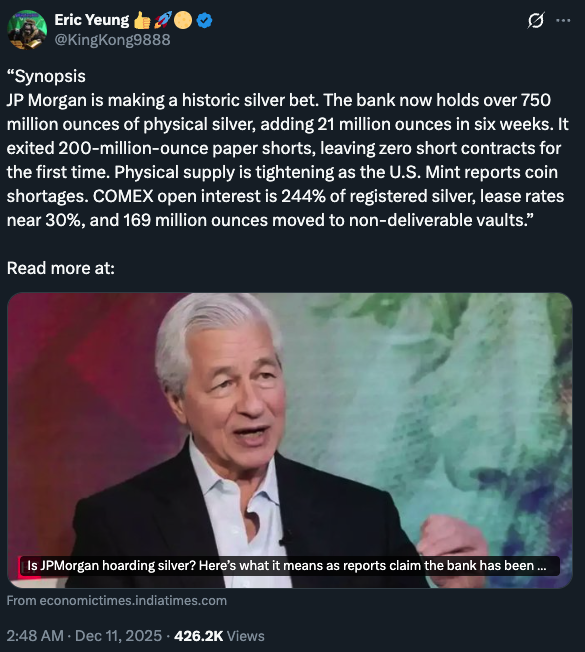
If you’re a long-term follower of the precious metals markets, you know what a sea change this would be.
JPMorgan Chase inherited a massive short position in silver when it took over a collapsing Bear Stearns in 2008. JPM has been the bête noire of precious metals bulls ever since — blamed for every downdraft in gold and silver prices.
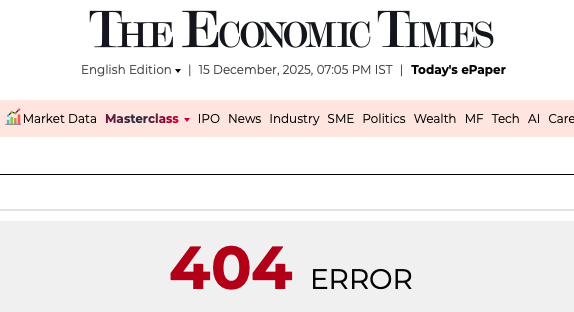
Alas, when you go to the link provided by the X poster, you get…
A Google search for “Is JPMorgan hoarding silver” turns up the following result…
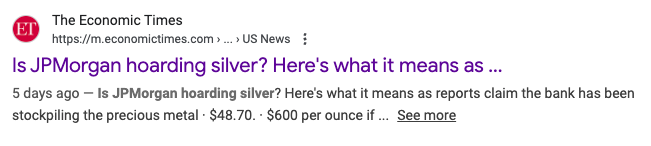
But clicking on the link results in the same 404 message.
On Reddit, someone posted an annotated screengrab that appears to be the beginning of the article before it was taken down…
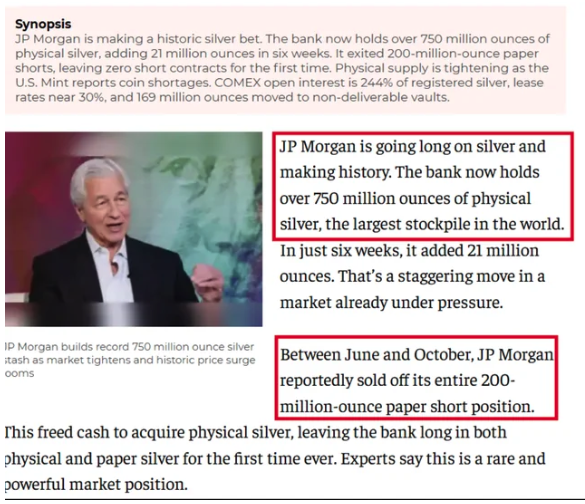
So what can we make of this?
The Economic Times is India’s leading English-language business newspaper. It covers South Asia thoroughly. We’ve cited it now and then when addressing matters in that part of the world, along with India’s role in the BRICS grouping of countries.
As far as we can tell, no other mainstream outlet picked up the silver story. There’s no reason to believe The Economic Times has any special insight into the activities of JPM compared with any other mainstream outlet. And for whatever reason, The Economic Times removed the story from its site no later than Saturday.
Verdict: There’s nothing to the “JPM is hoarding silver” story. But there’s also nothing stopping people on the internet from latching onto it to draw attention to themselves. (And the example we started this bullet with is just one of many.) Reader beware.
In the meantime, silver is starting to recover its steep losses Friday.
To whatever extent JPM and other shadowy forces depress the prices of precious metals, they’re losing their leverage.
In the last two or three years, those forces acquired a popular nickname — “Mr. Slammy.”
“Did you enjoy Mr. Slammy’s performance on Friday?” writes Paradigm’s recovering investment banker Sean Ring.
“He smashed silver as hard as he could, sending the devil’s metal from its high of $64.65 down to $60.82, before closing at $61.92. He does this the best on Friday evenings, when the Chinese are home, fast asleep.
“Amusing. Specifically, it’s amusing how Mr. Slammy makes it so much easier for those same Chinese to come in Sunday night and send silver back to $63.75, where it trades as I write.”
Sean sums up the state of play like this in today’s Rude Awakening: “the U.S. bullion banks have lost their power to crush the metals futures markets because there’s always a buyer where the sun rises first.”
Since Sean’s dispatch this morning, silver has pulled back a bit — but it’s still holding the line on $63. Gold, on the other hand, has lost its grip on $4,300.
Meanwhile, the major U.S. stock indexes are having trouble picking themselves up from their own Friday smackdown.
The S&P 500 is holding up best — down 0.15% and still above 6,800. The Dow is down a bit more steeply and the Nasdaq’s losses are steepest, a little over a third of a percent.
The recent buzz about tech valuations will likely take a back seat later this week to economic data: The Bureau of Labor Statistics is preparing two major reports delayed by the “partial government shutdown.” The November job figures arrive tomorrow, and the official inflation numbers on Thursday.
It seems the tech gloom has spread into crypto big-time: Bitcoin has sunk to $86,262 while Ethereum has cracked beneath $3,000 again. That said, we’re not approaching last month’s lows — at least not yet.
 Global Shipping Free-for-All
At $56.63, oil prices have sunk to two-month lows even though “we are now speeding toward a kinetic war involving seaborne commercial shipping,” tweets the military analyst Will Schryver.
As perhaps you heard, U.S. forces seized an oil tanker last Wednesday off the coast of Venezuela — sanctions enforcement, said the Trump administration. The ship is on its way to Houston now; no word about the fate of the crew, other than they didn’t put up any resistance.
“Threats of more seizures have now left tankers — loaded with about 11 million barrels of oil and fuel — stuck in Venezuelan waters and fearing to venture further,” reports the Reuters newswire.
Turns out this is not a one-off, and it’s not all about Venezuela.
On Friday, The Wall Street Journal reported that last month, U.S. special forces raided a ship several hundred miles off the coast of Sri Lanka. It had departed China, bound for Iran.
The paper cited unnamed U.S. officials who said the ship was carrying “dual-use items, with both civilian and military applications.”
Meanwhile, Iran seized a ship in the Gulf of Oman over the weekend — claiming it was smuggling Iranian fuel. No details about the ship’s registry or destination.
Last month, Iran also seized a Marshall Islands-flagged tanker in the Gulf of Oman. It took the cargo and released the crew. At that time, U.S. Central Command put out a testy statement calling the seizure “a blatant violation of international law, undermining freedom of navigation and the free flow of commerce.”
We don’t know where this all ends — but the proposition that commercial shipping can flow around the world unimpeded? It appears to be something we can no longer take for granted.
The new state of play might be having an impact on shipping stocks. They jumped impressively from mid-October until the start of December — only to stall out this month.
Oh, passenger air travel also appears to be at risk — at least in the vicinity of Venezuela, anyway.
“A JetBlue flight from the small Caribbean nation of Curaçao halted its ascent to avoid colliding with a U.S. Air Force refueling tanker on Friday,” reports The Associated Press. The plane was headed to New York-JFK.
“We almost had a midair collision up here,” said the JetBlue pilot. “They passed directly in our flight path… They don’t have their transponder turned on, it’s outrageous.”
Air traffic control agreed: “It has been outrageous with the unidentified aircraft within our air.”
According to The New York Times, a day after the near-collision, air traffic controllers in Curaçao told three pilots to keep an eye out for unidentified aircraft flying in the area — presumably referring to U.S. military aircraft whose transponders are turned off.
 Update: Data Centers in Space
All of a sudden, “data centers in space” is moving from the realm of the hypothetical to the almost, kinda-sorta real.
About six weeks ago, we noted that orbiting data centers powered by the sun would solve the growing problem of earthbound data centers competing for scarce electricity and driving up everyday consumers’ power bills.
Several startups are pursuing the idea — as are several tech bigwigs like Jeff Bezos, Eric Schmidt and of course Elon Musk.
Musk’s SpaceX is uniquely positioned to pursue the concept: His Starlink network of satellites already deliver internet access across the globe.
From there, he plans a new generation of satellites that can accommodate even greater speed and more bandwidth. Dozens of these satellites will be deployed with every Starship rocket launch next year.
But the scale of Musk’s ambitions came into view only three days ago — when SpaceX confirmed it has an eye toward going public next year.
Bloomberg reports the IPO would raise more than $30 billion — valuing the firm around $1.5 trillion.
“If executed,” says Paradigm tech-investing pro Ray Blanco, “this would be the largest IPO in history — surpassing even Saudi Aramco’s $29 billion offering in 2019.”
How would SpaceX put the money to use?
In a letter to employees and shareholders, SpaceX CFO Bret Johnson said the IPO “enables us to ramp Starship to an insane flight rate, deploy AI data centers in space, build Moonbase Alpha and send uncrewed and crewed missions to Mars — ultimately increasing the probability of making life multiplanetary in our lifetimes.”
Forget Mars for the moment. The lion’s share of the IPO money will go to “a new generation of space-based data centers,” Ray tells us.
That’s where the need is right now — “extending Starlink's role from connectivity provider into core infrastructure for cloud and AI workloads delivered from orbit.”
Ray has a 5-year-old boy. “By the time he's 10, those satellites won't just route phone calls. They'll run AI models powering his education and entertainment.
“By the time he's my age, the space economy will be larger than today's tech industry.”
 Comic Relief
In light of California’s loss of population since 2020…

 Mailbag: Silver Gains
“Due to silver's continued growth, what is the best way to profit if you hold actual Silver Eagle coins and where do you go to sell and make a profit?” a reader writes.
“I am sure there are many investors like myself that invested in silver and gold years ago as a safety net. I am getting ready to retire, thus my question.
“Thank you for your input — love reading your articles!”
Dave responds: Hmmm… At the risk of copping out, the answer is going to be different for everyone.
The answer that makes the most sense to me comes from legendary commodities investor Jim Rogers — when he was asked in 2020 whether gold was in a bubble. (At the time, gold was still oscillating around $2,000.)
“Gold may well turn into a bubble,” he said. “I hope it doesn't, because if it turns into a bubble, I'll have to sell it and I never want to sell it. I want my children to have my gold and silver someday."
Five years since that interview, Rogers is age 83. By now his two daughters would be in their late teens and early 20s. A Google News search turns up no evidence he’s selling!
With Rogers’ guidance in mind… your physical precious metal is what you keep 1) in the event of severe societal breakdown and 2) to hand on to the next generation.
In the latter instance, you don’t care about price fluctuations day-to-day or even year-to-year; you just want your kids and grandkids protected because they too will experience episodes of monetary debasement like the 1970s, 2000s and 2020s.
Hopefully you’re in a position to hold on to your physical metal for those purposes — while your metals ETFs and mining stocks are what you can draw on for retirement income.
Good luck — and congratulations on your gains to date!


