
$1.5 Trillion
 Bin Laden’s 16,086,000:1 Return
 For the first time, the Pentagon’s annual budget exceeds $1 trillion. And Donald Trump wishes to jack up that total by 50%.
Shortly before Christmas, the president signed the 2026 National Defense Authorization Act — setting aside $901 billion in military spending. Combined with an additional $156 billion tucked into the “One Big Beautiful Bill” last summer, the total is now over $1 trillion.
Shortly after Christmas, Trump expressed a desire to raise that total to $1.5 trillion in fiscal year 2027.
Hmmm… Already the United States accounts for nearly 40% of all military spending worldwide. And the Pentagon has never passed an audit.
In reality, Washington has had an over-$1 trillion military budget for years — once you include things like Homeland Security, the Department of Veterans Affairs and the nuclear weapons under the auspices of the Department of Energy.
Researcher Winslow Wheeler from the Project On Government Oversight pegs the real total at $1.77 trillion — nearly a quarter of all federal spending.
And it’s been over four years since the “forever wars” supposedly ended with Washington’s botched withdrawal from Afghanistan.
Sept. 11, 2001 — the day Osama bin Laden pulled off the most brilliant leveraged bet in history.
Recall the words attributed to bin Laden in a speech from 2004: “We, alongside the mujahideen, bled Russia for 10 years until it went bankrupt and was forced to withdraw [from Afghanistan] in defeat… So we are continuing this policy in bleeding America to the point of bankruptcy.”
Mission accomplished — for bin Laden. We’ve recounted the numbers before, but they’re worth a revisit.
The final report of the 9/11 Commission estimated al-Qaida spent about $500,000 to carry out its mission.
In September 2021, the Costs of War Project at Brown University issued a deeply researched estimate of the forever wars’ price tag to the U.S. government: $8.043 trillion, including veterans’ health care and interest on the wars’ share of the national debt.
So over 20 years, bin Laden generated a return of 16,086,000:1. Formidable.
The return generated by the “defense” industry wasn’t quite as impressive… but it’s still eye-watering.
Per figures from the Center for Responsive Politics, the Big Five military contractors — Lockheed Martin, Boeing, Northrop Grumman, Raytheon (now branded RTX) and General Dynamics — spent over $1.1 billion on lobbying between 2001–21.
A substantial sum, yes, but look at the payoff: According to Stephen Semler, co-founder of the Security Policy Reform Institute, Congress awarded $2.02 trillion to those five companies over that 20-year span.
That’s a return of 1,836:1.
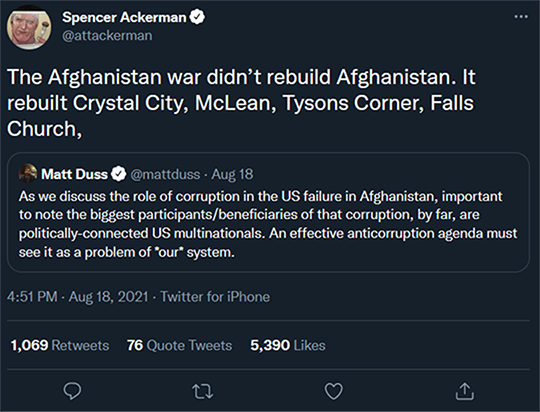
For most of that 20-year period, defense stocks outperformed the S&P 500 — and not by a little.
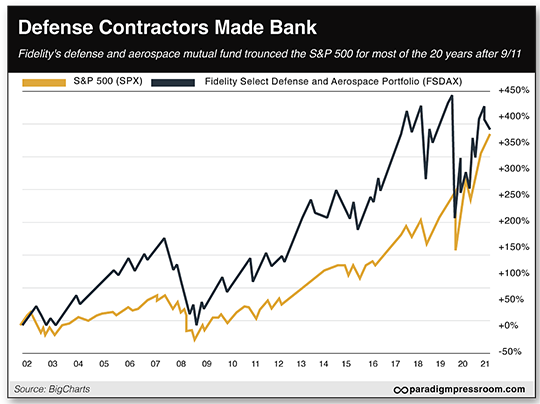
Only after it was apparent that U.S. involvement in Afghanistan was finally winding down in 2021 did the broad stock market close the gap with defense stocks.
And then the Ukraine war came to the rescue of the military-industrial complex less than a year later. But we’re getting ahead of ourselves…
 How Conservatives Came to Love Big Government
Sept. 11, 2001, was also the day many conservatives abandoned their suspicions of Big Government.
Despite the epic intelligence failures in the weeks before the attacks, conservatives suddenly found a new faith in lumbering government bureaucracies. Indeed, they couldn’t wait to create more of them.
“At the time of the 9/11 attacks,” journalist James Bovard recalled in 2021 for the Mises Institute, “I had been bashing government policies for 20 years. Conservatives relished my battering of the Clinton administration in books such as Feeling Your Pain.”
But then Bovard cast an equally jaundiced eye toward the Bush administration in volumes like Terrorism and Tyranny and The Bush Betrayal. “The Patriot Act,” he wrote in the former volume, “treats every citizen like a suspected terrorist and every federal agent like a proven angel.”
Conservatives didn’t want to hear it. On one book tour after another, “I was chagrined to see folks more fearful of alleged invisible Muslim perils than of rampaging federal agencies.”
And so began an ugly taking of sides: “Remember how Republicans in the Bush era talked about blue-state enemies?” journalist Matt Taibbi wrote in 2021. “Their conventional wisdom was that liberals equated with terrorists, liberalism was a ‘mental disorder,’ liberalism was ‘treason.’ Their rhetoric did not include a vision for the other half of America outside of conversion or expulsion.
“Plenty of this is still going on, but the updated version is prevalent now among Democrats,” Taibbi continued, “who are trying to make a strategy of absolute non-engagement stick with additional tools like platform censorship and domestic surveillance.”
Under the Biden administration, the federal government brought sufficient pressure to bear on the social media giants that across large swaths of the internet the First Amendment was effectively gutted. Worse, the Supreme Court gave its blessing to the whole thing.
And when it comes to surveillance? Last year Director of National Intelligence Tulsi Gabbard declassified a Biden-era plan aimed at combating “domestic terrorism.” For many conservatives, it confirmed their suspicions that the Biden White House considered them domestic terrorists simply because of the opinions they held about COVID or elections or gun control.
I wish I could tell you that the censorship and surveillance apparatus has been dismantled by the Trump administration. Unfortunately, it’s simply been redirected toward different targets, often those despised by many conservatives.
 >Madison’s Wisdom, Reagan’s Delusion
But really, it wasn’t 9/11 where conservatives lost their way. You have to go back to Ronald Reagan.
Within every Reagan speech... throughout every Reagan policy paper... behind every carefully choreographed Reagan photo op… there was an underlying assumption.
It went like this: The American government can have a giant military-industrial complex wielding its might around the globe… but the American people can still have individual liberty and limited government here at home.
The Founders would have thought Reagan’s construct was nuts.
We come back once more to our favorite quotation from the Founders: James Madison, 1795...
Of all the enemies to public liberty war is, perhaps, the most to be dreaded, because it comprises and develops the germ of every other.
War is the parent of armies; from these proceed debts and taxes; and armies, and debts, and taxes are the known instruments for bringing the many under the domination of the few… No nation could preserve its freedom in the midst of continual warfare. [Emphasis ours.]
Nor, for that matter, in the midst of continual mobilization for war — which has been the American way of life since passage of the National Security Act of 1947.
The conservatives of those early Cold War years also would have thought Reagan’s construct was nuts.
Conservatives back then disagreed about the wisdom of pursuing the Cold War — but none of them believed it possible to wage a Cold War abroad while still living as a free people at home.
The “Old Right” faction that fought valiantly against FDR and the New Deal shared the Founders’ deep suspicion of “standing armies” — professional militaries maintained in peacetime. With World War II won, they said it was time to demobilize — as America had done after all its previous wars.
Their leading light was Sen. Robert Taft (R-Ohio). But perhaps their most eloquent spokesman was Rep. Howard Buffett (R-Nebraska) — yes, Warren’s dad.
As Congress debated military aid to Greece and Turkey in 1947 — a radical concept back then — Buffett saw the writing on the wall…
Even if it were desirable, America is not strong enough to police the world by military force. If that attempt is made, the blessings of liberty will be replaced by coercion and tyranny at home.
Our Christian ideals cannot be exported to other lands by dollars and guns… We cannot practice might and force abroad and retain freedom at home. We cannot talk world cooperation and practice power politics. [Emphasis ours.]
Wise words those were, nearly 80 years ago. But the Old Right was fighting a losing battle. The “New Right” threw in its lot with the burgeoning deep state.
They too recognized the impossibility of waging the Cold War overseas while holding onto freedom stateside. But in their worldview, there was no choice: Our founding values would have to take a back seat to militarism for the duration of the conflict with the Soviet Union.
Conservative icon William F. Buckley Jr. stated the case in Commonweal in early 1952: “We have got to accept Big Government for the duration — for neither an offensive nor a defensive war can be waged, given our present government skills, except through the instrument of a totalitarian bureaucracy within our shores.”
Thus, he went on, we must endure “large armies and air forces, atomic energy, central intelligence, war production boards and the attendant centralization of power in Washington — even with Truman at the reins of it all.”
As it happens, Buckley wrote that article during a two-year stint on the CIA’s payroll. Conflict of interest much?
 A Startling Cost-Benefit Analysis
But when the Berlin Wall fell and the Cold War was over… well, it’s not as if folks in the military-industrial complex were going to pat themselves on the back for a job well done and go find real jobs that didn’t sponge off the taxpayer.
Only a few lonely voices in the Establishment said America had best return to being “A Normal Country in a Normal Time” — the title of an article in The National Interest by Jeane Kirkpatrick, Reagan’s U.N. ambassador.
“The end of the Cold War frees time, attention and resources to American ends,” she wrote in 1990:
The United States performed heroically in a time when heroism was required, altruistically during the long years when freedom was endangered. The time when America should bear such unusual burdens is past. With the return of ‘normal’ times, we can again become a normal nation.
A good society is defined not by its foreign policy but by its internal qualities… Foreign policy becomes a major aspect of a society only if its government is expansionist, imperial, aggressive or when it is threatened by aggression. One of the most important consequences of the half century of war and Cold War has been to give foreign affairs an unnatural importance.
Too late: Facing no threat of aggression, the United States nonetheless embarked on Desert Storm in 1991 — an act that ultimately set the stage for 9/11 a decade later.
Recall that once the war was over, “containing” Iraq’s Saddam Hussein for the rest of the 1990s entailed a large detachment of U.S. troops in Saudi Arabia.
Christian soldiers garrisoned on Muslim soil, indeed in the country that’s home to Islam’s two holiest cities: The presence of “Crusaders” was bin Laden’s prime grievance with Washington, D.C. — and his chief motive to “bleed America to the point of bankruptcy.”
But the costs of permanent mobilization for war were mounting long before 9/11.
In 1953, eight years before his famous warning about “the acquisition of unwarranted influence… by the military-industrial complex,” President Dwight Eisenhower delivered a startling cost-benefit analysis in his “Cross of Iron” speech:
Every gun that is made, every warship launched, every rocket fired signifies, in the final sense, a theft from those who hunger and are not fed, those who are cold and are not clothed.
That wasn’t a plea for welfare-state socialism. It’s basic economics: Every tax dollar that’s extracted from the productive economy for the military is a dollar you and I can’t spend improving our lives. In that regard, it’s like any other form of government spending.
Ike even ran the numbers in that speech…
The cost of one modern heavy bomber is this: a modern brick school in more than 30 cities. It is two electric power plants, each serving a town of 60,000 population. It is two fine, fully equipped hospitals. It is some 50 miles of concrete pavement. We pay for a single fighter plane with a half million bushels of wheat. We pay for a single destroyer with new homes that could have housed more than 8,000 people.
 Always an Enemy Somewhere
By now, almost no one alive today has an adult memory of what it was like to live in “a normal country in a normal time.”
We passed from republic to empire — an Empire of Debt, as Bill Bonner and Addison Wiggin titled a prescient book in 2006.
Depending on how you keep count, the United States maintains about 750 military bases overseas — compared with maybe a half-dozen each for Russia and China. Donald Trump bombed seven countries during 2025 and added an eighth in the opening days of 2026.
Since Russia’s invasion of Ukraine in 2022, Congress has authorized $183 billion in aid for Ukraine, military and otherwise. In the two years after Hamas’ attack inside Israel in 2023, U.S. military aid to Israel plus other U.S. military operations in the Middle East have cost nearly $34 billion.
And defense stocks are back on track. Since the outbreak of full-on war in Ukraine, the S&P is up about 56% — a stellar four-year performance — while the Fidelity Select Defense and Aerospace mutual fund (FSDAX) is up nearly 67%.
But at what cost to freedom and to the future?
“The days and weeks after every new U.S. war or ‘regime-change’ operation are triumphalist,” tweeted the journalist and civil libertarian Glenn Greenwald, shortly after the kidnapping of Venezuelan strongman Nicolas Maduro on Jan. 3.
“We're always vanquishing The Bad Guys. We're freeing the repressed peoples of the world. It makes everyone feel noble, purposeful and, most of all, brave and strong (even though they're not the ones fighting).”
The heady atmosphere “dissipates only a few months or a year later when the whole thing falls apart, when it becomes obvious none of the motives were benevolent or the ones stated, when only a tiny fraction benefit at everyone else's expense, when the only outcome is bloodshed, autocracy and misery.
“By then, most people who supported it won't admit they did (or they'll blame ‘poor implementation’ or a failure to carry it through).
“But those regrets don't matter. By then, it's just time to sell the new war, and the war propaganda process just starts anew.”
And all the while, the national debt soars… while bin Laden chuckles in hell.
P.S. It’s a bit of a mixed bag for U.S. stocks today. Although the Big Board’s down 0.40% to 49,175, the tech-heavy Nasdaq’s up 0.60% to 23,580. In the middle, the S&P 500’s up 0.20% to 6,925.
As for commodities, oil’s gained 2.45% to $60.80 for a barrel of WTI. Gold and silver are still rallying: Gold’s up almost 1% to $4,958.20 per ounce. But silver’s the star of the show today, up 3.80%, just crossing the $100 line.
Unlike over much of the week, the crypto market’s in the green — at the time of writing, Bitcoin’s up 0.20% to $89,680 while Ethereum’s up 0.50% to $2,950.


