“Can’t You Guys Make up Your Minds?”
 “Can’t You Guys Make up Your Minds?”
 It’s a common complaint we hear at Paradigm Press — especially from newer readers.
We’re encountering it again this month. Readers hear gloom from Jim Rickards amid the war. They hear optimism from James Altucher amid Nvidia’s annual GTC event. Can’t you guys make up your minds?
And so we’ll take this opportunity to say it again: We don’t enforce a “company line” among our team.
The last thing we want is for our editors to censor or second-guess themselves. You’ve paid good money for your subscription(s) and you deserve the editors’ unvarnished, no-holds-barred opinions.
On those occasions when their opinions diverge, we respect your intelligence enough to weigh those opinions and come to your own conclusions.
At times, we’ve even leaned into these divergences — as with our “Gold vs. Bitcoin” events in 2018 and 2025 featuring Jim making the case for gold and James making the case for crypto.
And on those occasions where they do agree, we try to spotlight that too — especially when they line up behind a single stock, and we’ll convene an “All-In Summit” for the Paradigm Mastermind Group.
 Trump’s Two Words
Two weeks to the day after Donald Trump moved markets bigly with four words, he’s done it again with only two.
As a reminder, on the afternoon of March 9 he told CBS News, “I think the war is very complete, pretty much.” Oil prices tumbled, U.S. stocks surged.
No one remembers that now because the war continued, indeed escalated.
That’s the context for a Trump social media post this morning. It was extremely wordy and in all caps but the two key words were “productive conversations” between U.S. and Iranian officials.
As such, he called a five-day postponement to his threat to bomb Iranian power plants if Tehran doesn’t reopen the Strait of Hormuz. (His original deadline was this evening.)
So, a few things here…
- What is there for the two sides to talk about if Trump’s sole demand is “unconditional surrender” as he laid out earlier this month?
- No one on the Iranian side is confirming that any talks are underway — and Iranian state media are outright denying it.
- Israel is also a belligerent in this conflict — and word is that the Israeli Air Force has launched a new series of airstrikes against “infrastructure” in the Iranian capital Tehran.
No matter. The effect, however fleeting it turns out to be, is the same as it was two weeks ago: Oil tumbling, U.S. stocks surging.
West Texas Intermediate began the new trading week last night around $98, edging past $100 early this morning. But with the president’s talk of “productive conversations,” it’s now under $88.
Futures on the major U.S. stock indexes were looking ugly last night. But this morning, the S&P 500 has roared over 2% higher to 6,638 at last check. The gains in the Dow and the Nasdaq are even stronger.
Bonds are rallying, too — prices up, yields down. The yield on a 10-year Treasury note sailed past 4.43% overnight — an eight-month high — but as we write it’s a hair below 4.34%.
Let’s take the president’s words at face value: Perhaps he or someone in his inner circle realized events over the weekend were quickly hurtling toward the abyss.
First… there was Trump’s Saturday evening threat to bomb Iranian power plants if Tehran did not reopen the Strait of Hormuz. Depending on which experts you want to believe, Iran’s biggest power plant generates only 3–4% of the country’s electricity.
Israel’s biggest power plant, on the other hand, generates about 20% of the country’s electricity — and would be an attractive target for Tehran. In addition, Tehran would surely amp up its attacks on the oil-and-gas infrastructure of the Gulf monarchies.
Second… U.S-Israeli airstrikes on Saturday targeted Iran’s Natanz uranium-enrichment plant. Tehran responded with airstrikes on Dimona — the Israeli city that sits about eight miles from the Negev Nuclear Research Center, site of Israel’s “secret” nuclear weapons program.
Israel has never acknowledged the existence of its nuclear weapons, estimated by outside experts to number about 90 warheads. That’s because under U.S. law, no country can receive U.S. military aid if it does not comply with regulations and inspections by the International Atomic Energy Agency — and Israel does not.
Third… Sen. Lindsey Graham (R-South Carolina) did the Sunday talk show circuit and talked up a ground attack on Iran’s Kharg Island oil terminal by invoking a World War II analogy. “We did Iwo Jima, we can do this.”
That was too much even for some of his fellow Republicans. “This is unacceptable and dark,” tweeted Rep. Anna Paulina Luna (R-Florida). “There were over 26,000 American casualties at Iwo Jima.”
So that’s the state of play. Perhaps the administration is looking for, as the pundits say, an “off ramp.”
On the other hand, we’ll note that Trump’s five-day deadline expires on Friday night — once more, while U.S. markets are closed for the weekend.
 Gold’s 2008 Moment?
The movement in precious metals once again deserves its own bullet today.
When electronic trading opened for a new week on Sunday night, the price action was positively ugly — gold cratering from just under $4,500 to nearly $4,100 and silver sinking from $68 to $62.
But with the “productive conversations” announcement, gold has trimmed much of those losses — now down $90 on the day, just below $4,400. And silver is actually in the green by almost a buck at $68.60.
Still, there’s been plenty of damage to the metals this month — i.e., gold tumbling 10% on Friday.
Paradigm natural resources authority Matt Badiali says there might be an X factor at work this time — the Gulf monarchies selling gold to prop up their currencies and their economies.
“Qatar’s central bank holds 115 metric tons of gold,” he told his Real Wealth Insider readers on Friday. “Kuwait’s holds about 79 metric tons. (A metric ton of gold is worth around $150 million.)
“Based on the downward move in gold price, it looks like some of these countries are selling to offset the economic damage from the war.”
In addition, gold is liquid. It’s something big-money players can readily sell when they need to raise cash because their other positions are falling apart.
Sean Ring described it like this last week in the Rude Awakening: “Hedge funds get margin calls. Banks hit their risk limits. Mutual funds face a wave of redemptions — people pulling money out all at once. These institutions don’t get to sell what they want. They sell what they can. And what they can sell is whatever is large and liquid enough to find a buyer.”
It was under those circumstances during the financial crisis in 2008 that gold sank from a peak of $1,020 in March to a trough below $700 in late October. Many of the proverbial “weak hands” were shaken out by that downdraft.
In case you’re wondering: A similar move now would entail a collapse from the late January peak of $5,501 to under $3,800. Again, the bid right now is just over $4,400.
Of course, strong hands in 2008 were rewarded with a rally to over $1,900 by Labor Day 2011.
Which is the setup that Paradigm macro maven Jim Rickards sees. “None of the fundamentals has changed,” he tells us.
“Central banks are still net buyers. Global output is still flat. Investor uncertainty still leaves gold as the only safe haven asset other than U.S. Treasury securities.
“BRICS and other nations are still using gold as a reserve asset and trade settlement medium in order to avoid exposure to U.S. Treasuries. This suggests that the gold price rally will soon resume after the technical beatdown.
“The hedge fund profit taking will soon be over and the weak hands will have cut and run. The strong hands (central banks and some institutional investors) will then step in.
“Look for gold to start rising again in the weeks ahead as the war drags on, other commodity prices spike and safe-haven demand puts gold front and center again.”
 Fake News That Feels True
And now a few words about fake news, in light of two things that happened over the weekend. As an old-school journalist who actually cares about the truth, they were painful for me to watch.
In recent years the Norwegian political scientist Glenn Diesen has acquired a following in the United States for his heterodox and frequently astute views about the conflicts in both Ukraine and the Middle East.
But on Saturday, he stepped in it big-time…
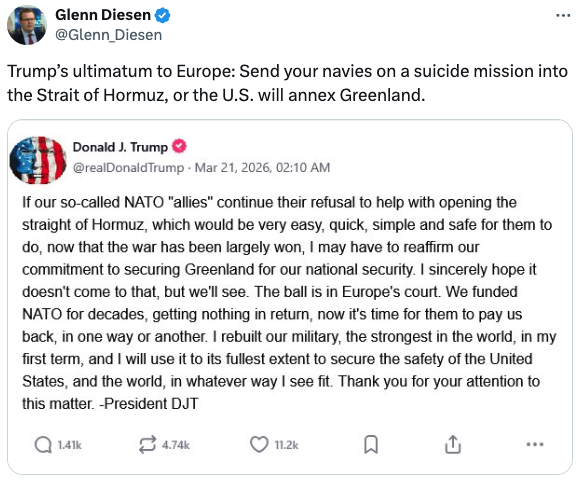
Just one problem: The Trump post was phony. (Diesen has since deleted his tweet, but as you see above, most everything on the internet lives forever.)
Then there was this bit of ridiculousness that got tens of thousands of views…
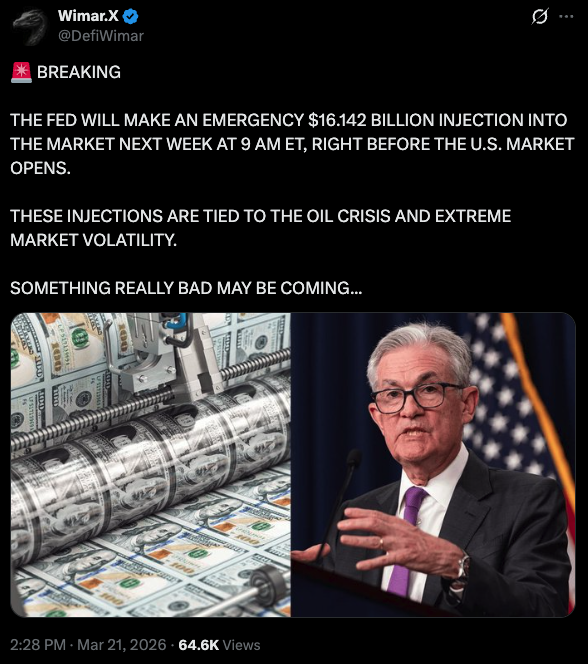
This post was further amplified by a Substack page called “2nd Smartest Guy in the World” — who does have some perceptive things to say now and then.
As several observers pointed out, a figure of $16.142 billion is right in line with the Federal Reserve’s regular purchases of U.S. Treasuries — purchases that have been underway ever since the Fed announced in December that it would resume expanding its balance sheet.
(The Fed knew better than to call it “quantitative easing” this time — even though that’s exactly what it is.)
The Fed blowing up its balance sheet is not a good thing in the long run — but in no way is it an EMERGENCY now.
What happened to Prof. Diesen and the “2nd Smartest Guy in the World” is an object lesson for all of us…
- Sometimes it’s hard to tell Trump parody apart from Trump reality.
- The amount of bogus information out there is proliferating like Topsy (and neither of these examples involves AI!).
- To be an informed citizen, you must be hyper-vigilant — especially when encountering information that soothes your own confirmation bias.
In other words… even if it rings true, look a little deeper. Take nothing at face value.
Or as they said to cub reporters back in the day at the old City News Bureau of Chicago, “If your mother says she loves you, check it out.”
 Comic Relief
Presented without comment…