
Drill, Baby, Drill (California Edition)
 Drill, Baby, Drill (California Edition)
 Amid the flurry of oil-and-war headlines yesterday, the story got lost in the shuffle.
“President Donald Trump is preparing to invoke Cold War-era powers to pave the way for renewed oil production off the southern California coast,” Bloomberg reported — “a long-shot bid to help ease the global crude supply crunch spurred by his war with Iran.”
The plan is to invoke the Defense Production Act of 1950 to quash California state law and clear the way for an outfit called Sable Offshore Corp. (SOC) to restart production at a cluster of platforms off Santa Barbara.
Those rigs have been effectively shut in since 2015 — when California regulators closed the pipelines necessary to bring the oil onshore.
The news sent shares of SOC roaring 34% higher at their peak yesterday. This morning, they’re trading at a five-month high.
The Trump administration’s approach here is right in line with other steps it’s taken in the last 14 months — leveraging the authority of the federal government to secure minerals it sees as critical for the economy and the military.
Really, invoking the Defense Production Act to goose oil output is the next logical step. Last month brought the announcement of Project Vault — a $10 billion taxpayer-backed loan to start a critical-minerals stockpile for automakers, aerospace firms and energy producers.
And of course starting last year the federal government took equity stakes in several natural-resource companies — the rare-earth name MP Materials, the copper-zinc firm Trilogy Metals and the lithium miner Lithium Americas among others.
Members of the Paradigm Mastermind Group were positioned ahead of time when the feds announced they were taking a stake in USA Rare Earth (USAR).
It was a rare instance when Jim Rickards, James Altucher and Enrique Abeyta — three experts with vastly differing investment approaches — were in consensus on a single name. During our “All-In” Summit back on Aug. 7, they all sang the praises of USAR.
Result? Readers bagged a 180.1% gain in a little over two months. Jim, James and Enrique recommended selling half the position… and letting the rest ride, awaiting the next profit catalyst.
For the record, the three of them passed on Sable Offshore. Sable makes headlines every few months, but the price action is just too volatile. As Bloomberg’s story puts it, “The company’s shares have seen sharp swings and multiple trading halts in the last year.” Too risky.
Besides, our trio of experts is much more excited right now about an opportunity faraway from the natural resource sector.
They’re expecting an announcement from Nvidia next week that will mark a huge leap in “aAI” or autonomous AI — where AI meets robotics and automation.
The announcement comes Monday — only four days from now, when Nvidia CEO Jensen Huang is set to name the tiny software company Nvidia is partnering with to make it all possible. Profit potential — an estimated 2,566%.
Paradigm Mastermind Group readers are already positioned ahead of this announcement. And it’s not too late for you to join them. Click here to check out this updated presentation featuring Jim, James and Enrique right away.
 So Long, SPR, Been Nice Knowing You
“The end of the Strategic Petroleum Reserve as we know it,” quips Paradigm’s resident oil field geologist Byron King.
As mentioned here yesterday, the 32 member states of the International Energy Agency have agreed to release 400 million barrels of oil from their reserves.
Last night, the Trump administration announced the United States would kick in nearly half that total — 172 million barrels — from the government’s Strategic Petroleum Reserve in the salt caverns of Texas and Louisiana.
If you’re a longer-term reader, you might be wondering: Wait, didn’t the Biden administration drain the SPR at some crazy-unprecedented rate? And has it been replenished?
The answers are “yes” and “not much.”
Here’s a chart of the SPR’s level going all the way back to when the government started filling it during Ronald Reagan’s first term.
Many presidents have tinkered with the SPR to achieve political outcomes — but Joe Biden literally took it to a whole new level amid $5-a-gallon gasoline in 2022, with midterm elections looming.
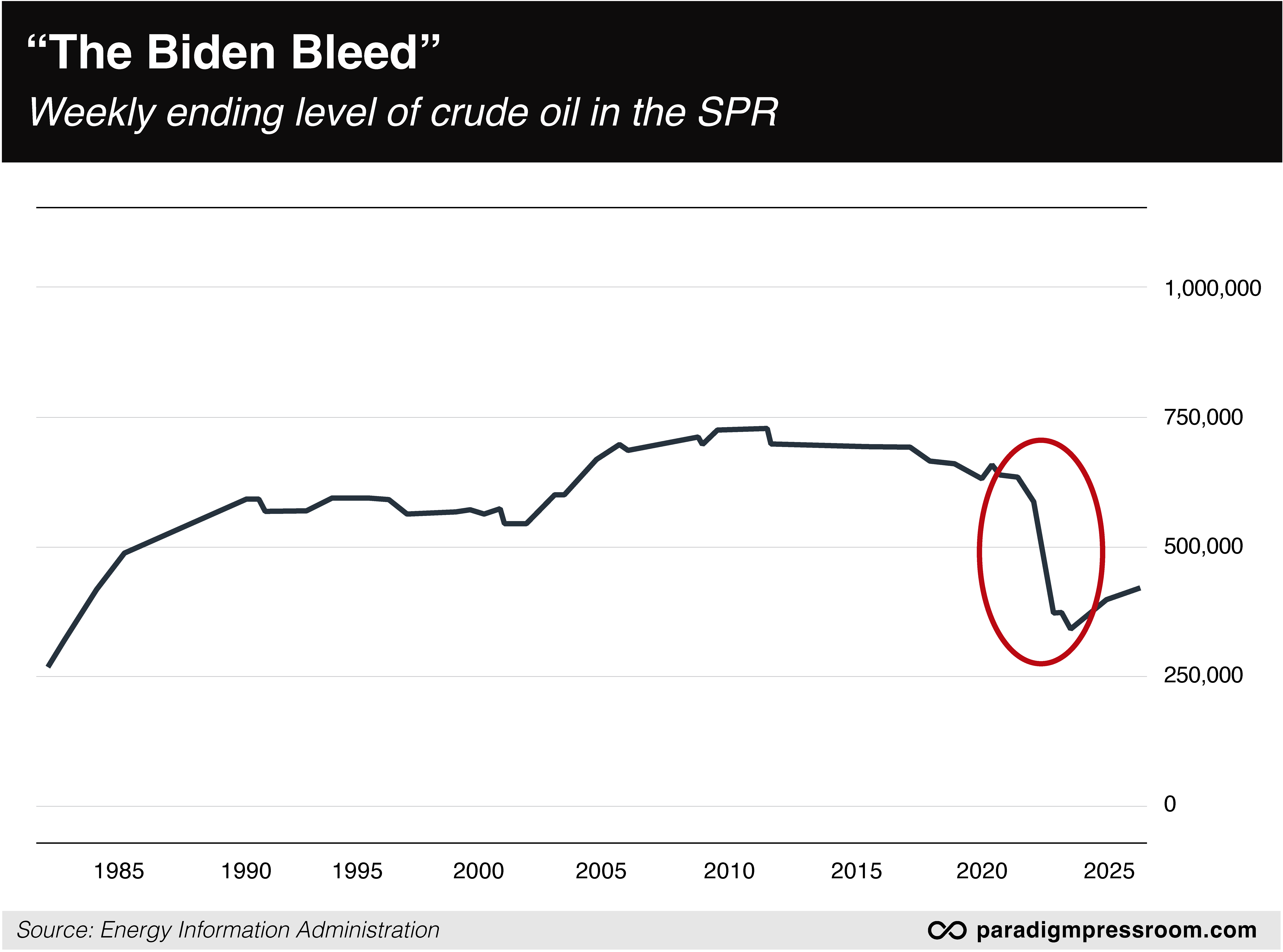
The Biden administration started refiling the SPR in 2024 — veeerrry slowwwly — and the Trump administration carried on at that glacial pace last year.
At present the level is a little over 415 million barrels. Draining 172 million would bring the level down to where it is on the very left of that chart.
At which point the damage to the SPR salt walls would be nearly beyond repair.
Byron King explains how drawing crude from the SPR actually works: “Imagine a big glass jar filled with oil. The glass represents the salt, in that it doesn’t dissolve due to contact with oil.
“But it gets complicated because to move the oil upward, the trick is to pump saltwater down to the bottom of the oil column. And then, because oil floats on water due to density differences, when it comes time to withdraw oil the pumps just lift the petroleum off the top.”
Well, the “Biden bleed” had the effect of cracking the glass jar — or to be precise, damaging some of the salt walls. “The walls thinned out and weakened, which required significant, expensive and technically challenging repairs.”
The original idea behind the SPR in the 1970s was to store a massive quantity of oil, “then pretty much draw down in a one-and-done event — an absolute submarines-sinking-tankers emergency,” Byron says. It wasn’t set up for something like this.
And the damage only gets worse with a further drawdown. “As you get down to the lower ‘half’ of the barrels, you get into sediment and crud that has settled out over the years. You’re pulling out oil that’s more viscous, with higher solids in it.”
It can damage pumps. It flows through pipelines at a snail’s pace. Refineries have a hard time processing it.
And it doesn’t even solve the immediate problem.
Energy Secretary Chris Wright says the release will take place over a four-month span. Which works out to about 1.4 million barrels a day.
For perspective, that’s about 6.9% of the country’s oil consumption — roughly 20.4 million barrels a day.
For further perspective, the fastest pace at which the Biden administration was able to drain the SPR was 1 million barrels a day — considerably less than Wright’s promise.
And the coup de grace, according to a post on X from Geiger Capital: After this release, China will have a strategic oil reserve five times the size of America’s.
No, China is not a member of the International Energy Agency. It is not one of the 32 countries taking part in this global coordinated release.
 Oil Soaring Again
As for progress of the war…

Iran’s new Supreme Leader — the son of the one killed by U.S.-Israeli airstrikes — just delivered his first public statement, read aloud by an announcer on state TV.
The upshot is that Tehran will continue to use the “lever of blocking the Strait of Hormuz.” As such, the Iranian military has attacked at least three more foreign cargo ships in or near the Strait.
At last check, a barrel of West Texas Intermediate is up over $10 to $97.17. That’s still lower than it was before Donald Trump’s “very complete, pretty much” jawboning on Monday afternoon — but not much lower.
The aforementioned Energy Secretary Chris Wright tells CNBC the U.S. Navy is “not ready” to start escorting oil tankers through the Strait of Hormuz. (CNBC failed to ask him about his botched market-moving tweet on Tuesday because of course.)
And whenever the Navy is “ready,” it faces a herculean task, according to The Economist.
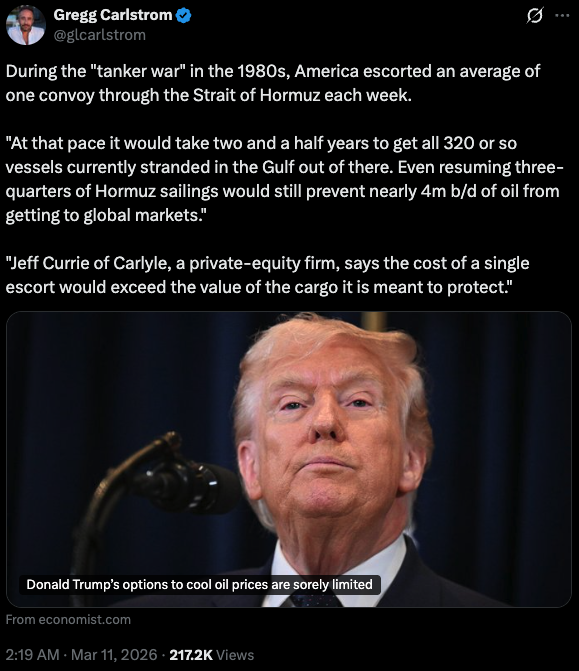
And all of this comes amid figures from the shipping-data firm Kpler that show Iran is now exporting more oil than it did before the war began.
The Financial Times describes the U.S.-Israeli effort as “a rare joint military campaign that has little precedent. Israel since its independence in 1948 has almost exclusively fought alone. The sole exception was during the Suez Crisis, waged seven decades ago with Britain and France, two fading colonial powers forced into ignominious retreat.”
The article let that historical tidbit hang, without elaborating on any parallels to the present moment. Draw your own conclusions…
As for stocks, “we should expect this choppy action to continue,” Greg Guenthner tells his Trading Desk readers.
“The herd is getting bearish and mixed messaging about the war that isn’t helping investor confidence right now. We need to expect overreactions to any and all Iran headlines.” As such, he’s not laying on any new trades today.
As we write, all the major indexes are down 1%, give or take. The S&P 500 rests at 6,710. If that number holds by day’s end, it will be the lowest close since late November and about 4% below its record high in late January.
On the flipside, “I'm very impressed with crypto here,” says Greg. “I think we could see a bigger upside move if BTC and ETH continue to hold up.” Bitcoin continues to hover over $70,000 while Ethereum sits at $2,073.
Precious metals? Quiet by recent standards, gold still over $5,100 and silver a hair below $85.
 $100 Million Gold Mystery
Back to the Trump admin’s minerals policy…
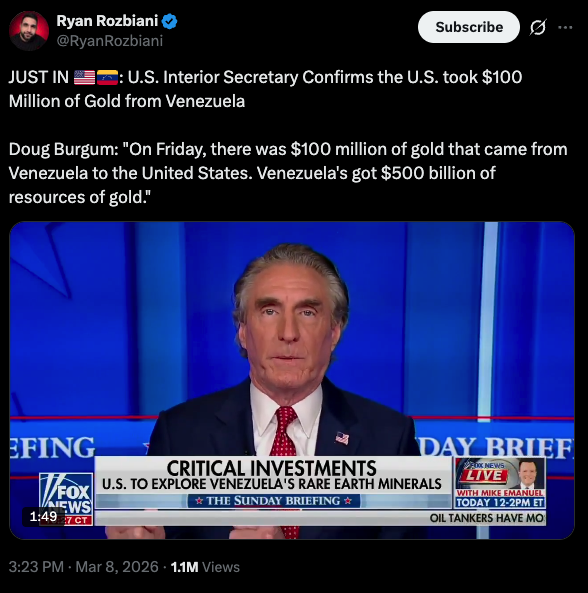
There’s not a lot of coverage fleshing out this story. As near as we can tell, Interior Secretary Doug Burgum was in Venezuela last week meeting with acting President Delcy Rodriguez and representatives of a couple dozen natural resource firms.
“After the meeting,” reports an Indian news outlet, “Burgum said Venezuela’s government had given security assurances to mining companies interested in investing in the country, where mineral-rich areas have long been controlled by guerrilla groups, gangs and other illegal actors.”
The mind boggles with questions. Who’s going to provide security? Who’s going to cover the cost? Will it be the U.S. taxpayer?
As we said shortly after the administration kidnapped President Nicolas Maduro at the start of the year, it would be trivially easy for leftist paramilitaries to sabotage Venezuelan pipelines in the middle of nowhere to ensure the Yanquis are deprived of the country’s oil wealth,
And then there was the bit about the gold: “On Friday,” Burgum told Fox News, “$100 million worth of gold came from Venezuela to the U.S., both for industrial purposes and other commercial uses.”
Really? “Industrial” and “commercial” uses of gold make up about 6% of global gold demand — electronics, dentistry, etc. (The rest is for jewelry, coins and bars.)
Again the mind boggles: Which companies are getting this gold? How is the administration choosing them? Are they paying a discounted price? And who’s getting paid?
Inquiring minds want to know!
 Mailbag: Fertilizer
On the subject of a looming fertilizer shortage thanks to Iran’s blockade of the Strait of Hormuz, a reader issues a brief and pointed proposition…
“Great! Farmers can return to organic farming and Americans will be healthier.”
Dave responds: Don’t disagree in theory… but I’m not sure that’s very high on the agenda of Health and Human Services Secretary Robert F. Kennedy Jr.
Domestically, getting from here to there would be exceptionally challenging. As former RFK adviser Charles Eisenstein wrote in his 2022 collection of essays The Coronation, widespread organic food production would be much more labor-intensive than the current practices of Big Agra.
Not that there’s anything wrong with that. If AI is going to put legions of white-collar workers out of a job, there are worse things they could do than grow healthy food. (Whether it pays as well is another question.)
Overseas, getting from here to there would be impossible. The “Green Revolution” and its widespread use of fertilizers made it possible to feed hundreds of millions of mouths in the developing world, people who otherwise would have never been born or who would have starved to death at a young age.
In the present moment, former CIA officer Larry Johnson says India and Brazil are in grave danger in the event of an extended Hormuz blockade — with Bangladesh not far behind.
In contrast, the United States and Canada will fare reasonably well. Ditto for oil and natural gas.
Brings to mind the quip attributed to Germany’s “Iron Chancellor” Otto von Bismarck: "God has a special providence for fools, drunkards and the United States of America."


