
The Most Dangerous Word in Investing
- The mellow market of 2023…
- … and why it’s still got legs
- Still, every rally needs a rest
- Here we go again with a Pentagon audit
- “A with-us-or-against-us mindset."
 “Where’s My Damn Crash Already?!”
 “The market’s ‘fear gauge’ just hit its lowest level since January 2020,” says an article from Yahoo Finance.
True enough. Volatility as measured by the VIX slipped under 13 yesterday. Nice ’n’ mellow.
Of course, the Yahoo article neglects to point out that only two months after the January 2020 low, the VIX soared to over 82 amid maximum COVID panic… but we’ll let that go.
As we write the S&P 500 will likely end this week in the red… but at 4,353 it’s rallied 21.7% from its lows last October.
If you’re a newer reader who came upon the work of Paradigm Press during 2022 — while the stock market was having its worst year since 2008 — you might be asking yourself, Where’s my damn crash already?
Here’s the thing: Stock market rallies frequently last longer and soar much higher than “should” to be the case in light of an impending recession, stresses in the regional banks, geopolitical tensions or whatever.
I’ve observed before that should might be the most dangerous word in all of investing. Frequently markets do not respond to events the way you think they should.
You have to invest not in light of what should be… but rather what is. And what “is” the case right now is an atmosphere of FOMO, or “fear of missing out.”
“This is true both for individual investors and also for professional investors,” pointed out Paradigm income-investing specialist Zach Scheidt on a recent subscriber-only call.
“In fact, sometimes we think about the individual investors as being less sophisticated — and the professional investors as being more staid and logical and so forth. But that's not always the case.”
As Zach knows well from his days running a $20 million hedge fund portfolio.
“We had to look at our numbers quarterly, and we had to make sure that we were not just doing well for our clients, but that we were keeping up with the market — that we were doing better than our competitors.
“And so, when you end up with a new bull market, often you wind up with professionals who may not be keeping up with this bull market and all of a sudden, the spotlight is shown on them. And their investors and their bosses are saying, ‘Why didn't you keep up? Why are you not fully invested? Why are you not invested in these stocks that are moving higher quicker?’
“So this new bull market can actually cause a lot of buying pressure as this fear of missing out hits both the individual investors and the professional investors. Because for the pros, they can actually lose their job if they're not keeping up with this new bull market.”
These incentives lead to a perverse phenomenon called “closet indexing” — in which a fund manager is too afraid to stick his neck out, lest he deliver a few weeks of underperformance.
So he winds up constructing a portfolio that merely keeps pace with a broad stock-market index like the S&P 500. His clients pay ginormous fees when they could have just stuck their money in a low-fee ETF from an online brokerage!
Of course, Zach was part of a rare breed — nimble enough to stick his neck out and still outperform the market.
 The Sign of a Healthy Rally
But it’s not just FOMO at work: As we’ve mentioned frequently this month, it’s no longer just seven tech-adjacent stocks propping up the entire market.
That’s a sign of a healthy rally, regardless of what you think the market should be doing.
“In the first five months of the year,” Zach said, “we saw the major megacap tech stocks really driving the market higher. You've seen Nvidia (NVDA), the semiconductor stock that's rallied just astronomically and actually had the biggest one-day gain in market cap that we've ever seen after it announced earnings. We've seen Microsoft trading higher. Apple is hitting a new all-time high, and that's the largest stock in the market.
“These Big Tech stocks have been driving the market higher. And that has been a little bit unhealthy because a lot of the other smaller stocks just haven't been keeping up.
“But we're seeing a bit of a rotation just now in the month of June. So it's very fresh, it's very new and it has some staying potential where we're seeing small-cap stocks in other areas of the market. Industrials, retail stocks, these different areas of the market are now catching up and trading higher, and that's a very healthy sign.
“I love it because it gives us more opportunities to make money,” Zach says. “We don't have to be just in this handful of stocks that are driving higher now. The broad market is starting to move higher.”
Of course, you don’t want to merely keep pace with the market. You want to be like Zach’s old hedge fund clients — outperforming the market when it’s going up, and still collecting income when it’s going down.
That’s the key to Zach’s premium advisory we launched two months ago called The Income Alliance. It harnesses all the know-how Zach accumulated during his hedge-fund days… and puts it to work in a simple strategy everyday folks can use in an online brokerage account.
Best of all, he’s investing right alongside you — with $100,000 of his own money in an account dedicated to Income Alliance trades. You prosper when he prospers.
Already this strategy has delivered proven gains of as much as 166% in less than a week. Zach walks you through how it works when you follow this link.
 Sad Stock-Photo Guy Is Sad Again
It’s been a downer week for the stock-photo trader dude on CNBC’s website…
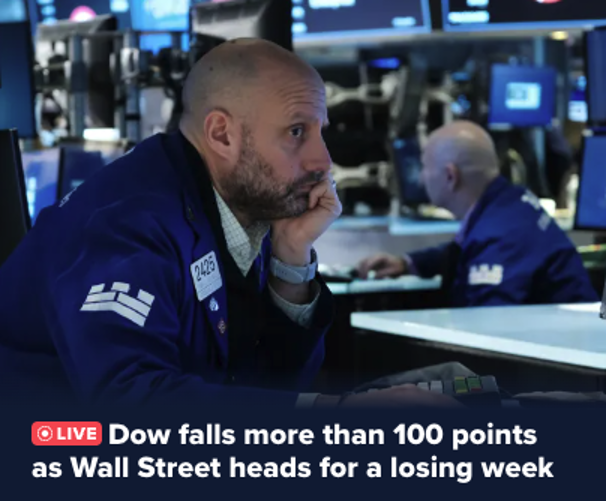
But after several “up” weeks in a row, the market is due for a rest. That 100-point loss on the Dow has expanded to 200 as we check our screens, the Big Board down 0.6% at 33,746.
The S&P 500 has shed 0.75% on the day, down to 4,347. The Nasdaq is taking it worst, down over 1% to 13,477.
Hot money leaving stocks is flowing into bonds and gold; the yield on a 10-year Treasury note sits at 3.73%. Gold has rallied, however modestly, to $1,926.
Crude is set to end the week back below $70, a barrel of West Texas Intermediate down about a buck to $68.53. Bitcoin continues to hold the line on $30,000.
➢ The lone economic numbers of the day are the “flash PMIs”... and once again they’re a tale of two economies. Manufacturing continues to shrink with a way-lower-than-expected reading of 46.3. But services continue to grow with a higher-than-expected reading of 54.1. (As a reminder 50 is the dividing line between expansion and contraction.)
 “This Time for Sure!” (Pentagon Audit)
Here we go again: There’s bipartisan legislation in Congress to audit the Pentagon.
Maybe you heard the other day about the “accounting error” in which the Defense Department discovered it had a spare $6.2 billion that it could blow on additional aid to Ukraine.
A $6.2 billion error — close enough for government work, right?
Enter the “Audit the Pentagon Act of 2023” sponsored by Sens. Chuck Grassley (R-Iowa) and Bernie Sanders (I-Vermont). It would require the Pentagon to pass a full independent audit next year. Any unit of the Pentagon that fails to pass would have to return 1% of its budget to the Treasury.
The pitiful amount of news coverage surrounding this bill points out that the Defense Department has failed five audits in a row going back to 2018.
In reality, this sorry saga goes back much longer than 2018. We’ve chronicled it in the past, but it’s worth a revisit today.
Way back in 1990, Congress passed a law ordering the Pentagon to be audit-ready by 1996.
But there were never any “or else” consequences attached to the deadline, which Congress kept pushing back. The Pentagon didn’t even get around to attempting an audit until — well, that first of five failed audits in 2018.
From time to time, American leaders performatively wrung their hands about the Pentagon’s inability to maintain its books. Perhaps the most infamous instance occurred on the day before the 9/11 attacks in 2001 — when Defense Secretary Donald Rumsfeld fessed up that, “According to some estimates, we cannot track $2.3 trillion in transactions.”
That’s $2.3 trillion going back only five years to the original 1996 deadline. By 2013, the total swelled to about $8.5 trillion.
Of course, because we’re talking about transactions that can’t be “traced, documented or explained,” the numbers are going to be squishy. The most recent estimate we find is five years old and it comes from Michigan State economist Mark Skidmore. He totaled “undocumented adjustments” between 1998–2015 of $21 trillion. That’s more than three times what Uncle Sam will spend this year on, well, everything.
We’re not holding out much — no, check that, any — hope for this state of affairs to change. A previous version of the Grassley-Sanders bill died in committee two years ago; it’s likely the defense hawks will swing into action to kill this one too.
In the meantime, the SPDR S&P Aerospace & Defense ETF (XAR) is up 20% year-over-year, compared with a 15% gain for the S&P 500.
 “With Us or Against Us”
“Like the insight from you guys even though it seems you guys are lefties to me,” says a reader’s email.
The reader then launches into a defense of Donald Trump that I can only guess was inspired by my brief mention on Tuesday that even before COVID came along, Trump ran up the first $1 trillion budget deficit in seven years.
“I believe in Trump’s four years as president we had no new wars and $2.50 gas and inflation was at 2%... am I missing something here!!
“Give me the tax break back and all the other good things that TRUMP did to make this country better.. FJB!!! and the demorat party and the RINOs… we know who they are and they will be gutted!
“Keep up the interesting info... you’ll get it someday!”
Dave responds: So there’s a lot to unpack here.
First, I appreciate your willingness to give us the time of day even though you (mistakenly) perceive a left bias.
That’s an increasingly rare trait these days. In an interesting Boston Globe Op-Ed this week, culture writer and novelist Kat Rosenfield laments how “politics is increasingly defined by negative polarization and a with-us-or-against-us mindset in which anyone who doesn’t fully support every last tenet of a given ideology is deemed a member of the loathed outgroup.”
This mindset is most obvious among the center-left types who dominate the power elite nowadays… but it’s also coming through from the right in your own words. (But again, props for your willingness to engage!)
If it makes you feel any better, our own Jim Rickards has described himself in the past as “ultra-MAGA.”
But me? My approach to our two-party system is far more cynical and is captured in memes like these…
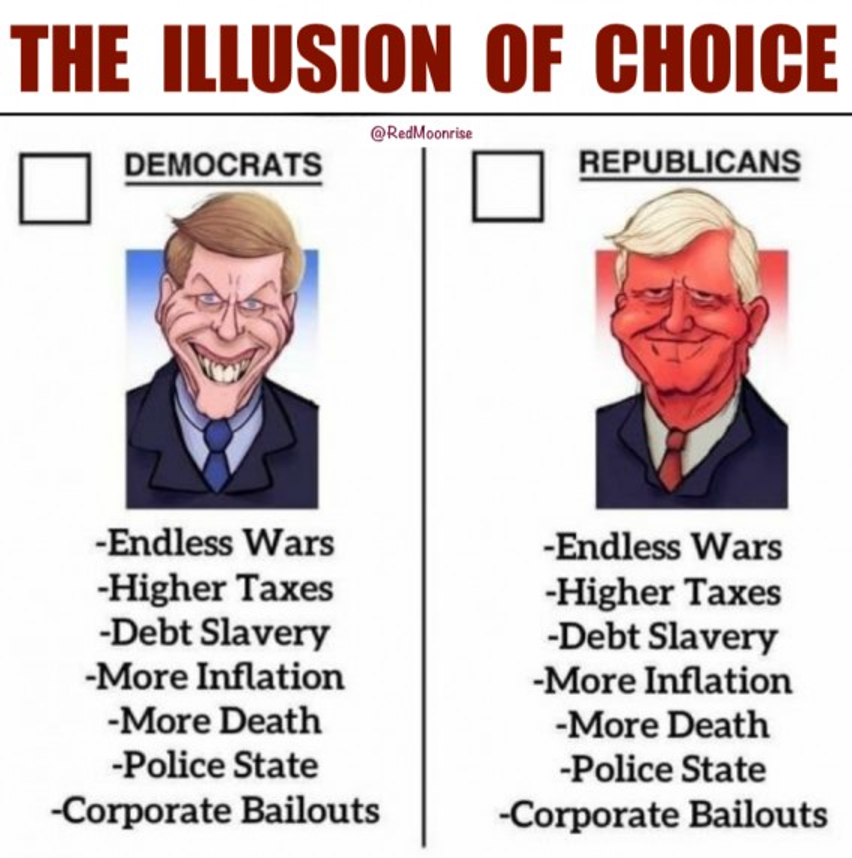

As for the particulars in your defense of Trump…
- True, no new wars. But he continued escalating the Bush-Obama provocations against Russia that ultimately led to the Ukraine invasion last year. (Hell, even Obama knew better than to send lethal weaponry to Ukraine — but not Trump)
- In the main, presidents have far less control over gasoline prices than you might think. But that’s a topic for another day
- You still have your tax cuts; they don’t expire until the end of 2025.
But more important than any of that… you’re giving Trump a pass on lockdowns?
As I demonstrated in March, Trump allowed himself to get steamrolled by Anthony Fauci and Deborah Birx.
The shuttered small businesses, the backsliding in little kids’ education, the uncontrolled spending and the inevitable inflation that followed — sorry, it’s on him. Not that he’ll ever admit it.
And if you’re willing to give him a pass on that… well, you’ve set a mighty low bar.
Let’s wrap up the week’s mailbag with something a little less depressing…
“I can only hope that the Musk/Zuck cage match becomes a pay-per-view event and the proceeds go to some worthy nonprofit cause, without any sort of ‘agenda’ behind it.”
Dave responds: Well, that would be the one good thing to come out of it!
Have a good weekend,

Dave Gonigam
Managing editor, Paradigm Pressroom's 5 Bullets


