
Wall Street’s “Witch Doctors”
 Wall Street’s “Witch Doctors”
 It might be the most passionate debate in all of investing — as divisive as anything you’ll encounter in religion or politics.
On one side are people who keep a laser focus on things like a company’s revenue… profits… cash flow.
They might augment their study of those numbers with analysis of how the economy is performing… and how that performance might impact those numbers going forward.
This is fundamental analysis. No, its adherents are not called fundamentalists. But they can summon a fundamentalist’s degree of fervor...
… especially when they encounter the heretics who engage in technical analysis — chart patterns, price and volume data, etc. Or as the fundamental types would call it, “voodoo.”
“Serious investors pay attention to technicals,” says Paradigm’s hedge fund veteran Enrique Abeyta — who applies both technicals and fundamentals when making winning picks.
“Not because charts tell the future… but because they reveal things that the fundamentals alone can’t tell you.”
Fundamentals are essential for the long term. But technicals help in the short term — where human behavior often trumps the fundamentals. We’re talking about “forces like enthusiasm or fear that don’t show up on a balance sheet.”
After all, “Stocks can trade at significantly different values than the economic value of their businesses for long periods,” Enrique reminds us.
That’s because “thousands (or often millions) of participants of all different kinds have different reasons for buying and selling at a specific price.
“It's impossible to have transparency to understand all of their motivations. However, it is possible to understand the balance of their motivations in aggregate.
“This is done by looking at trading data — the goal of technical analysis.”
Here’s a helpful metaphor: “Think of the technical analysis as the waves and tides of the ocean,” Enrique says.
“These are the physical results of many physical inputs, things like temperature, salinity levels, wind or the moon’s gravity.
“Trying to understand all of these elements in a single equation is impossible. But we can see the waves and feel the tides. They also happen over and over again in similar patterns.
“Despite our ability to know the aggregate input of the many individual factors, we can make reasonably accurate predictions about what happens next through observing the outcome.
“This is precisely what's happening with technical analysis.
“We can't ever know the exact weighting of any input into the price action of individual stocks. But through time, the balance of these inputs results in similar outcomes.
“It doesn't mean that the same pattern results in the same outcome every time. Still, it's often enough to make it statistically significant.”
And actionable.
Another helpful metaphor comes from the gambling realm: Say the dealer has dealt a hand — and only one or two of the cards is a face card. That’s no guarantee the next card will be a face card — but the probability is higher than it was before the dealer started with a full deck.
“And by increasing your bet,” Enrique says, “you can take advantage of it across a large group of decisions.”
Bottom line: “Technical analysis doesn’t promise certainty. Nothing in markets does. What it offers is something far more practical… a repeatable way to identify when the odds tilt in your favor.”
 Drama at the Fed
Wall Street has slipped into neutral — as it often does ahead of a Federal Reserve decision.
The Fed’s Open Market Committee convened this morning for one of its every-six-weeks meetings to set policy.
There’s no drama about the decision: Tomorrow afternoon the Fed will lower the benchmark fed funds rate another quarter percentage point to 3.75%. That’s down from a peak of 5.5% less than 18 months ago.
But there will be big drama going into that decision: “This meeting promises to be one of the most divisive at the board level since the 1980s,” says Paradigm macro maven Jim Rickards.
“There are only two ways to vote on an interest rate decision — yes or no. But there are three distinct views among the board members.
“A group of doves led by Stephan Miran, recently appointed by President Trump, not only want to cut rates but are pushing for a larger rate cut of 0.50%. Board members Michelle Bowman and Christopher Waller lean in that direction.
“A group of hawks led by Kansas City Federal Reserve Bank President Jeff Schmid and a large group (described as ‘many’ in recent FOMC minutes) favor no rate cut. A centrist group led by Chair Jay Powell and other governors including Phil Jefferson, Michael Barr and Lisa Cook support the 0.25% rate cut, although some may lean in a hawkish direction.
“The result may be an 8-4 vote in favor of the 0.25% rate cut where the four dissenters are of two different minds — some supporting a larger cut and some supporting no cut at all.
“The takeaway will not be about interest rate policy but about Powell’s loss of control of his own board. That will clearly weaken Powell’s role in early 2026 and accelerate the timing of Powell’s replacement. In effect, Powell will be a lame duck chair.”
Reminder: Powell’s term is up next May. Usually, markets hang on every word uttered by a Fed chair during the post-meeting press conference. But maybe not this time? Stay tuned…
Ahead of tomorrow’s decision, the major U.S. stock indexes are treading water.
At 6,848 the S&P 500 has barely budged from yesterday’s close. The Nasdaq is slightly in the red, while the Dow is barely in the green.
In the precious metals space, silver has a dynamic of its own right now entirely separate from the Fed: At last check the white metal has screamed $1.73 higher and it’s less than 20 cents away from a $60 handle.
“We might see a correction in the near term, but $100 per ounce is highly likely in 2026,” Daily Reckoning editor Adam Sharp just posted on the Paradigm press mobile app. “And $200 per ounce is just a matter of time.”
Gold’s gains are much more modest, the bid hovering around $4,200. Elsewhere in the commodity complex, crude is down to $58.25 — the lowest so far in December.
Crypto is showing signs of life — Bitcoin comfortably over $92,000 for the first time since Friday. Ethereum has rallied to $3,231.
 Good Help Is Hard to Find (Update)
Whatever was whacked-out about the U.S. job market a month ago is… well, maybe less whacked-out now.
Back on Nov. 11 we spotlighted the monthly Small Business Optimism Index put out by the National Federation of Independent Business. There’s an often-revealing part of the survey where NFIB members are asked to identify their single-most important problem.
The percentage of respondents identifying “quality of labor” skyrocketed — from 18% in September to 27% in October.
Something happened that was making good help much harder to find — and there was nothing in the NFIB’s report to shed any light. Well, apart from the fact the problem was especially acute in the construction and transportation sectors.
Relative to other lines of business, construction and transportation rely more on illegal migrants. Was the federal crackdown on illegal migrants having an impact?
Obviously no one is going to say so in a survey, so we were left to speculate… and wait for the next month’s data.
The November survey is out this morning… and the percentage of owners citing labor quality as their biggest problem retreated from 27% to 21%.
Again, the “why” is lacking from NFIB’s 23-page report. A handful of comments from survey respondents includes…
“Labor needs are never met,” says a business owner in Florida. “The quality of workers is very poor.”
“Struggling to find full-time employees who will stay for more than one year,” says a respondent from Missouri. “I am struggling with finding management and good, responsible employees who don’t have other responsibilities.”
Perhaps the problem lies in… the survey’s sample size?
The NFIB survey has a long history, going back over 50 years now, but the number of respondents can be “lumpy.” In October, 984 business owners answered the survey — but in November it was 505.
And in general the number of respondents has fallen over the last five years. (The same phenomenon has occurred with government data in the “post-pandemic” era.)
One thing is certain: Compared with labor quality, nothing else comes close on the single-most important problem list: After labor quality at 21%, inflation comes in second place, cited by 15% of respondents — followed by taxes at 14%.
Then there’s a tie at 10% between regulations and “cost/avilability of insurance.”
“Poor sales” has inched down to 9% — but that’s still up from only 5% a year ago.
[Inquiry to the readership: We have a fair number of small-business owners in the ranks of our readers. Are you an NFIB member and have you ever responded to its surveys? Let us know at this email address.]
 Canada’s Booze Boycott Goes Critical
The Canadian protest over U.S. trade policy has reached an odd juncture.
Remember this last winter?
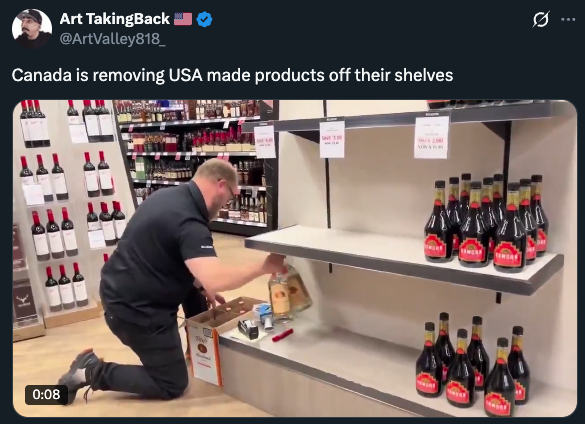
Well, that was then and this is now. “Canadian provinces have a strange problem,” reports the BBC: “What to do with millions of dollars worth of American alcohol, pulled from the shelves in anger over U.S. tariffs and now gathering dust in stockrooms?”
See, the whole Canadian booze boycott wasn’t necessarily something supported by everyday Canadians. In most of the country, alcohol sales are subject to stiff controls by provincial governments — “which operate boards that manage the import and sale of most wine and spirits, giving them broad authority over what is sold.”
They were the ones who pulled U.S. brands from their shelves.
And now this booze sits gathering dust in back rooms. A small amount of it — flavored drinks and whatnot — is approaching expiration.
Ontario is sitting on $57.7 million worth — and its leaders haven’t tipped their hand yet about their plans.
Manitoba and Nova Scotia have settled on plans to sell the remaining inventory and donate the proceeds to charity.
More from the BBC: “Since restocking their shelves with U.S. liquor last week, Nova Scotia stores saw higher than usual sales, said Terah McKinnon, spokesperson for the province's liquor board.” That said, “Nova Scotia will not be ordering any more alcohol from the U.S. once it sells out.”
Meanwhile, British Columbia is reselling its inventory to American restaurants and bars.
Go figure: U.S. brands remain for sale in two of the Prairie Provinces — Alberta and Saskatchewan — where the system is fully privatized.
 Mailbag: Self-Checkout
After our item in yesterday’s 5 Bullets about the number of people who fess up to stealing stuff at self-checkout, we heard from a couple of readers…
“I use self-checkout a lot at our local Kroger store, which sells hardware among other things.
“I was trying to scan a rake, and the cameras detected it was on the wrong side of the scanner before it successfully scanned. Alarms went off and store employees immediately descended. They had an instantly accessible video of everything I did right there on my terminal. Fortunately, they were there to help.
“I would not try to get anything out of that store, or any store that has a modern self-checkout.”
“I’m trying to tease out what the societal and investment implications may be from those alarmingly high percentages of admitted theft — or pay (wink),” writes one of our longtimers.
“One we may already be seeing is that the younger generations believe in something for nothing and elected a socialist promising them just that in NYC.
“They may lead America to full-blown socialism. We’ve already been sliding that way for a long time under both parties.
“It occurred to me over the weekend that a once-common phrase used by my generation (boomer) frequently I now no longer use or hear. ‘It’s a free country isn’t it?’ Today maybe it should be ‘This isn’t a free country, is it?’ as we apparently have the Democratic Party fully embracing and identifying as socialist.
“Also, as a boomer I have not stolen anything, but I do ‘rebel’ in other ways.
“As I’ve explained to the employees who ask to see my receipts as I leave the store… ‘Nope! You don’t even pretend to stop the criminals who run out of the store with cartloads of stolen goods so until you do, forget it!’”
Dave responds: Your early-wave GenX editor weighed in on the “free country” expression earlier this year.
Meanwhile, I’m truly fascinated by the bit of the survey in which 35% of respondents said self-checkout amounts to “unpaid work” and that stealing a small item “feels like compensation.”
Some of us are old enough to remember the bargain you made when, say, you went to a discount grocer — bag your own stuff in exchange for lower prices. Now you have to bag your own stuff and get nothing in return.
This is “shadow work” — a term coined by the Austrian philosopher Ivan Illich in 1981 and given a digital-age spin in a book that came out a decade ago.
From a 2023 Financial Times column by Rana Foroohar…
In the 2015 book Shadow Work: The Unpaid, Unseen Jobs That Fill Your Day, former Harvard magazine editor Craig Lambert focused on the myriad tasks that used to be done by other people, which most of us now do for ourselves, usually with the help of digital devices. This includes everything from banking to travel bookings, ordering food in restaurants to bagging groceries, not to mention downloading and navigating the apps we need to pay parking tickets or track our children’s school assignments or even troubleshoot our own tech problems.
While neither Lambert nor groups like the IMF Statistical Agency have a good estimate of the total amount of extra work represented by such tasks, it’s clearly substantial, and growing, particularly if you consider research showing that a quarter of all jobs in the U.S. will be severely disrupted by automation by 2030 (indeed most jobs will experience some level of disruption). “I’m just amazed how we’ve been suckered into spending our own time straightening out things that other people used to do for us,” says Lambert.
Supposedly “AI agents” will be able to smooth out a lot of this friction — colleague Chris Campbell describes how they work in a recent edition of Altucher Confidential — but we’re not there yet!


