
Trump's $10 Billion Buying Spree
 It’s Not Too Late
 Usually by the time a story makes it into the corporate media, it’s too late to make any money off it.
After all, first-mover advantage goes to those capable of acting on information that might be public — but isn’t widely known. That’s how you buy quality stocks at a bargain price.
Today’s Bullet No. 1 is an exception to the rule…
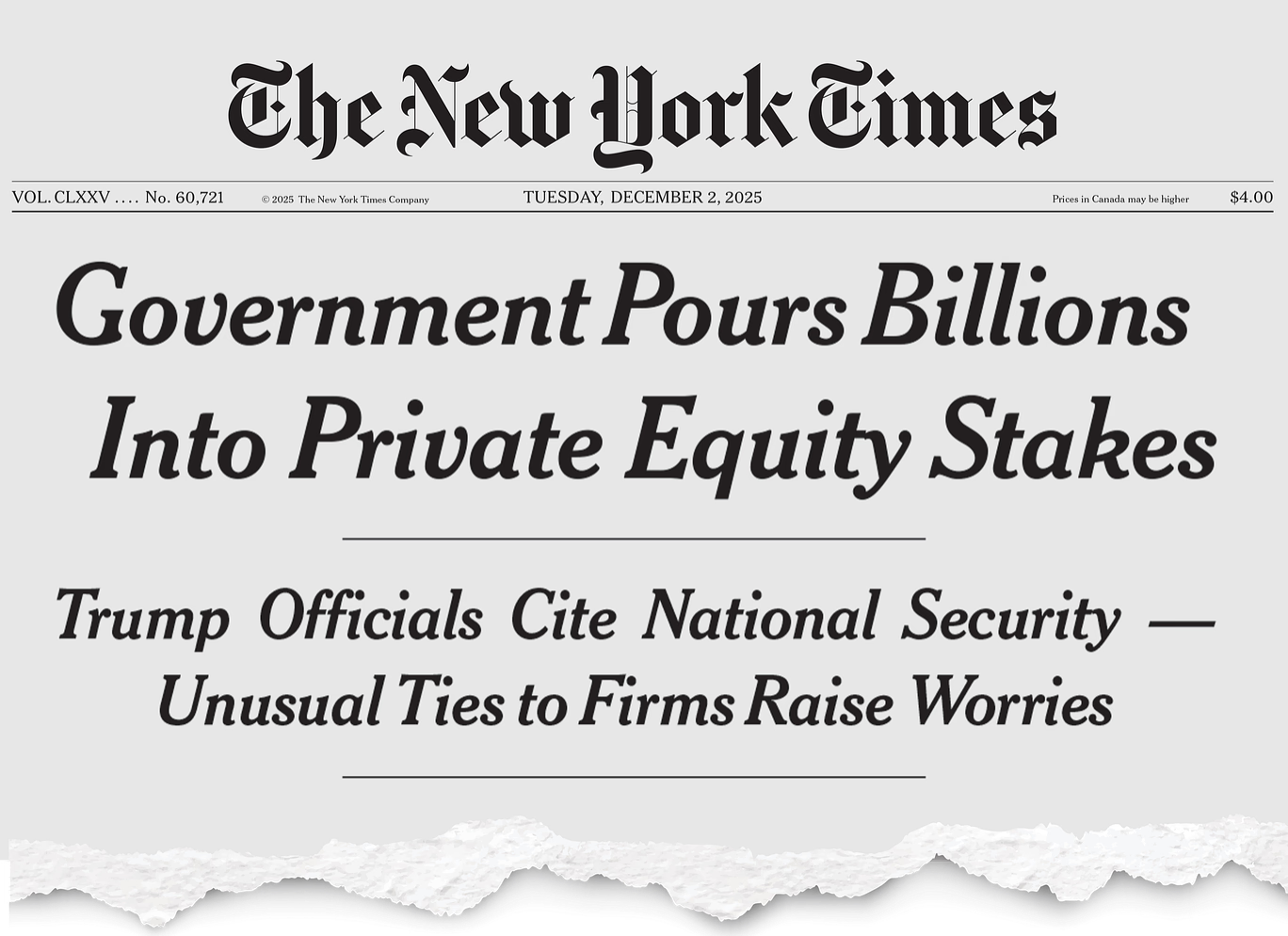
There it is in yesterday’s New York Times — front page, above the fold. “The Trump administration is snapping up ownership shares of private companies it deems essential to national security.
“It is an unusual new strategy that has already committed more than $10 billion in taxpayer funds and shows little sign of slowing.”
Not exactly news if you keep up with these 5 Bullets each day. It’s especially not news if you’re a Jim Rickards subscriber.
Even before Donald Trump returned to office last January, Jim anticipated the new administration would aggressively tap into the energy and mineral wealth underneath federal lands — a $150 trillion bounty that Jim dubbed the “American Birthright.”
Then in late April came a variation on the theme…
That’s when we spotlighted a statement by Interior Secretary Doug Burgum — in which he said upfront that the U.S. government was looking to invest in mining companies.
Or as he put it, an “equity investment in each of these companies that’s taking on China in critical minerals.”
The first such acquisition came on July 10 — when the Pentagon took a 15% stake in the rare-earth firm MP Materials.
Several Paradigm editors, taking Jim’s “Birthright” cue, had recommended MP Materials in anticipation of a development just like this. Members of Altucher’s True Alpha profited the most — 918% playing MP call options.
Then came a flurry of other government acquisitions — several in the rare earth space but also the 10% stake in Intel and a “golden share” of U.S. Steel that gives the government veto power over many boardroom decisions.
It’s hard to overemphasize what a departure from modern norms we’re looking at here.
The Times acknowledges as much:
Prior administrations have tried to speed the development of sectors like semiconductors and clean energy with grants, loans, tariffs and other policies. But taking equity stakes in companies is incredibly rare. During the 2008 financial crisis, the government took over shares in companies that were faltering or whose collapse posed broader financial risks, including General Motors and Chrysler, along with the giant insurer AIG.
The Trump administration has taken a more aggressive and opportunistic tack.
Our purpose today is not to analyze the right and wrong of the policy. With this administration, as with any other, we seek to follow the money.
And while the best profit opportunities are usually gone by the time the mainstream notices them, that’s not the case this time around.
Readers of Jim Rickards’ premium advisory The Situation Report are clued in to a select group of companies perfectly positioned to start reaping outsized gains from the Trump administration’s buying spree.
 When Google Was Cheap
No longer can Google parent Alphabet be called a “cheap” stock.
Colleague Davis Wilson of our sister e-letter The Million Mission turned heads last spring when he called GOOG “the most underappreciated Big Tech stock on the planet.”
At the time, Alphabet’s market cap was $2 trillion — and he figured the company was worth $2.75 trillion. “That’s a 27.5% discount to my conservatively estimated sum-of-the-parts valuation.”
Now?
Well, GOOG has nearly doubled since then — to a market cap of $3.8 trillion. The company is finally getting credit for developing a credible challenger to ChatGPT (Gemini). Further, it’s looking to take the high-end chips it builds in-house and start selling them to other customers (in other words, moving in on territory that now belongs almost entirely to Nvidia).
At this stage, applying the same methodology he did last spring, Davis says GOOG is now fairly valued….
- $2.6 trillion for the core business (search, YouTube, etc.)
- $1 trillion for its AI ventures and the Waymo autonomous-vehicle platform
- $500 billion for its miscellaneous operations, including chipmaking.
In other words, GOOG is no longer cheap. “The upside from mispricing has largely played out,” he tells his Million Mission readers — “and I am now starting to look for other opportunities that haven't yet been recognized by the market.”
It’s another Magnificent 7 stock that’s got Mr. Market’s attention this morning.
Microsoft is down 1.5% after reports that the company has cut its growth targets for AI software sales.
But MSFT’s woes aren’t dragging down the market as a whole. The S&P 500 is up a third of a percent to 6,852. The Dow’s gain is stronger, the Nasdaq’s weaker.
Traders are also shrugging off a discouraging job report: The payroll firm ADP says private-sector employers shed 32,000 jobs this month. Whoops, the typical Wall Street economist was expecting a modest increase of 20,000.
Meanwhile, the government is still catching up on a data backlog from the shutdown: The Federal Reserve reports that industrial production inched 0.1% higher in September, not enough to make up for August’s contraction.
For once there’s not much to say about precious metals: Gold hovers a little over $4,200 and silver just over $58. Crude is up about 1% to $59.24. Crypto is adding to yesterday’s gains — Bitcoin now over $93,000 and Ethereum back above $3,100.
For more about the job picture, read on…
 Where’s All the Seasonal Hiring?
Folks looking for part-time work over the holidays are discovering the toughest conditions since the aftermath of the 2008 financial crisis.
The National Retail Federation says retailers expect to hire 265,000-365,000 seasonal workers this year — down from last year’s figure of 442,000. The outplacement firm Challenger, Gray & Christmas also foresees the weakest holiday-hiring season in over 15 years.
"I've never seen the job market like this — it’s pretty crazy,” says Nicholas Strahl of Indianapolis. "It doesn't really leave a lot of power for people who just want to get a job, or have a supplement in income,” he tells the BBC.
Unlike in previous years, big-box retailers like Walmart and Target have been mute about how many workers they plan to add for the holidays in 2025. At Walmart, current workers are likely to get extra hours before any new hires.
Exactly what the problem is depends on who you talk to. The workforce research firm Revelio Labs says retail job openings were down 22% in October compared with a year earlier.
On the other hand, the Indeed Hiring Lab says the number of openings is about the same as a year ago; the problem is that more people are looking for part-time seasonal work.
This much is certain: "The cautious pace of announcements so far suggests that companies are not betting on a big seasonal surge," says Andy Challenger from Challenger, Gray & Christmas.
 Comic Relief
Making the internet rounds…

I can personally attest that this photo is not the product of Photoshop or AI. I’ve seen the billboard on Wisconsin Highway 29 — the main east-west drag between the Twin Cities and Green Bay.
 Mailbag: Gold, Trump
“Dave, going by yesterday's action in gold and the reaction of silver looks like 1999 again,” a reader writes from Canada.
“1999 was the year Gordon Brown sold the U.K. taxpayers' gold reserves at the sought-after lowest price available. Brown's policy was to diversify the U.K.'s foreign exchange reserves and create so-called transparency.
“In fact it was to bail out a bullion bank caught on the wrong side of a gold-paper bet according to reliable sources who structured the disposition.
“Mr. James Rickards in his presentations has often used the word ‘suckered’ when referring to the U.K.'s disastrous loss of half of its gold reserves.
“So here we are again with a short position massively underwater in the paper silver bets, which reportedly need to be unwound before Dec. 31, 2025. In 1999 it was a bank massively underwater in gold!
“Yet silver is not responding to Mr. Slammy and in fact it appears to be looking for a new historical high again!
“What happens now, Dave. Will screens go blank and for how long?”
Dave responds: Gee, are you referring to the “cooling issue” at the data centers feeding CME Group — which then shut down futures trading late last Thursday and into Friday?
There was a lot of social-media chatter on Black Friday that it was all a ruse to suppress the silver price. But if it was, it didn’t work!
“My goodness, you are relentlessly negative about the American economy and President Trump’s policies,” a reader writes after yesterday’s edition.
“I understand the need for objective analysis (anything else is propaganda) but is it really as bad as you suggest? Tariff revenues don’t impress you? The unemployment rate, though flawed as a measure of economic health, is still low, and gas prices are down. None of that merits a mention? Did you not think that things needed to be shaken up a bit after four years of leftist political control?
“Your writings are very thought-provoking though. I’m old, and that’s the way we used to treat disagreements, rather than as an excuse to rage and name-call. Keep up the good work.”
Dave responds: Thank you for the civil discourse — which I also value even if I’m perhaps not as old as you!
Look, the center-left Democrat wing of the power elite had to be repudiated last year — as I made clear a week after Election Day. But as I also wrote on that occasion, Trump and his people still have to be held accountable.
Be that as it may, the point of yesterday’s edition wasn’t to pile on Trump.
It was to spotlight a phenomenon that was decades in the making and that neither Trump nor the opposition in D.C. fully appreciate. The law of unintended consequences doesn’t care about party affiliation!
P.S. By the way, the subject line on the reader’s email was “So negative.” For anyone who thinks I’m too cynical, I direct your attention to this edition from last spring. The name Trump comes up only in passing…


